.png)


- Obecnie brak na stanie
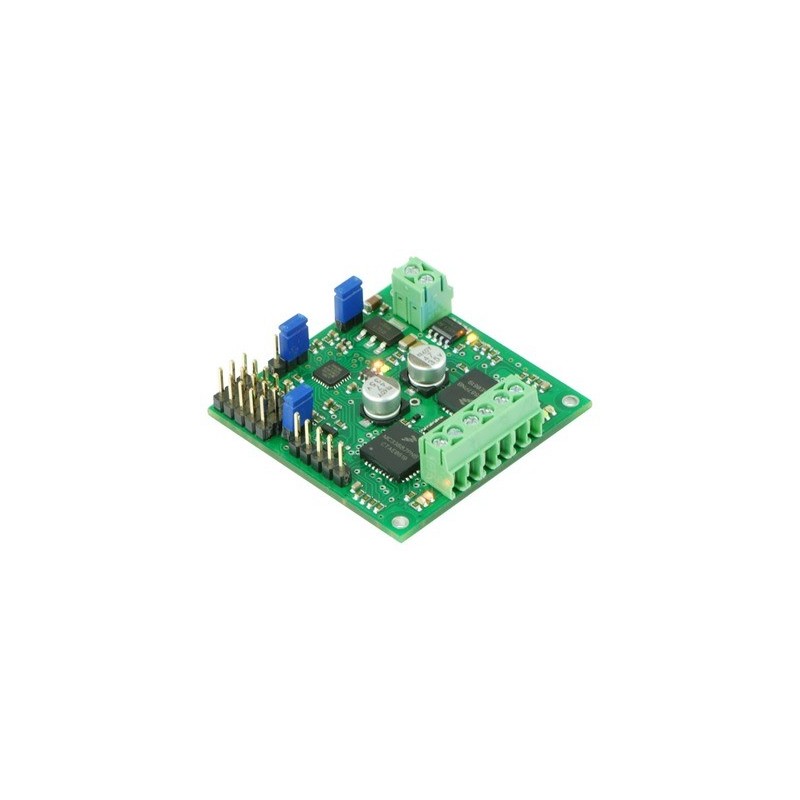

Pololu TReX Jr Dual Motor Controller DMC02
Pololu TReX Jr Dual Motor Controller DMC02
This lower-power, smaller, and lower-cost version of the TReX is the ultimate general-purpose motor controller for small motors: it has a wide operating range (5 to 24 V), delivers 2.5 A continuously per motor, provides current sensing on the two main channels, and it features the TReX triple interface that allows you to control motors from a serial line (RS-232 or TTL), radio control (RC) receiver, or analog voltage source such as a potentiometer.
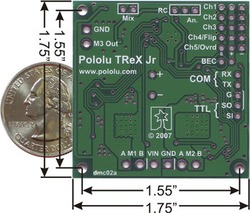 |
| Pololu TReX Jr bottom with labels and dimensions |
|---|
The TReX Jr Dual Motor Controller, a lower-power version of the TReX Dual Motor Controller, is a versatile DC motor controller designed to seamlessly blend autonomous and human control of small robots. The TReX Jr can control two bidirectional and one unidirectional motor via three independent control interfaces: radio control (RC) servo pulses, analog voltage, and asynchronous serial (RS-232 or TTL). Using the compact MC33887 motor driver allows for a single-board design that reduces cost while maintaining a small package. As an added benefit, the use of the MC33887 motor driver allows operation to 24 V.
The TReX Jr uses five input channels to receive the RC or analog control signals. When operating in RC or analog mode, the five channels function as follows:
The serial interface can switch instantly with one of the other two interfaces, allowing mixed autonomous and remote control. For example, a robot could be configured to run autonomously most of the time, but a human operator could override the autonomous function if the robot gets stuck or into a dangerous situation. If the serial mode is selected as the primary interface, high-resolution measurements of all five channel input signals (be they RC pulses or analog voltages) are made available to the autonomous robot controller, allowing for complex and unlimited mixing of operator control and sensor input. For example, the TReX would be a great motor controller for a remotely controlled balancing robot.
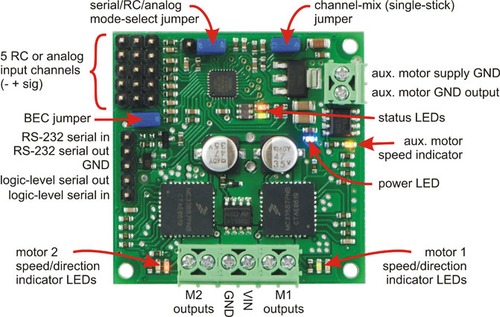 |
| Pololu TReX Jr Dual Motor Controller with labels |
|---|
| Dimensions | 1.75" x 1.75" x 0.5" (0.3" height without connectors) |
| Supply voltage | 5 – 24 V |
| Primary motor outputs | 2 bidirectional, 5 A peak, up to 2.5 A continuous (may be combined to control 1 bidirectional, 5 A continuous) |
| Auxiliary output | 1 unidirectional, 10 A continuous |
| Speed control | 128 steps in each direction |
| Control interfaces | RC servo pulses, analog voltages, or serial commands; master interface set by mode-select jumper |
| Input channels | 5 (RC servo pulses or analog voltages) |
| RC pulse measurements | 12-bit resolution, 1 us accuracy |
| Analog measurements | 10-bit resolution |
| Serial interface | both RS-232 and TTL (logic level), bidirectional |
| Baud rates | supports 11 common baud rates ranging from 1200 to 115,200 bps |
| Expanded protocol | Allows multiple Pololu servo and motor controllers on one serial line |
| Compact protocol | Allows both motors 1 and 2 to be simultaneously set with just three bytes |
Note: The TReX Jr does not require use of the serial interface to function; it will work right out of the box as an electronic speed control (ESC). You will not have access to the full suite of features the TReX Jr provides if you do not make use of the serial interface, though.
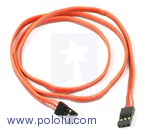 |
| 24" (600 mm) female-female RC servo extension cable. |
|---|
The TReX Jr has male 0.1" headers; for direct connection to an RC receiver or serial servo controller, we recommend ordering one 6" female-to-female cable, 12" female-to-female cable, or 24" female-to-female cable per channel you intend to use (the TReX Jr can use up to five channels).
 |
Servo Extension Cable 6" Female - Female |
Cechy
Producent
Osoba odpowiedzialna
Brak towaru
Brak towaru
Brak towaru
Brak towaru
Brak towaru
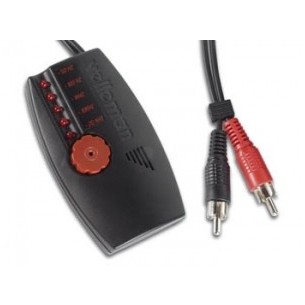
Zabezpieczenie głośnika niskotonowego - zestaw do samodzielnego montażu
Brak towaru
Brak towaru
Brak towaru
Brak towaru
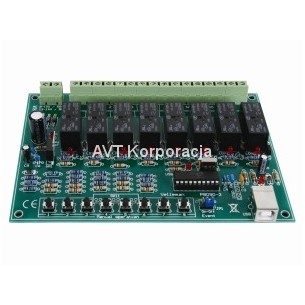
8-kanałowa karta przekaźników usb - układ zmontowany i uruchomiony
Brak towaru
Brak towaru
Brak towaru
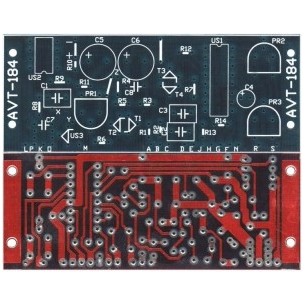
PŁYTKA DRUKOWANA - PROGRAMOWANY STEROWNIK DO ZABAWEK I MODELI - PŁYTKA DRUKOWANA PROGRAMATORA
Brak towaru
PŁYTKA DRUKOWANA - PROGRAMOWANY STEROWNIK DO ZABAWEK I MODELI - PŁYTKA DRUKOWANA STEROWNIKA
Brak towaru
PŁYTKA DRUKOWANA - PROGRAMOWANY STEROWNIK DO ZABAWEK I MODELI - PŁYTKA PULPITU STERUJĄCEGO
Brak towaru
Brak towaru
Pololu TReX Jr Dual Motor Controller DMC02