.png)


- Obecnie brak na stanie
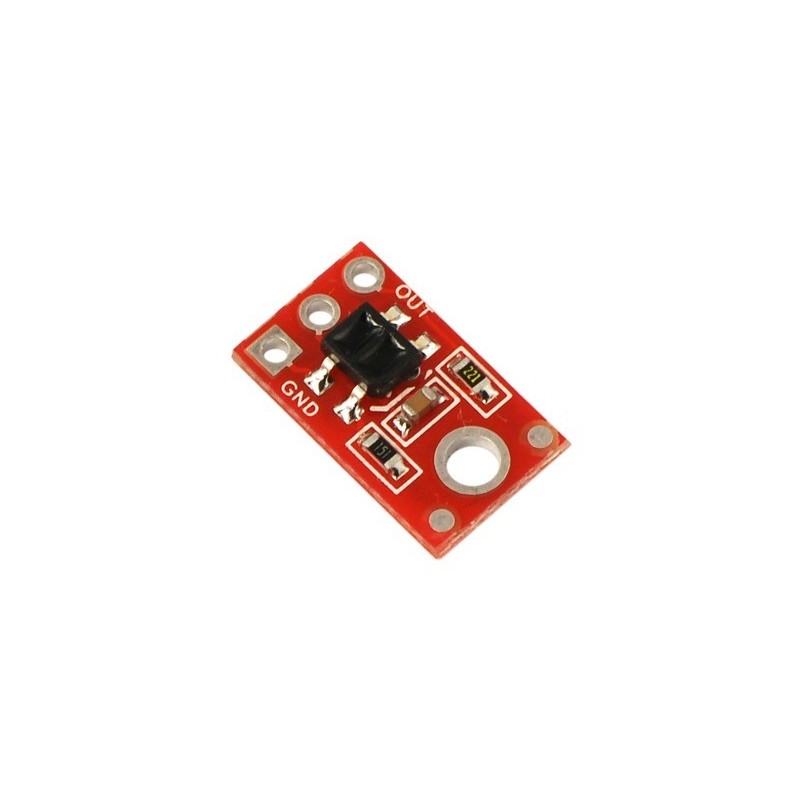

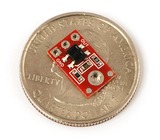
QTR-1RC Reflectance Sensor
Zamiennik - pakowany po 2 szt. Pololu - 2459
QTR-1RC Reflectance Sensor
The QTR-1RC reflectance sensor carries a single infrared LED and phototransistor pair in an inexpensive, tiny 0.5" x 0.3" module that can be mounted almost anywhere and is great for edge detection and line following applications. The output is designed to be measured by a digital I/O line.
Note: The QTR-1RC reflectance sensor requires a digital I/O line to take readings. The similar QTR-1A reflectance sensor is available with an analog output.
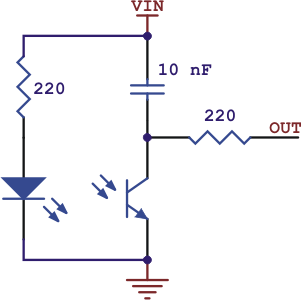 |
The Pololu QTR-1RC reflectance sensor carries a single infrared LED and phototransistor pair. The phototransistor uses a capacitor discharge circuit that allows a digital I/O line on a microcontroller to take an analog reading of reflected IR by measuring the discharge time of the capacitor. Shorter capacitor discharge time is an indication of greater reflection.
The LED current-limiting resistor is set to deliver approximately 20-25 mA to the LED when VIN is 5 V. The current requirement can be met by some microcontroller I/O lines, allowing the sensor to be powered up and down through an I/O line to conserve power.
Because of its small size, multiple units can easily be arranged to fit various applications such as line sensing and proximity/edge detection. For a line sensor with eight of these units arranged in a row, please see the QTR-8RC reflectance sensor array.
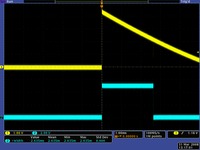 |
| QTR-1RC output (yellow) when 1/8" above a black line and microcontroller timing of that output (blue). |
|---|
Like the Parallax QTI, the QTR-1RC module has sensor outputs that require a digital I/O line capable of first charging the output capacitor (by driving the line high) and then measuring the time for the capacitor to discharge through the phototransistor. This measurement approach has several advantages, especially when multiple units are used:
The typical sequence for reading a sensor is:
 |
These steps can typically be executed in parallel on multiple I/O lines.
With a strong reflectance, the discharge time can be as low as several dozen microseconds; with no reflectance, the discharge time can be up to a few milliseconds. The exact time of the discharge depends on your microcontroller’s I/O line characteristics. Meaningful results can be available within 1 ms in typical cases (i.e. when not trying to measure subtle differences in low-reflectance scenarios), allowing up to 1 kHz sampling.
Our Pololu AVR library provides functions that make it easy to use these sensors with our Orangutan robot controllers and other AVR-based controller boards such as Arduinos. Please see section 11 of our library command reference for more information.
This module has a single mounting hole intended for a #2 screw (not included); if this mounting hole is not needed, this portion of the PCB can be ground off to make the unit even smaller. The reflectance sensor ships with a 3-pin 0.1" header strip, which can be soldered in the conventional perpendicular orientation or parallel to the PCB, as shown below. You can also solder wires, such as ribbon cable, directly to the pads for the smallest installation.
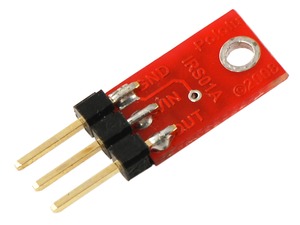 |
| An example of soldering header pins parallel to QTR-1A PCB for compact installation. |
|---|
 |
QTR-1A Reflectance Sensor |
 |
Pololu Carrier with Sharp GP2Y0D810Z0F Digital Distance Sensor 10cm |
 |
Sharp GP2Y0A21YK0F Analog Distance Sensor 10-80cm |
Producent
Osoba odpowiedzialna
Brak towaru
Brak towaru
Brak towaru
Brak towaru
Brak towaru
Brak towaru
Brak towaru
Brak towaru
Brak towaru
WZMACNIACZ MOCY 2X45W Z STK4182 - ZESTAW DO SAMODZIELNEGO MONTAŻU (poprzednia wersja zestawu – bez radiatora)
Brak towaru
Brak towaru
Brak towaru
Brak towaru
Brak towaru
Brak towaru
Brak towaru
QTR-1RC Reflectance Sensor