.png)




- Out-of-Stock
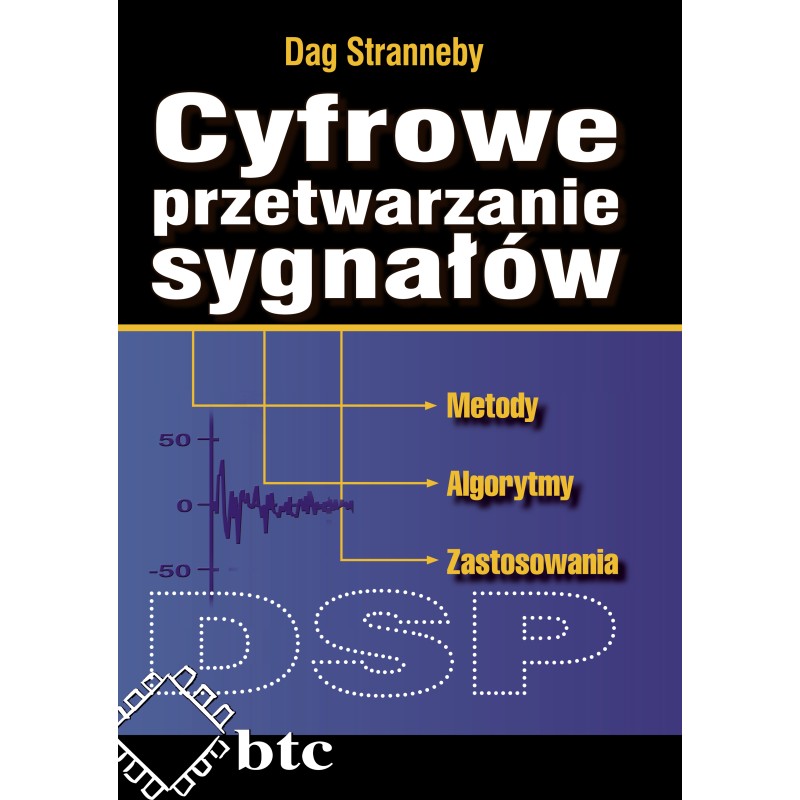

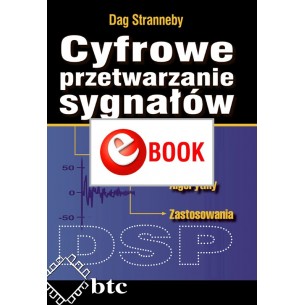
Dag Stranneby
Author: Dag Stranneby
Original title: Digital Signal Processing: DSP and Applications
Translation: dr inż. Michał Nadachowski
ISBN: 83-921073-4-9
Format: B5, 256 pages
Hardcover
BTC publishing house
Warsaw 2004
Written by Daga Stranneby, the book about DSP has great didactic and practical values. The author puts the main emphasis on explaining the principles and applications of DSP with minimal use of a mathematical apparatus. One volume covers a wide range of digital signal processing systems - a / c and c converters, adaptive filters, spectral estimation, neural networks, Kalman filters, fuzzy logic, data compression, error correction and DSP algorithms.
The book can be used as a textbook or supplement to other studies for teaching the subject covering digital signal processing for students of technical universities. It is also perfectly suited for students of postgraduate courses and people professionally involved in digital signal processing.
This book is not a digital signal processing (DSP) manual. Although in the first chapter the DSP theoretical basis is given in short form, it is assumed that the reader already has knowledge about sampling, differential equations, Z transforms, finite and infinite impulse response filters, fast Fourier transform (FFT), etc. The book's guiding principle is a combination of theoretical problems of signal processing using DSP algorithms in practice. A wide overview of the various applications of digital signal processing was also presented, which should be an incentive to further study this subject.
In my opinion, the main goal of teaching is to lead to an intuitive understanding of concepts and systems. Therefore, the substantive material of the book is somewhat simplified at the expense of limiting mathematical considerations. The reader, especially with only elementary knowledge about DSP and methods of processing, may have difficulty in capturing some details of the issues discussed at once. You do not have to worry about it. The first, most important step in studying each topic is - before getting into details - understanding the nature of the problem and learning the basic methods to solve it.
Dag Stranneby is a professor at the University of Örebro in Sweden. During many years of didactic work, he lectured, among others from the basics of electronics, digital signal processing, radio systems, wireless communication systems, neural networks, control theories, assembler and C ++ programming.
Manufacturer
Responsible person
Dag Stranneby
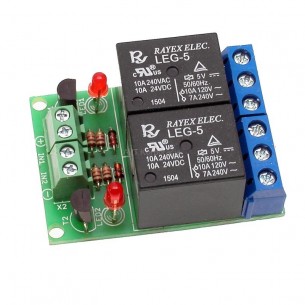
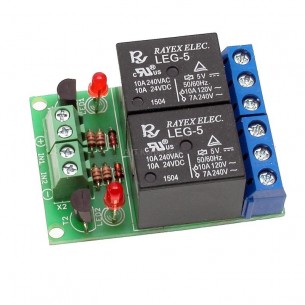
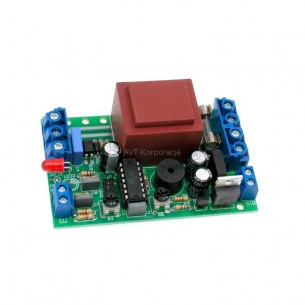
AVT kit for self-assembly of a universal 2-channel relay module. AVT1914 B
No product available!
Assembled universal 2-channel relay module. AVT1914 C
No product available!
Printed circuit board and programmed system for the electromagnetic transom control. AVT1919 A +
No product available!
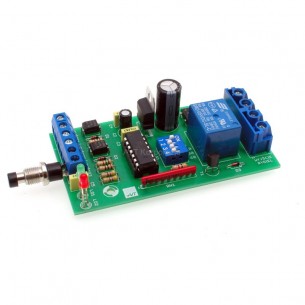
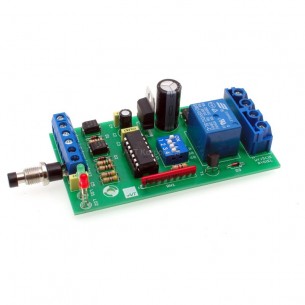
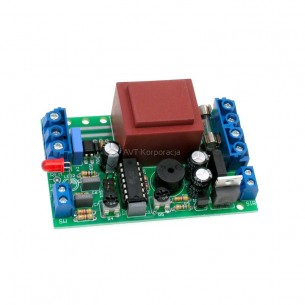
AVT kit for self-assembly of the electromagnetic lock controller. AVT1919 B
No product available!
Assembled electromagnetic lock controller. AVT1919 C
No product available!
Printed circuit board and programmed system for the alarm control panel cooperating with the motion sensor. AVT1925 A +
No product available!
AVT kit for self-assembly of the alarm control panel cooperating with the motion sensor. AVT1925 B
No product available!
Assembled alarm control panel cooperating with the motion sensor. AVT1925 C
No product available!
AVT kit for self-assembly of the power distributor. AVT1930 B
No product available!
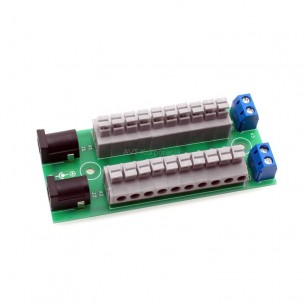
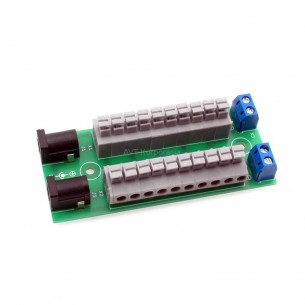
Assembled power divider, designed to supply several receivers from one voltage source with more power. AVT1930 C
No product available!
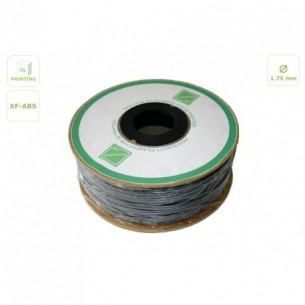
High quality XF-ABS filament for 3D printer with 1.75 mm diameter. 1 kg of wire is wound on the spool. XF-ABS-175-GRAY
No product available!
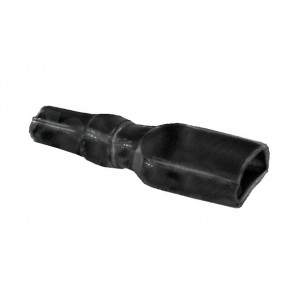
Flexible PVC cover for 6M3 connector, for ØD = 3.5mm cable, length L = 24mm, width W = 6.5mm, black, RoHS
No product available!
No product available!
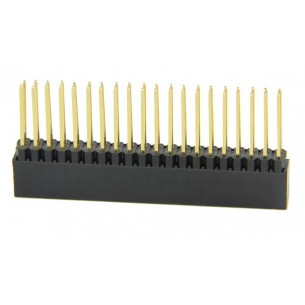
Pin strip straight in black, double-row, female with 2x20 layout, 2.54mm pitch and elongated legs (12mm). Thru-hole assembly (THT), often used to build GPIO modules for single board computers. PBD40S L
No product available!
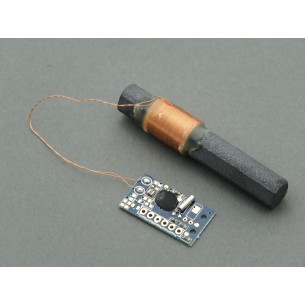
The AM receiver of the DCF77 signal with the MAS6180 system, allows to receive the frames of the synchronization signal from the time standard, using the carrier frequency of 77.5kHz. Thanks to this module, it is possible to create a clock with automatic date and time synchronization. The module has a ferrite antenna. modDCF77
No product available!
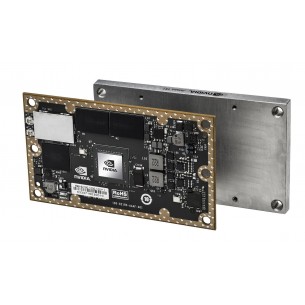
Module with Tegra X1 SoC system containing four 64-bit ARM Cortex A57 cores and a Maxwell graphic layout consisting of 256 cores supporting CUDA technology. NVIDIA Jetson TX1
No product available!
Dag Stranneby