.png)



- New

zł57.52 tax excl.
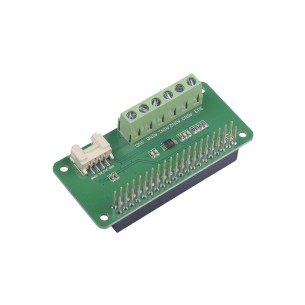
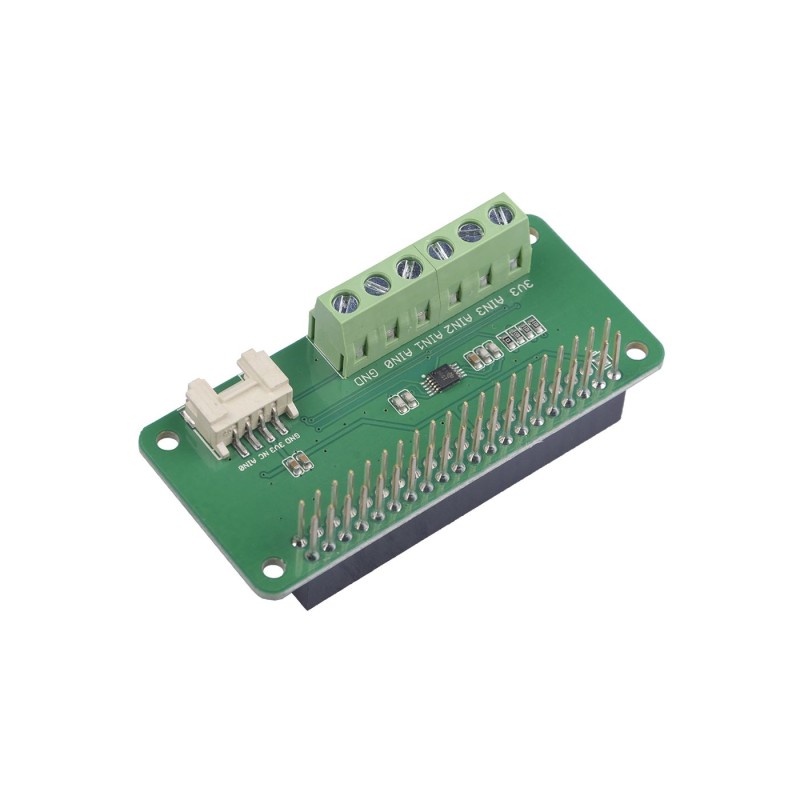
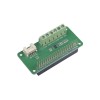
4-channel ADC expansion board for Raspberry Pi, featuring a 16-bit Texas Instruments ADS1115 converter for measuring analog voltage signals. Supports four single-ended inputs or two differential inputs, programmable gain amplification (PGA), and conversion rates from 8SPS to 860SPS. Communicates via I2C at the default address 0x48, configurable to 0x49, 0x4A or 0x4B. Equipped with screw terminals and an analog Grove connector. Seeed Studio 103030279
The Seeed Studio 4-Channel 16-Bit ADC for Raspberry Pi expansion board uses a 16-bit Texas Instruments ADS1115 analog-to-digital converter, enabling analog voltage measurements with a Raspberry Pi single-board computer. The IC provides four single-ended inputs or two differential inputs, selected through an internal multiplexer. The module is designed for reading analog sensor signals, monitoring battery voltages and building data acquisition systems. Applications include measurement equipment, temperature monitoring systems, industrial automation and IoT projects.
The ADS1115 converter uses a delta-sigma architecture and supports programmable conversion rates from 8SPS to 860SPS. The integrated programmable gain amplifier (PGA) allows the measurement range to be adjusted to the amplitude of the input signal. Available full-scale ranges extend from ±0.256V to ±6.144V. However, the voltage applied to the physical inputs must remain within the permissible limits relative to ground and the IC supply voltage. An internal voltage reference, oscillator and programmable comparator extend the measurement capabilities and enable detection of predefined voltage thresholds.
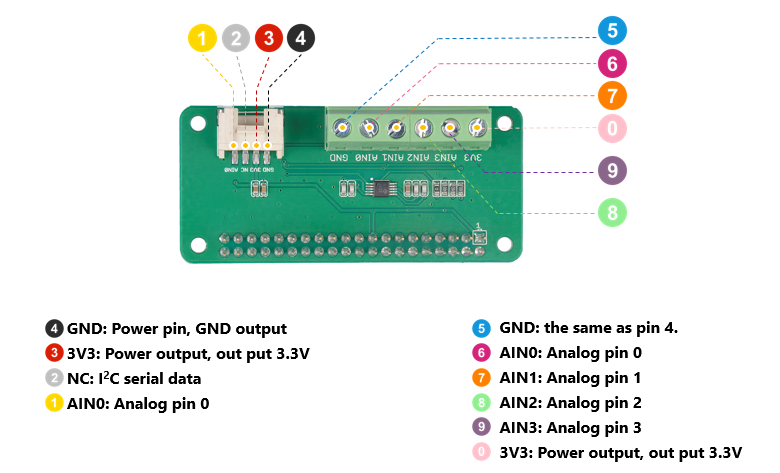
Communication with Raspberry Pi takes place through the I2C interface. The default device address is 0x48, while changing the connection configuration on the board allows addresses 0x49, 0x4A or 0x4B to be selected. Multiple converters can therefore be connected to the same I2C bus, provided each device has a unique address. The ADS1115 IC typically draws approximately 150µA during continuous conversion and supports a single-shot mode that automatically powers down the measurement circuitry after completing a conversion.
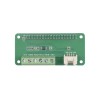
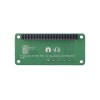
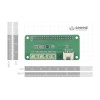
The board features a compact form factor corresponding to the dimensions of Raspberry Pi Zero and connects to the computer through its 40-pin GPIO header. Analog signals can be connected using screw terminals, while an additional analog Grove connector supports compatible sensors from the Seeed Studio ecosystem. The manufacturer specifies compatibility with Raspberry Pi 3B, 3B+ and 4. The module measures approximately 65 × 30 × 20mm.
The manufacturer provides a module setup guide on Seeed Studio Wiki, covering I2C bus activation, driver configuration and reading conversion results under Linux. A software library and example code in the pi-hats repository are also available. Detailed converter specifications and supported measurement ranges are described in the Texas Instruments ADS1115 datasheet.
Data sheet
Manufacturer
Responsible person
Module with ADC 16-bit converter for Raspberry Pi Zero / Zero W / 2B / 3B / 3B + with I2C communication interface.
No product available!
4-channel ADC expansion board for Raspberry Pi, featuring a 16-bit Texas Instruments ADS1115 converter for measuring analog voltage signals. Supports four single-ended inputs or two differential inputs, programmable gain amplification (PGA), and conversion rates from 8SPS to 860SPS. Communicates via I2C at the default address 0x48, configurable to 0x49, 0x4A or 0x4B. Equipped with screw terminals and an analog Grove connector. Seeed Studio 103030279
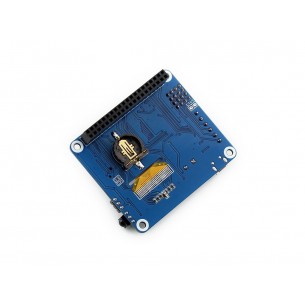
Module with a 10-channel ADC ADS1263 converter with a resolution of 32-bits designed to work with the minicomputer Raspberry Pi and Jetson Nano. Waveshare High-Precision AD HAT
A 4-channel power parameter monitoring module dedicated to Raspberry Pi minicomputers. Allows voltage, current and power monitoring via I2C or SMBus. Waveshare Current/Power Monitor HAT
An advanced shield for the Raspberry Pi that allows you to monitor temperature, pressure, humidity, air quality, and eCO2 levels using the BME688 sensor. Data can be viewed on the built-in 128x64 OLED screen, and is signaled by three ZIP LEDs and a buzzer. The board also offers high-current outputs up to 1A, a servo output, and analog inputs, allowing you to connect additional components and sensors. Kitronik 5038
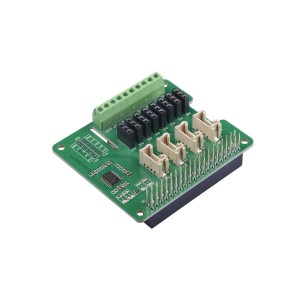
Seeed Studio 8-channel 12-bit ADC module designed to add analog inputs to Raspberry Pi. The board communicates over I2C, provides 8 analog channels A0–A7 and 4 Grove Analog connectors, and operates at 3.3V. Current versions may use the MM32F031F6P6 instead of STM32F030F4P6TR while preserving the same functions and usage. Seeed Studio 103030280
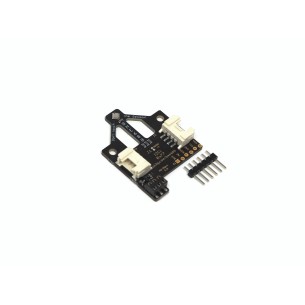
BME688 environmental sensor module for measuring temperature, humidity, atmospheric pressure and VOC gas resistance; IAQ index calculation using the Bosch BSEC library; Bosch AI Studio support for gas mixture recognition; I2C interface; 3.3 V power supply and logic levels; 2 Grove connectors; compatible with Raspberry Pi and Raspberry Pi Pico.
4-channel ADC expansion board for Raspberry Pi, featuring a 16-bit Texas Instruments ADS1115 converter for measuring analog voltage signals. Supports four single-ended inputs or two differential inputs, programmable gain amplification (PGA), and conversion rates from 8SPS to 860SPS. Communicates via I2C at the default address 0x48, configurable to 0x49, 0x4A or 0x4B. Equipped with screw terminals and an analog Grove connector. Seeed Studio 103030279