.png)


- Out-of-Stock
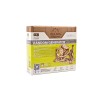

For generations, humanity has been futilely wrestling with perennial questions, such as whose turn is it to take out the rubbish? Who will hoover today? And, of course, who does the dishes?
Those who volunteer to do all these chores have our eternal respect, but what if no one volunteers? The fair way to handle this would be to let chance decide and throw a coin. If you have ever bet on heads or tails, this means you got close and personal with probability theory and its practical application. UGears 70146
Ugears suggests an alternative to the classic coin solution that is not only elegant and fun but has an extra educational benefit. To all questions there is now the answer with Ugears model Random
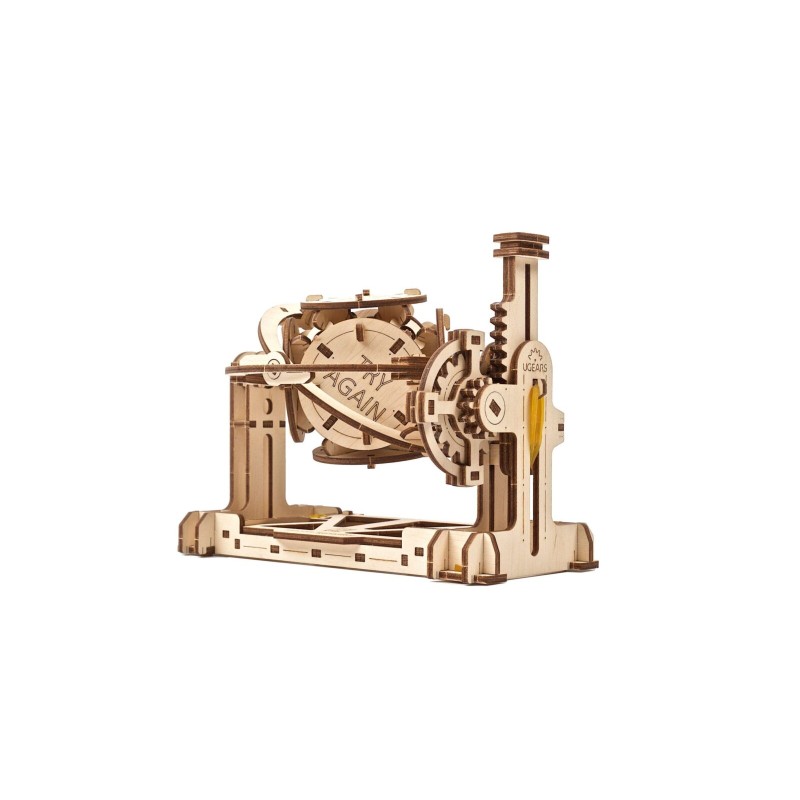
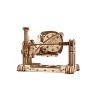
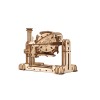
DIY wooden puzzle Random Generator, as you might have guessed from its name, is a device that generates random numbers and provides different random results based on probability theory. How it does this is exactly what the Ugears STEM model will demonstrate.
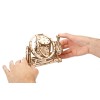
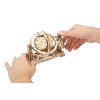
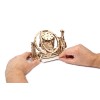
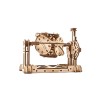
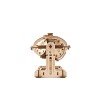
The main element of the 3D puzzle Random Generator’s design is a cube with an octahedron inside it that in its turn contains a metal ball to provide weight. This construction is powered by a rack-and-gear drive initiated manually and providing energy through a driven gear that rotates a three-axle gear. This is how the cube with all its contents begins to move, which is important for summoning the magic of randomness. Of course, we can only call it magic until we know the science of it. And to learn it, let us take a closer look at the main structure.
The vertices of the octahedron coincide with the sides of the cube. In this way as the energy of the system expires and it stops moving, gravity suspends the metal ball in the lowest part of the octahedron and due to the inclination of the walls it rolls within, it ends up in one of the octahedron’s vertices pulling in down. Whichever of the vertices turns up in the bottom, the side of the cube it is attached to will be right under it and parallel to the floor. In this way, the side of the cube with the answer will be the one facing up on the opposite side.
The probability to get any of the vertices facing down is virtually the same due to symmetry of the octahedron that rotates freely around the axis of its mass. This leads us to a simple conclusion that the probability to receive one of six answers is 1/6 or 0.167.
Data sheet
No product available!
No product available!
No product available!
No product available!
No product available!
Wixel Pair (Fully Assembled) + USB Cable
No product available!
No product available!
MinIMU-9 Gyro, Accelerometer, and Compass (L3G4200D and LSM303DLM Carrier)
No product available!
Rechargeable NiMH Battery Pack: 6.0 V, 350 mAh, 3+2 2/3-AAA Cells, JR Connector
No product available!
No product available!
No product available!
Rechargeable NiMH Battery Pack: 8.4 V, 900 mAh, 4+3 AAA Cells, JR Connector
No product available!
No product available!
No product available!
No product available!
ACS709 Current Sensor Carrier -75 to +75A
No product available!
For generations, humanity has been futilely wrestling with perennial questions, such as whose turn is it to take out the rubbish? Who will hoover today? And, of course, who does the dishes?
Those who volunteer to do all these chores have our eternal respect, but what if no one volunteers? The fair way to handle this would be to let chance decide and throw a coin. If you have ever bet on heads or tails, this means you got close and personal with probability theory and its practical application. UGears 70146