.png)


- Out-of-Stock
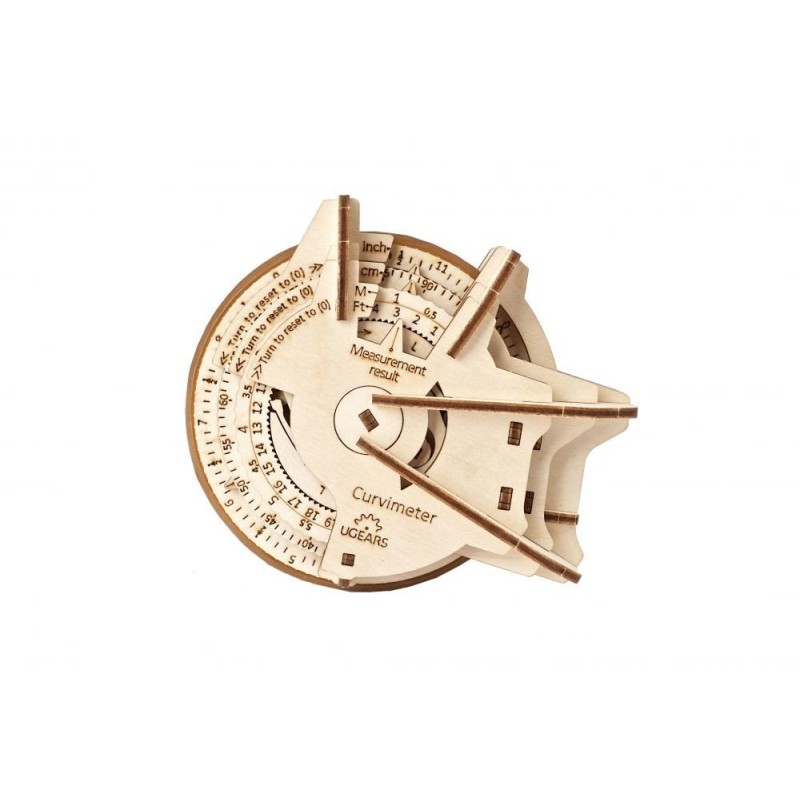
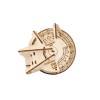
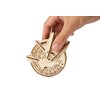
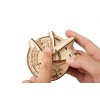
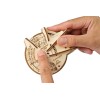
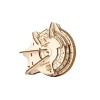

The Curvimeter – or opisometer – is a device that measures the length of curved lines and helps to calculate the distance between the points on a map more precisely than a ruler or a compass.
The mechanism has a measuring wheel, a clock face, and a hand. When the wheel moves along the line on a map that you need to measure, the hand moves around the clock face marked with measuring units – centimeters, inches, etc. All you need to do in the end is to check the map scale and to multiply your data by the denominator in the scale. UGears 70138
You can rely on the curvimeter when planning a hike with your friends or a family trip – it will help you to determine the distance you’d cover to get to your destination. The device is especially useful when you have no access to any electronic gadgets or the internet.
There is no verified information about the actual inventor of the curvimeter. Some sources say the credit of its invention belongs to the Roman engineer Virtuvius, who describes a very similar device around 23 BC. Others refer to a Chinese scholar, Zhāng Héng. Russian sources suggest that the curvimeter might have been invented by the polymath Mikhail Lomonosov who presumably initially called it “krivimetr”. All in all, the official first curvimeter patent belongs to the English engineer Edward Russell Morris who in 1873 registered “a novel device for measuring distances”.
The Curvimeter is used to measure the length of curved lines on topographic maps, charts, schemes, and plans. It is a common tool for map-makers, tourists, and road services.
Ugears STEM-models are designed to suit different age groups with a special focus on learning component. The assembly of the model will be interesting and won’t take much time.
QR-code to download a pocket study guide about your model, its mechanism, principle of its working, main characteristics, physical and mechanical formulas, and fun practical tasks.
QR-code to download AR-application. Fascinating innovation from Ugears – new drive to learn more new things!
Data sheet
No product available!
No product available!
No product available!
No product available!
No product available!
No product available!
No product available!
No product available!
No product available!
No product available!
No product available!
No product available!
No product available!
No product available!
No product available!
No product available!
The Curvimeter – or opisometer – is a device that measures the length of curved lines and helps to calculate the distance between the points on a map more precisely than a ruler or a compass.
The mechanism has a measuring wheel, a clock face, and a hand. When the wheel moves along the line on a map that you need to measure, the hand moves around the clock face marked with measuring units – centimeters, inches, etc. All you need to do in the end is to check the map scale and to multiply your data by the denominator in the scale. UGears 70138