.png)



zł14.64 tax excl.
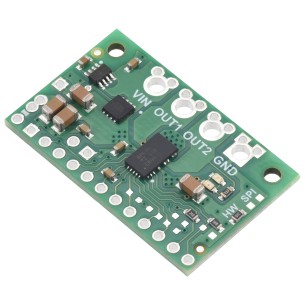
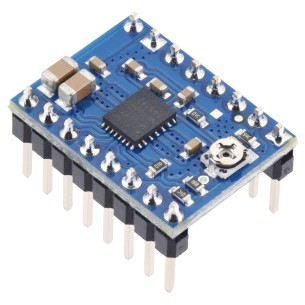
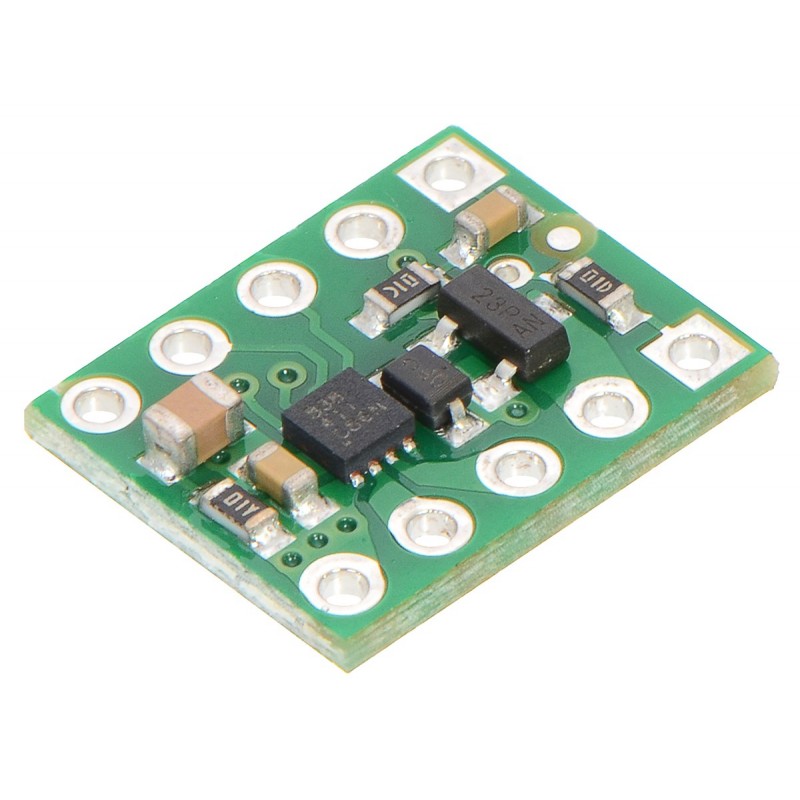
Tiny breakout board for TI’s DRV8838 motor driver can deliver a continuous 1.7 A (1.8 A peak) to a single brushed DC motor. Operating voltage range from 0 V to 11 V, built-in protection against reverse-voltage, under-voltage, over-current, and over-temperature. Pololu 2990
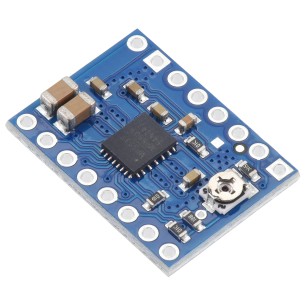
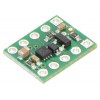
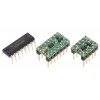
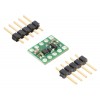
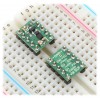
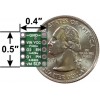
This tiny breakout board for TI’s DRV8838 motor driver can deliver a continuous 1.7 A (1.8 A peak) to a single brushed DC motor. With an operating voltage range from 0 V to 11 V and built-in protection against reverse-voltage, under-voltage, over-current, and over-temperature, this driver is a great solution for powering a small, low-voltage motor. The carrier board has the form factor of a 10-pin DIP package, which makes it easy to use with standard solderless breadboards and 0.1″ perfboards.
Texas Instruments’ DRV8838 is a tiny H-bridge motor driver IC that can be used for bidirectional control of one brushed DC motor at 0 V to 11 V. It can supply up to about 1.7 A continuously and can tolerate peak currents up to 1.8 A for short durations, making it an ideal driver for small motors that run on low voltages. The DRV8838 is a great IC, but its small, leadless package makes it difficult for the typical student or hobbyist to use; our breakout board gives this driver the form factor of a 10-pin DIP package, which makes it easy to use with standard solderless breadboards and 0.1″ perfboards. Since this board is a carrier for the DRV8838, we recommend careful reading of the DRV8838 datasheet (1MB pdf). The board ships populated with SMD components, including the DRV8838, and adds a FET for reverse battery protection.
This motor driver is essentially a smaller, lower-cost, single-channel alternative to our DRV8835 dual motor driver carrier and DRV8833 dual motor driver carrier, which have very similar operating voltage ranges and current ratings but offer an additional motor channel.
| PHASE | ENABLE | SLEEP | OUT1 | OUT2 | operating mode |
|---|---|---|---|---|---|
| 0 | PWM | 1 | PWM | L | forward/brake at speed PWM % |
| 1 | PWM | 1 | L | PWM | reverse/brake at speed PWM % |
| x | 0 | 1 | L | L | brake low (outputs shorted to ground) |
| x | x | 0 | Z | Z | coast (outputs floating/disconnected) |
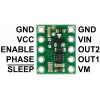
Pinout

DRV8838 Single Brushed DC Motor Driver Carrier, labeled top view
| PIN | Default State | Description |
|---|---|---|
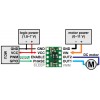
| VIN | Reverse-protected motor power supply input. While the driver can operate from a motor supply of 0 V to 11 V, the reverse-protection circuit will start negatively affecting performance below a few volts, and 1.5 V is the lower limit of where it can be used. Power can be supplied directly to VM to bypass the reverse-protection circuit. | |
| VCC | 1.8 V to 7 V logic power supply connection. Logic supply current draw is typically only a few milliamps at most, so in many applications this pin can optionally be dynamically powered by a microcontroller digital output. | |
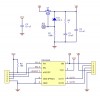
| VM | This pin gives access to the motor power supply after the reverse-voltage protection MOSFET (see the board schematic below). It can be used to supply reverse-protected power to other components in the system. It is generally intended as an output, but it can also be used to supply board power (such as in cases where the motor supply voltage is too low for the reverse-protection circuit). | |
| GND | Ground connection points for the motor and logic power supplies. The control source and the motor driver must share a common ground. | |
| OUT1 | H-bridge output 1. | |
| OUT2 | H-bridge output 2. | |
| PHASE | LOW | Direction control input. |
| ENABLE | LOW | Speed control input; logic high causes the motor to drive. |
| SLEEP | HIGH | Sleep/coast mode input; logic high results in normal operation. |
Data sheet
Manufacturer
Responsible person
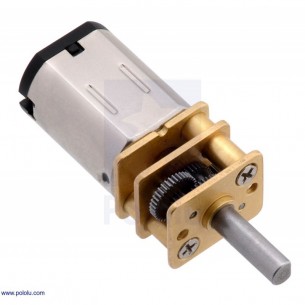
5:1 Micro Metal Gearmotor HP
No product available!
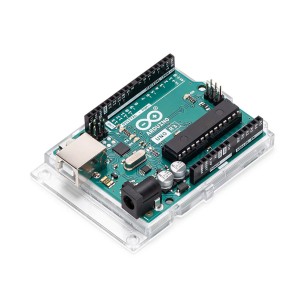
Arduino Uno Rev3 is a popular board with Atmel ATmega328 microcontroller from the AVR family, there are 14 I / O lines, 6 PWM channels and 6 analog inputs. The additional ATmega16U4 microcontroller realizes communication via the USB interface. Arduino A000066
No product available!
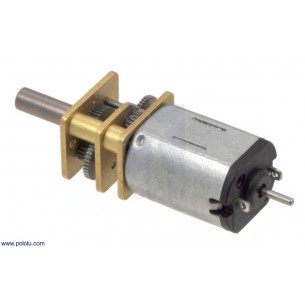
75:1 Micro Metal Gearmotor HP with Extended Motor Shaft
No product available!
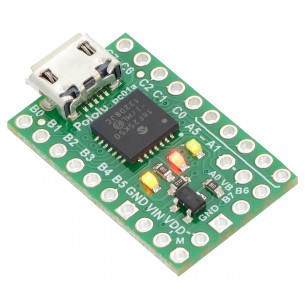
Tiny programmable module featuring Microchip’s PIC18F25K50 microcontroller. It packs a Micro-USB interface and 16 digital input/output pins onto a 1″×0.6″ board and ships preloaded with a USB bootloader, so no external programmer is required. Pololu 3150
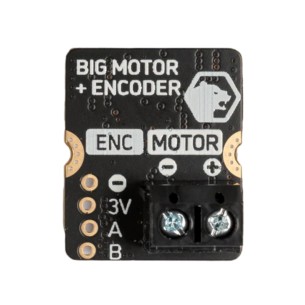
A powerful controller designed to drive a single brushed DC motor with an encoder in the Pimoroni Yukon system. It offers up to 8 A continuous and 12 A peak current at a supply voltage of 5 to 17 V, making it suitable for demanding robotic projects. The module provides precise control thanks to encoder support and built-in current, temperature, and error sensors. Pimoroni PIM691
Compact module for driving two DC motors, 6.5–37 V, continuous current 12 A per channel, peak 70 A, with protections and status indicators. DFRobot DFR0601
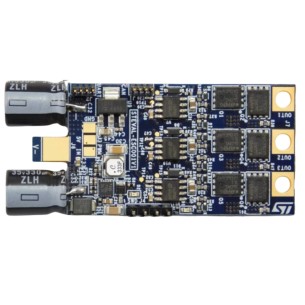
A compact and powerful ESC module for BLDC and PMSM motors, ideal for racing drones and lightweight aircraft. Featuring an STM32F303 microcontroller with sensorless FOC and advanced 3-shunt current measurement, it delivers smooth operation and high efficiency. It supports 3S–6S LiPo power, currents up to 20A RMS, and PWM, UART, CAN, and I²C communication for easy integration with flight controllers. STMicroelectronics STEVAL-ESC001V1
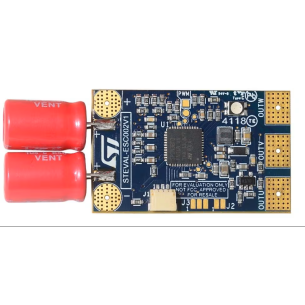
A compact ESC module designed for BLDC motors, ideal for drones and mobile devices. Equipped with the STSPIN32F0A chip and ultra-low RDS(on) transistors, it provides efficient operation and currents up to 20A. It supports 2S–6S LiPo batteries and offers precise sensorless control thanks to BEMF detection. STMicroelectronics STEVAL-ESC002V1
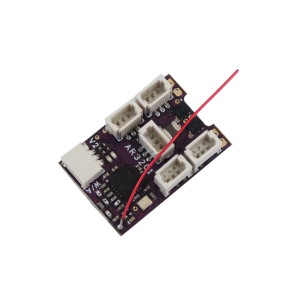
Brushed DC motor ESC with integrated FlySky receiver, designed for remote control of DC motors in RC models and mobile projects, supporting speed and direction control. modAR3201-F2
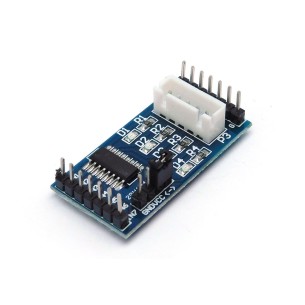
Stepper motor driver module based on the ULN2003 IC in SMD package, integrating 7 Darlington transistor pairs with common emitter configuration, designed for controlling motors and relays
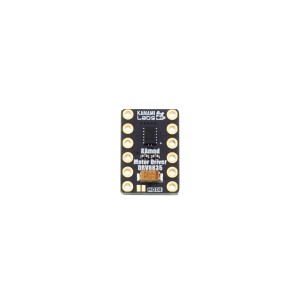
Dual-channel motor driver module designed for controlling two DC motors or one bipolar stepper motor. The circuit supports motor voltages up to 11 V, works with 3.3 V and 5 V logic systems, and provides output current up to 1.2 A per channel. The design includes dual H-bridges, PWM support, IN / IN and PHASE / ENABLE operating modes, as well as overcurrent and thermal protection. Kamod Motor Driver DRV8835
DC motor driver based on the Texas Instruments DRV8263H-Q1. It can control one DC motor in two directions or two motors in one direction from a supply voltage of 4.5-65V and a continuous current of up to 3.5A (limited to 10A). The module offers three control modes: Phase/Enable (PH/EN), PWM (IN/IN), and independent half-bridges. Built-in current sensors and protection features protect against overload, overheating, and reverse power connection. The 3-5V logic control is decoupled from the motor supply, increasing safety and integration flexibility. Pololu 5238
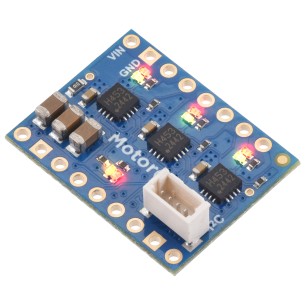
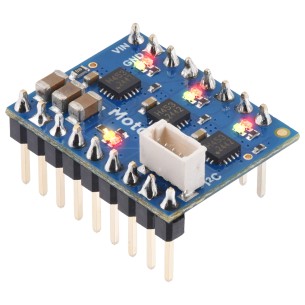
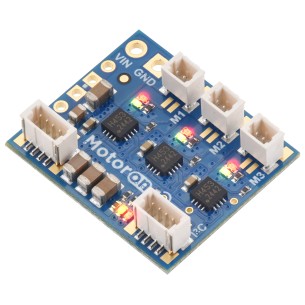
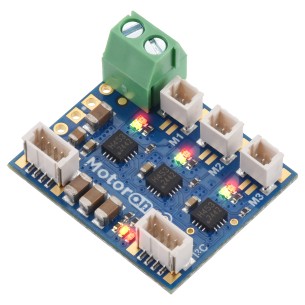
This controller allows independent control of three DC motors using a single I²C bus. It supports motor supply voltages ranging from 4.5 to 44 V and currents up to 0.8 A continuous per channel, making it suitable for a wide range of robotic and mobile applications. I²C communication eliminates the need to generate PWM signals and significantly saves microcontroller pins. The ability to connect multiple controllers on a single bus allows for easy scaling of the system to larger motor counts. Pololu 5085
This controller allows independent control of three DC motors using a single I²C bus. It supports motor supply voltages ranging from 4.5 to 44 V and currents up to 0.8 A continuous per channel, making it suitable for a wide range of robotic and mobile applications. I²C communication eliminates the need to generate PWM signals and significantly saves microcontroller pins. The ability to connect multiple controllers on a single bus allows for easy scaling of the system to larger motor counts. Pololu 5084
This controller allows independent control of three DC motors using a single I²C bus. It supports motor supply voltages ranging from 4.5 to 44 V and currents up to 0.8 A continuous per channel, making it suitable for a wide range of robotic and mobile applications. I²C communication eliminates the need to generate PWM signals and significantly saves microcontroller pins. The ability to connect multiple controllers on a single bus allows for easy scaling of the system to larger motor counts. Pololu 5083
This controller allows independent control of three DC motors using a single I²C bus. It supports motor supply voltages ranging from 4.5 to 44 V and currents up to 0.8 A continuous per channel, making it suitable for a wide range of robotic and mobile applications. I²C communication eliminates the need to generate PWM signals and significantly saves microcontroller pins. The ability to connect multiple controllers on a single bus allows for easy scaling of the system to larger motor counts. Pololu 5082
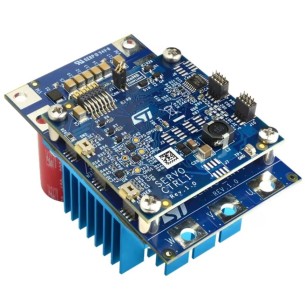
EVLSERVO1 is a reference servo drive from STMicroelectronics designed for driving three-phase BLDC motors with output power up to 2 kW (or 3 kW with active cooling), based on the STSPIN32G4 system-in-package integrating an STM32G4 microcontroller. The module supports advanced control algorithms such as FOC and 6-step commutation, multiple feedback methods, and CAN communication, making it a complete development platform for industrial automation and motion control applications. EVLSERVO1 STMicroelectronics
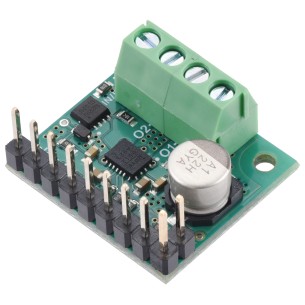
Single-channel bipolar stepper motor driver based on the MP6603 IC, supporting microstepping down to 1/8 step and operating with a motor supply voltage of 8–55 V. The module can deliver up to approximately 2 A continuous current per phase without additional cooling and up to 4 A peak. It features adjustable current limiting via a potentiometer and a control interface compatible in many applications with popular A4988 driver carriers. This version includes factory-soldered header pins, allowing direct connection to breadboards or sockets compatible with A4988 modules. Pololu 5691
Single-channel bipolar stepper motor driver based on the MP6603 chip, supporting microstepping down to 1/8 step and operating with a motor supply voltage of 8-55 V. The module can deliver approximately 2 A continuous current per phase without additional cooling and up to 4 A peak, features adjustable current limiting via a potentiometer, and offers an interface compatible in many applications with popular A4988 carrier boards. Version without soldered header pins, intended for custom connector installation. Pololu 5690
Single-channel brushed DC motor driver based on the MPQ6612A chip, enabling bidirectional motor control with a supply voltage of 4-40 V and up to 4 A continuous current. The module offers motor current sensing, active current limiting, overcurrent and thermal protection, and supports PWM control up to 200 kHz. The carrier board includes factory-soldered connectors, allowing the module to be used without additional soldering. Pololu 5286
Tiny breakout board for TI’s DRV8838 motor driver can deliver a continuous 1.7 A (1.8 A peak) to a single brushed DC motor. Operating voltage range from 0 V to 11 V, built-in protection against reverse-voltage, under-voltage, over-current, and over-temperature. Pololu 2990