.png)





zł68.01 tax excl.
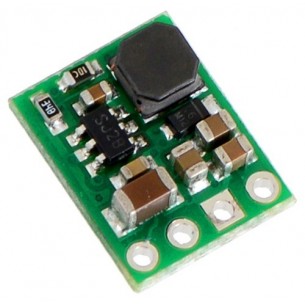
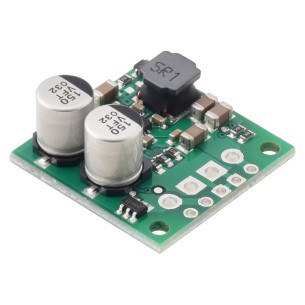
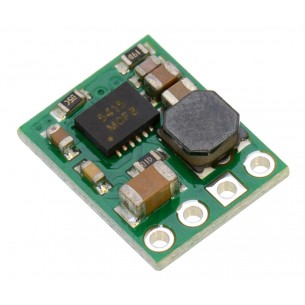
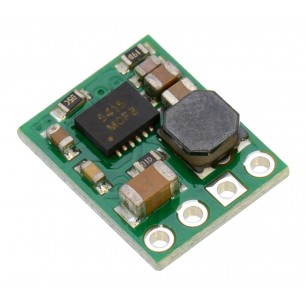
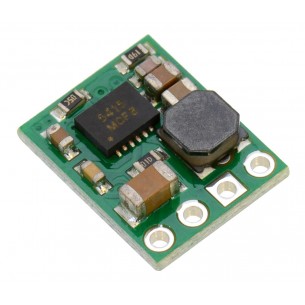
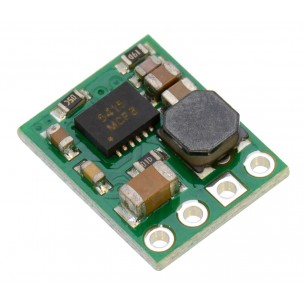
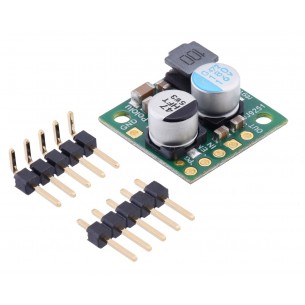
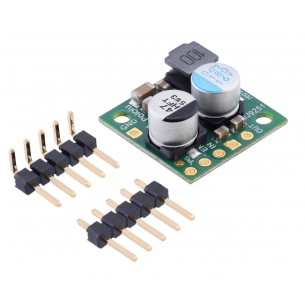
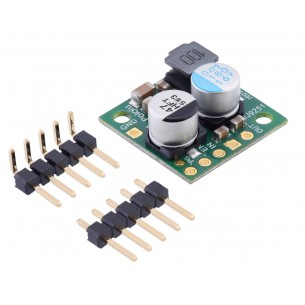
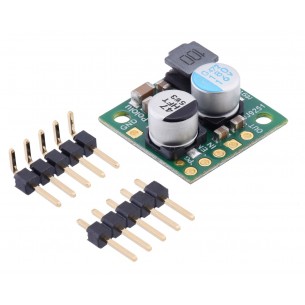
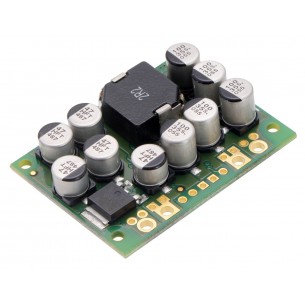
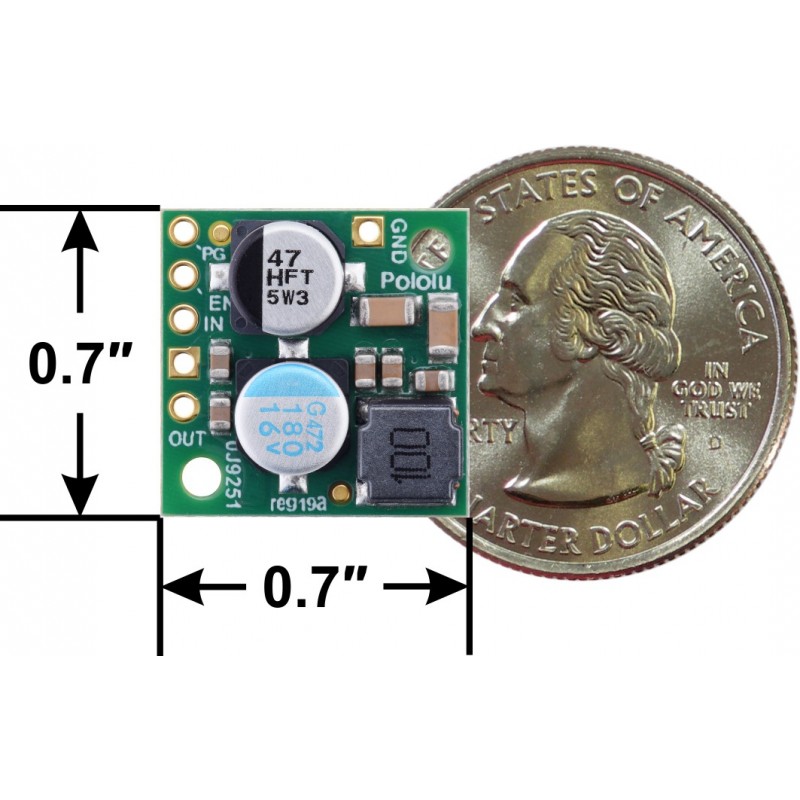
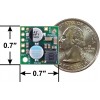
This small synchronous switching step-down (or buck) regulator takes an input voltage of up to 36 V and efficiently reduces it to 9 V. The board measures only 0.7″ × 0.7″ yet delivers a typical continuous output current of up to 2.3 A and features reverse voltage protection.
These regulators have a typical quiescent (no load) current draw of around 1 mA, and an enable pin can be used to put the boards in a low-power state that reduces the quiescent current to approximately 5 µA to 10 µA per volt on VIN.The D24V22Fx family of step-down voltage regulators generates lower output voltages from input voltages as high as 36 V. They are synchronous switching regulators (also called switched-mode power supplies (SMPS) or DC-to-DC converters) with typical efficiencies of 85% to 95%, which is much more efficient than linear voltage regulators, especially when the difference between the input and output voltage is large. These regulators can typically support continuous output currents of over 2 A, though the actual available output current is a function of the input voltage and efficiency (see the Typical efficiency and output current section below). In general, the available output current is a little higher for the lower-voltage versions than it is for the higher-voltage versions, and it decreases as the input voltage increases.
The modules have built-in reverse-voltage protection, short-circuit protection, a thermal shutdown feature that helps prevent damage from overheating, and a soft-start feature that reduces inrush current.
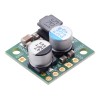
The different voltage versions of this regulator all look very similar, so you should consider adding your own distinguishing marks or labels if you will be working simultaneously with multiple versions. This product page applies to all versions of the D24V22Fx family.
The D24V22Fx family is intended to replace our older D24V25Fx family of step-down voltage regulators. The two designs have the same size and similar current capabilities and input voltage ranges, but they do not have the same pinout and are based on different internal circuits, so there are fundamental differences in operation. In particular, these newer D24V22Fx regulators have much lower dropout voltages and provide a “power good” signal, and the newer design allows for higher output voltages (e.g. 12 V).
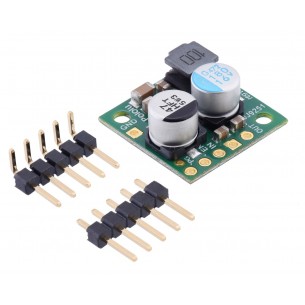
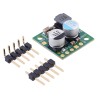
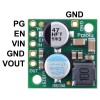
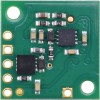
These buck regulators have five main connection points for five different electrical nodes: power good (PG), enable (EN), input voltage (VIN), ground (GND), and output voltage (VOUT). The board also features a second ground connection point off the main row of connections that might be convenient for applications where you are soldering wires directly to the board rather than using it in a breadboard.
The output voltage, VOUT, is fixed and depends on the regulator version: the D24V22F3 version outputs 3.3 V, the D24V22F5 version outputs 5 V, the D24V22F6 version outputs 6 V, the D24V22F7 version outputs 7.5 V, the D24V22F9 version outputs 9 V, and the D24V22F12 version outputs 12 V.The input voltage, VIN, powers the regulator. Voltages between 4 V and 36 V can be applied to VIN, but for versions of the regulator that have an output voltage higher than 4 V, the effective lower limit of VIN is VOUT pluse the regulator’s dropout voltage, which varies approximately linearly with the load (see below for a graph of dropout voltages as a function of the load).
The regulator is enabled by default: a 270 kΩ pull-up resistor on the board connects the EN pin to reverse-protected VIN. The EN pin can be driven low (under 1 V) to put the board into a low-power state. The quiescent current draw in this sleep mode is dominated by the current in the pull-up resistor from EN to VIN and by the reverse-voltage protection circuit, which altogether will draw between 5 µA and 10 µA per volt on VIN when EN is held low. If you do not need this feature, you should leave the EN pin disconnected.
The “power good” indicator, PG, is an open-drain output that goes low when the regulator’s output voltage falls below around 85% of the nominal voltage and becomes high-impedance when the output voltage rises above around 90%. An external pull-up resistor is required to use this pin.
The maximum achievable output current is typically over 2 A, but this depends on many factors, including the ambient temperature, air flow, heat sinking, and the input and output voltage.The board has two 0.086″ (2.18 mm) diameter mounting holes intended for #2 or M2 screws. The mounting holes are at opposite corners of the board and are separated by 0.52″ (13.21 mm) both horizontally and vertically. For all the board dimensions, see the dimension diagram (204k pdf).
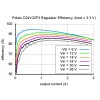
The efficiency of a voltage regulator, defined as (Power out)/(Power in), is an important measure of its performance, especially when battery life or heat are concerns. This family of switching regulators typically has an efficiency of 85% to 95%, though the actual efficiency in a given system depends on input voltage, output voltage, and output current. See the efficiency graph near the bottom of this page for more information.
The dropout voltage of a step-down regulator is the minimum amount by which the input voltage must exceed the regulator’s target output voltage in order to ensure the target output can be achieved. For example, if a 5 V regulator has a 1 V dropout voltage, the input must be at least 6 V to ensure the output is the full 5 V. Generally speaking, the dropout voltage increases as the output current increases. See the “Details” section below for more information on the dropout voltage for this specific regulator version.
During normal operation, this product can get hot enough to burn you. Take care when handling this product or other components connected to it.
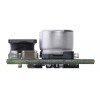
| Size: | 0.7″ × 0.7″ × 0.31″1 |
|---|---|
| Weight: | 2.3 g1 |
| Minimum operating voltage: | 9.6 V2 |
|---|---|
| Maximum operating voltage: | 36 V |
| Continuous output current: | 2.3 A3 |
| Output voltage: | 9 V |
| Reverse voltage protection?: | Y |
| Maximum quiescent current: | 4 mA4 |
| PCB dev codes: | reg19a |
|---|---|
| Other PCB markings: | 0J9251 |
Data sheet
Manufacturer
Responsible person
The Step-Down D24V3F9 Buck Voltage Regulator module gives the output voltage of 9V with a wide input voltage range of 11-42V and a maximum output current of 300 mA. Pololu 2099
No product available!
Step-Up/Step-Down DC-DC converter module. It has an input voltage of 2.8 to 22 V, an output voltage of 7.5 V and a maximum output of 2.5 A to 3.5 A. Pololu 4982
The compact (0.4″ × 0.5″) D24V5F9 synchronous buck voltage regulator takes an input voltage of up to 36 V and efficiently reduces it to 9 V while allowing for a maximum output current of 500 mA. Pololu 2845
No product available!
The compact (0.4″ × 0.5″) D24V5F6 synchronous buck voltage regulator takes an input voltage of up to 36 V and efficiently reduces it to 6 V while allowing for a maximum output current of 500 mA. Pololu 2844
The compact (0.4″ × 0.5″) D24V5F5 synchronous buck voltage regulator takes an input voltage of up to 36 V and efficiently reduces it to 5 V while allowing for a maximum output current of 500 mA. Pololu 2843
The compact (0.4″ × 0.5″) D24V5F2 synchronous buck voltage regulator takes input voltages between 3 V and 36 V and efficiently reduces them to 2.5 V while allowing for a maximum output current of 500 mA. This regulator offers typical efficiencies between 80% and 90%. The pins have a 0.1″ spacing, making this board compatible with standard solderless breadboards and perfboards.
No product available!
The compact (0.4″ × 0.5″) D24V5F1 synchronous buck voltage regulator takes input voltages between 3 V and 36 V and efficiently reduces them to 1.8 V while allowing for a maximum output current of 500 mA. This regulator offers typical efficiencies between 75% and 90%. The pins have a 0.1″ spacing, making this board compatible with standard solderless breadboards and perfboards.
This small synchronous switching step-down (or buck) regulator takes an input voltage from 4 V to 36 V and efficiently reduces it to 3.3 V. The board measures only 0.7″ × 0.7″ yet delivers a typical continuous output current of up to 2.6 A and features reverse voltage protection.
This small synchronous switching step-down (or buck) regulator takes an input voltage of up to 36V and efficiently reduces it to 5V. The board measures only 0.7″ × 0.7″ yet delivers a typical continuous output current of up to 2.5A and features reverse voltage protection. Pololu 2858
The very small step-down 6 V, 2.5 A synchronous inverter can be supplied with voltage up to 36 V, dimensions: 17.8 mm x 17.8 mm. Pololu 2859
No product available!
This small synchronous switching step-down (or buck) regulator takes an input voltage of up to 36 V and efficiently reduces it to 7.5 V. The board measures only 0.7″ × 0.7″ yet delivers a typical continuous output current of up to 2.4 A and features reverse voltage protection.
No product available!
This small synchronous switching step-down (or buck) regulator takes an input voltage of up to 36 V and efficiently reduces it to 9 V. The board measures only 0.7″ × 0.7″ yet delivers a typical continuous output current of up to 2.3 A and features reverse voltage protection.
No product available!
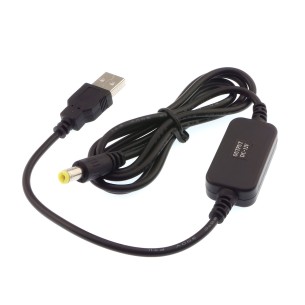
A handy way to power 12V powered devices with a center-positive 2.1mm DC barrel jack from a USB port. Adafruit 2778
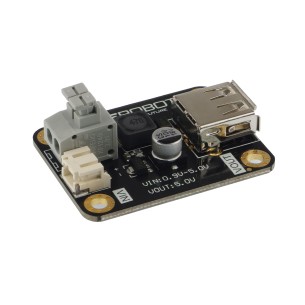
A small DC - DC boost module that converts a 0.9..5V power source to standard 5V, making it capable of supplying power to an Arduino microcontroller and other small electronic devices that use a 5v input. It integrates a PFM DC-DC boost control chip. FIT0471
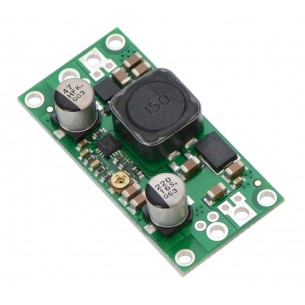
This powerful step-up/step-down regulator efficiently produces an adjustable 4 V to 12 V output from input voltages between 3 V and 30 V while allowing a typical output current of up to 2 A when the input voltage is close to the output voltage and offering typical efficiencies of 80% to 90%.
No product available!
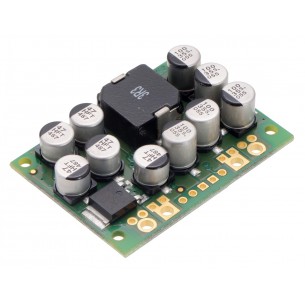
Step-Down DC-DC converter module based on the D24V150F9 chip. Input voltage 11 ... 40V, output voltage 9V (max 15A). Pololu 2884
Step-Down DC-DC converter module based on the D24V150F7 chip. Input voltage 9..40V, output voltage 7.5V (max 15A). Pololu 2883
No product available!
DFR0379
This small synchronous switching step-down (or buck) regulator takes an input voltage of up to 36 V and efficiently reduces it to 9 V. The board measures only 0.7″ × 0.7″ yet delivers a typical continuous output current of up to 2.3 A and features reverse voltage protection.