
- Out-of-Stock
.png)









Laurens Valk
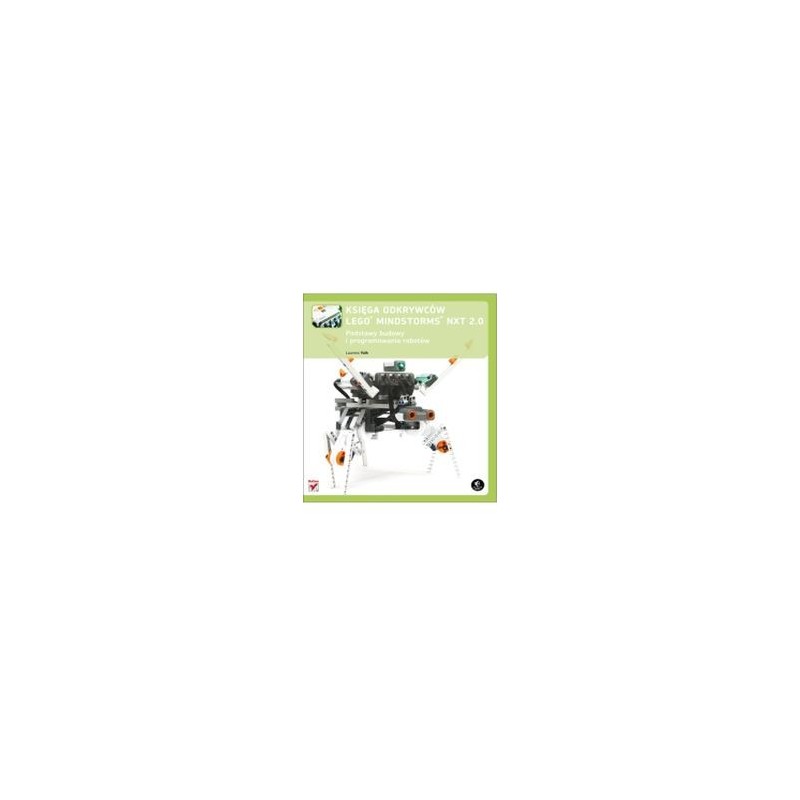
If you have your own MINDSTORMS set, you already know that the manual attached to it describes only a piece of knowledge that you will need to build and program the robot yourself. However, with the book of explorers, you will begin an adventure that will consume you for a long time!
This guide will help you build your dream machine quickly. Fifty example programs and nearly ninety programming and construction tips will awaken your imagination! Many step-by-step instructions will help you create complex devices that move, use sensors, and use advanced techniques such as data and variable data cables.
If you are a novice user, with this book you will learn the basics of creating a structure. If you already have some experience, you will quickly develop your programming skills. This is a real treat for designers of all ages. Regardless of whether you have several or several dozen years - all the way forward to a new adventure!
Valuable tips for explorers can also be found at http://www.discovery.laurensvalk.com .
Laurens Valk is a member of MINDSTORMS Community Partners (MCP), an elite MINDSTORMS expert group that helps in testing and developing new NXT products. He creates robots from the MINDSTORMS NXT sets from the moment they were on the market, and one of the robots of his project was presented on the NXT 2.0 box.
Table of Contents
Acknowledgments (XV) Introduction (XVII)
PART I BEGINNINGS 1. Gathering parts for the robot (3)
2. Building the first robot (7)
3. Creating and modifying programs (23)
4. Working with programming blocks: motion, sound and display (31)
5. Expectation, repetition and other programming techniques (43)
PART II. BUILDING AND PROGRAMMING OF ROBOTS FITTED WITH SENSORS 6. Understanding the sensors (55)
7. Using touch, color and rotation sensors (67)
8. Sagittarius: a robotic defense system (87)
9. Walker: a six-footed walking insect (121)
PART III CREATING ADVANCED PROGRAMS 10. Using data hubs and data cables (149)
11. Using data blocks and data cables in loops and switches (171)
12. Using variables, constants and playing games on NXT (183)
PART IV ADVANCED ROBOT PROJECTS 13. Gripper: autonomic robotic arm (197)
14. Hybrid block sorter: sorting blocks by color and size (237)
15. KAK: Compact chimney climber (265)
Appendix Diagnosing and solving connectivity problems (285)
Index (291)
Black and silver aluminum case designed for Raspberry Pi 4B. It acts as a heat sink and ensures proper heat dissipation from the processor. FLIRC 102476
No product available!
Evaluation kit with the Zynq-7000 APSoC chip integrating the ARM Cortex-A9 based processor with the Artix-7 FPGA chip. Provides two SYZYGY interface connectors enabling cooperation with fast modular systems. The set works under the control of Linux. Digilent Eclypse Z7 (410-393)
No product available!
Dual-channel ADC converter compatible with the SYZYGY standard. The module can simultaneously obtain two 25V signals with 14-bit resolution and sampling frequency up to 100MS/s. The module is compatible with Eclypse Z7 and Genesys ZU evaluation kits. Digilent Zmod Scope 1410-105 (410-396)
No product available!
Dual-channel DAC converter compatible with the SYZYGY standard. The module can simultaneously generate two 5V signals with 14-bit resolution and sampling frequency up to 100MS/s. The module is compatible with Eclypse Z7 and Genesys ZU evaluation kits. Digilent Zmod AWG 1411 410-397
No product available!
Lens for ArduCAM cameras with variable M12 lens designed for Raspberry Pi. It is characterized by a 8mm focal length, 40/45 ° view angle and 1/3 format. ArduCAM LS-8020
No product available!
BeagleBone AI is a minicomputer with an AM5729 processor, it has 1 GB of DDR3L RAM memory. It was created to explore issues related to artificial intelligence. BBBONE-AI
No product available!
NanoPi M4V2 is a FriendlyELEC single board computer. It uses LPDDR4 RAM memory and adds among others: POWER and RECOVERY micro switches and a microphone input.
No product available!
NanoPI NEO is a single-board chip from FriendlyELEC with a RAM of 256 MB, successfully competing with the systems created by the giant in this field Raspberry Pi. It is 25% smaller and cheaper than the Raspberry Pi Zero board with similar capabilities
No product available!
Minicomputer with Allwinner H3 quad-core chip (ARM Cortex-A7). It is equipped with 512 MB RAM memory, an Ethernet port and 3 USB 2.0 interfaces. NanoPi NEO-LTS 512MB
No product available!
HAT for powering over Ethernet (PoE) for Raspberry Pi. It allows you to use the PoE interface to power the minicomputer via an Ethernet cable
No product available!
HAT for powering over Ethernet (PoE) for Raspberry Pi. It allows you to use the PoE interface to power the minicomputer via an Ethernet cable
No product available!
The SparkFun Qwiic Shield for Arduino Nano allows you to add the SparkFun Qwiic ecosystem to development boards that use the Arduino Nano Footprint in an easy-to-assemble shield. It connects the I2C bus (GND, 3.3V, SDA, and SCL) on your Arduino Nano to four SparkFun Qwiic connectors.
No product available!
The SparkFun Qwiic Shield for Thing Plus provides an easy-to-assemble way to add the SparkFun Qwiic ecosystem to any development board with the Thing Plus Footprint. It connects the I2C bus (GND, 3.3V, SDA, and SCL) on your Thing Plus to four SparkFun Qwiic connectors. Sparkfun DEV-16138
No product available!
Cytron 0.8Amp 5V-26V DC Motor Driver Shield - DC motor driver for Arduino
No product available!
No product available!
No product available!
Laurens Valk


