






- Out-of-Stock

.png)












Addressable RGB 60-LED Strip, 5V, 2m (High-Speed TM1804)
Addressable RGB 60-LED Strip, 5V, 2m (High-Speed TM1804)
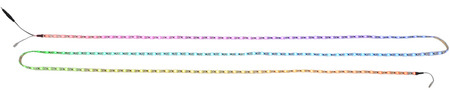
This 2-meter long strip contains 60 RGB LEDs that can be used in a single RGB LED. The waterproof, adhesive-backed stripe runs on 5 V high-speed TM1804 strips to form a longer run. LED for shorter segments.
Clearance: These high-speed TM1804-based LED strips are on the floor and will be discontinued when the stock is gone. They are being replaced by similar, newer WS2812B-based strips . The new strips can be used in the same way. However, the two types of strips have different, incompatible connectors, and the order of TM1804 colors are sent in the red-green-blue order while the WS2812B colors are sent in green-red -blue order.
These RGB LED strips are an easy way to add complex lighting effects to a project. A dedicated driver IC for each LED independently. LED independent. The strips are available in lengths of 1 meter (30 LEDs), 2 meters (60 LEDs), and 5 meters (150 LEDs).
 |
 |
 |
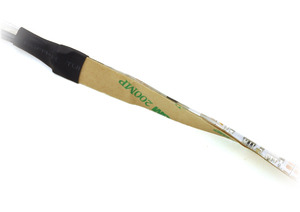 |
| Weatherproof coating and 3M adhesive backing on an RGB LED strip. |
|---|
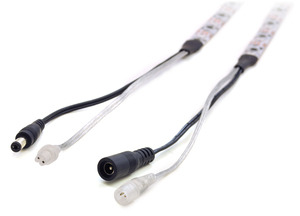 |
| Connectors on an addressable RGB LED strip. |
|---|
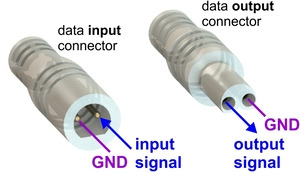 |
| Data connector pinout for the addressable LED strips (products # 2543, # 2544, and # 2545 only). |
|---|
Each LED strip has four connectors (except for the 5 m strip, which does not have a power output). Can These can These These These These These, output These output These These These These These These These These These These These. The data and power output connectors are only used when chaining multiple strips together.
The ground wires on all four connectors are electrically connected.
Note: The white connector is visible on one of the connectors Do not a good indicator of polarity. Please use the labeled connector diagram to help determine which pin is the signal. You can also verify the ground pin with a multimeter.
Multiple LED strips can be chained together with other tapes. When they are connected, they can be controlled as one continuous strip.
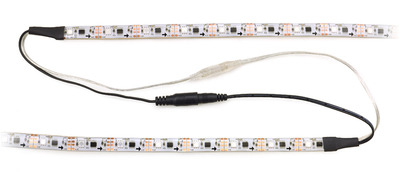 |
| Two addressable RGB LED strips connected. |
|---|
With the 1 m and 2 m LED strips, it is possible to use a power supply. However, this can happen in the long chain of strips.
Do not chain more than 5 meters of LEDs in a single DC circuit. It is fine to make the chains with connected data lines, but you should power each five-meter section separately.
The LED strip is divided into segments, with each 33.3 mm segment containing one RGB LED and its driver chip. The strip can be cut into two usable shorter sections. To access the connections on the side of the epoxy. The data connection is labeled OUT or IN , the positive power connection is labeled + VC , and the two pads in the middle are both connected to ground.
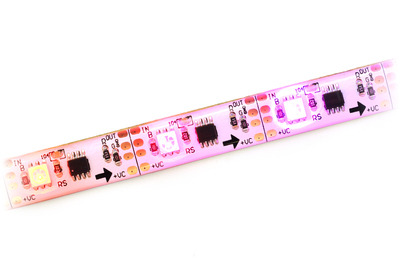 |
| Addressable RGB LED strip segments. |
|---|
These LED strips are controlled by a high-speed one-wire protocol.
The default, idle state of the signal line is low. To update the LED colors, you need to transmit a series of high pulses on the signal line. Each high pulse encodes one bit: a short pulse (0.4 μs) represents a zero, while a long pulse (0.85 μs) represents a one. The time between consecutive rising edges should be 1.25-9.0 μs. After the bits are sent, the signal line should be held for 24 μs to send a reset command. Our tests indicate that the pulse widths do not have to be precise: 0.6 microseconds that determines whether the pulse is a 0 or a 1, and a wide range of pulse.
 |
| Addressable RGB LED strip timing diagram (products # 2543, # 2544, and # 2545 only). |
|---|
The color of each LED is encoded as a LED RGB (red-green-blue) order. Each brightness value is encoded as a series of 8 bits, with the most important bit being transmitted. LED color takes 24 bits. The first color is the LED input. The LED is in the strip, and so on.
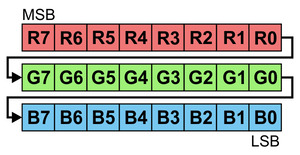 |
| 24 bits represent the color of one LED in an addressable RGB LED strip. |
|---|
To update all the LEDs in the strip, you should send all the colors at once with no pauses. If you send fewer colors than the number of LEDs on the strip, then some LEDs near the end of the strip will not be updated. For example, to update all 30 LEDs on a 1-meter strip, you would send 720 bits. If multiple strips are chained together with the same line (two chained 1-meter strips behave the same as one 2-meter strip).
Each RGB LED is controlled by the driver. IC that is the next IC using its data output line. The high-speed protocol of the driver for fast updates; our library for the Arduino is about 1.1 ms to update 30 LEDs, so it is possible to update 15 meters of LED strips faster than 60 Hz. However, constant updates are not necessary; the LED strip can hold its state indefinitely as long as power reserves connected.
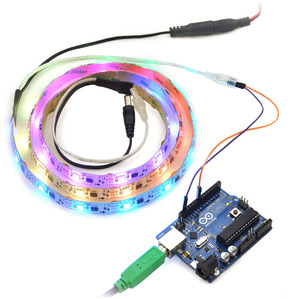 |
| Controlling an addressable RGB LED strip with an Arduino. |
|---|
Since this LED strip does not use a standard protocol, and the software has a microcontroller. Because of the sub-microsecond timing, the bit-banging code needs to be printed. If it is interrupted in your code are fast enough,
To help you get started quickly, we provide sample code for these microcontroller platforms:
Manufacturer
Responsible person
Module with IR motion sensor AK9753. The board is equipped with a Grove connector and communicates via the I2C interface. Seeed Studio 101020554
No product available!
The module with the driver of 2 DC motors TB6612FNG and 3 servos, designed for the educational micro:bit module. Seeed Studio 105990091
No product available!
Module with a UV light sensor VEML6070. The board is equipped with a Grove connector and communicates via I2C. Seeed Studio 101020600
No product available!
The module with the CY8C4014LQI touch sensor in the form of two buttons and a 5-segment slider. The board is equipped with a Grove connector and communicates via I2C. Seeed Studio 101020552
No product available!
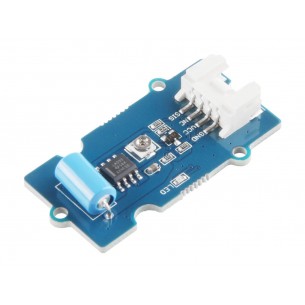
Module with vibration sensor SW-420. The board is equipped with a Grove connector and has a digital output. Seeed Studio 101020586
No product available!
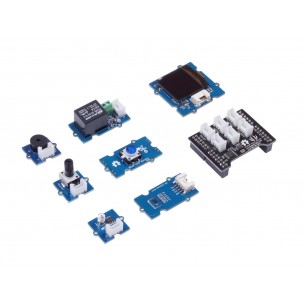
Starter kit with Grove modules designed to work with the Azure Sphere MT3620 development board. Seeed Studio 110060947
No product available!
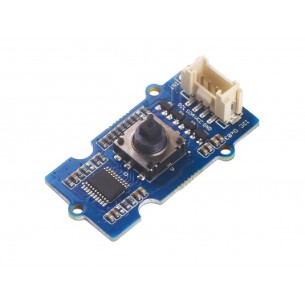
Module with 5-way joystick. The board is equipped with a Grove connector and communicates via I2C. Seeed Studio 111020048
No product available!
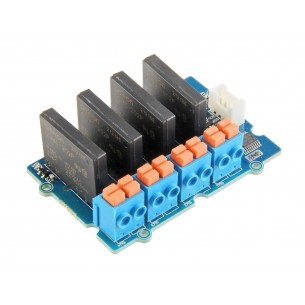
Module with 4 relays SSR G3MC202P with a load up to 2 A. The board is equipped with a Grove connector and communicates via I2C. Seeed Studio 103020135
No product available!
Module with GP2Y0D805Z0F proximity sensor, which can detect the presence of objects in the range from 0.5 to 5 cm. The board is equipped with a Grove connector and communicates via a digital interface. Seeed Studio 101020533
No product available!
Module with FM receiver RDA5807M. The board is equipped with a Grove connector and communicates via the I2C interface. Seeed Studio 107020049
No product available!
A module with a microphone for recognizing voice commands. The board is equipped with a Grove connector and communicates via the UART interface. Seeed Studio 101020312
No product available!
Module with driver for 64x32 or 32x16 LED matrix displays. The board is equipped with a Grove connector and communicates via the UART interface. Seeed Studio 105020013
No product available!
The module with an incremental encoder with channels A and B. The board is equipped with a Grove connector and communicates via a digital interface. Seeed Studio 103020030
No product available!
Module with a track ball that allows you to track the movement in 5 axes in the range of 360 °. The board is equipped with a Grove connector and communicates via the I2C interface. Seeed Studio 101020091
No product available!
Module with a vibration motor and the ability to generate 123 different vibration modes. The board is equipped with a Grove connector and communicates via the I2C interface. Seeed Studio 105020011
No product available!
Module with a dynamic NFC M24LR64E-R tag and an external antenna. The board is equipped with a Grove connector and communicates via the I2C interface. Seeed Studio 101020070
No product available!
Addressable RGB 60-LED Strip, 5V, 2m (High-Speed TM1804)