



zł287.42 tax excl.
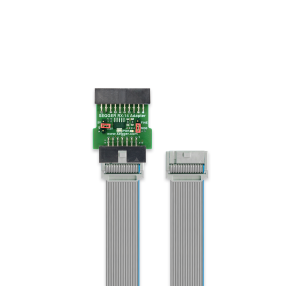
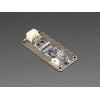
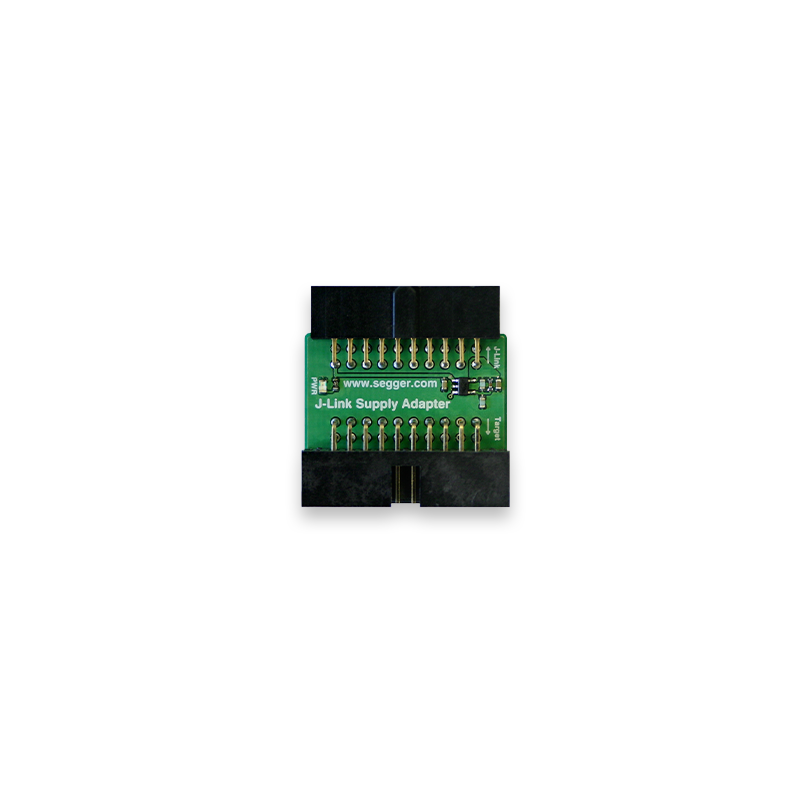
The Segger J-Link Supply Adapter (8.06.14) allows you to manually set the debug probe I/O voltage, preventing damage to the target board, adjustable from 1.2V to 5.0V. It can be inserted between J-Link or Flasher and the target device, reducing the number of connections needed, which is especially useful in a production environment.
The Segger J-Link Supply Adapter (8.06.14) is used to adjust the I/O voltage for the debug probe, thus protecting the debug pins of the target device from damage. Typically, the target device supplies its I/O voltage (VTRef) to the probe via pin 1, but if the VTRef signal is not desired on the target board, it can be bypassed by using an adapter and manually setting the I/O voltage. The default is 3.3V. For greater flexibility, the adapter can adapt to other target voltages ranging from 1.2V to 5.0V by replacing one resistor on the adapter (soldering required, 0603 SMD resistor package).
The Supply Adapter can be inserted between the J-Link or Flasher and the target device, keeping all debug signals unambiguously connected (except VTRef/pin 1). It has a standard 20-pin 0.1" socket directed to the J-Link debug probe and a standard 20-pin 0.1" connector on the target side. The main purpose of using the adapter is to reduce the number of connections to the target device, especially in a production environment. It can also be used with Flasher devices. For 2-wire debug interfaces such as SWD, only 3 wires are usually required: SWDIO, SWDCLK and GND. For single-wire interfaces such as SPD, the number of connections is reduced to 2 accordingly.
Manufacturer BTC Korporacja sp. z o. o. Lwowska 5 05-120 Legionowo Poland sprzedaz@kamami.pl 22 767 36 20
Responsible person BTC Korporacja sp. z o. o. Lwowska 5 05-120 Legionowo Poland sprzedaz@kamami.pl 22 767 36 20
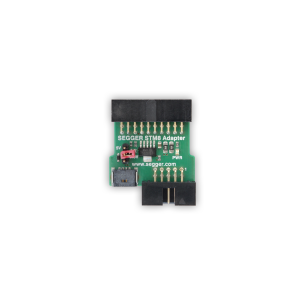
Adapter enabling connection of J-Link and Flasher debugging devices with a 20-pin 0.1" connector to a 14-pin 0.05" connector compliant with the ST standard. Segger STDC 14 Adapter (8.06.39)
No product available!
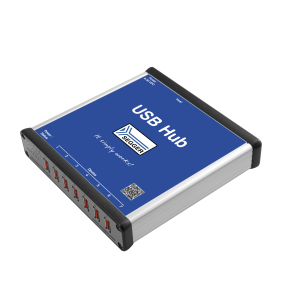
The SEGGER USB Hub is a seven-port, industrial-grade USB hub that provides power to Flasher Compact devices and connects them to the Flasher Hub. Segger USB Hub (5/01/10)
No product available!
Xilinx adapter that connects to Xilinx\'s 14-pin, 2mm JTAG connector, providing debugging of MCU cores such as the Arm Cortex-A9 on Xilinx Zynq FPGAs. With its compact design and high signal quality, it is a reliable tool for engineers working with FPGA platforms. Segger Xilinx Adapter (06/08/19)
No product available!
A compact reference platform that enables rapid testing and verification of trace configurations, providing excellent signal quality for analysis. With the NXP iMX RT1051/52 microcontroller and support for the SWD debug interface, the board provides high performance and flexibility in monitoring system performance. Segger NXP iMX RT1050 Trace Reference Board (6.68.19)
No product available!
Adapter that enables JTAG connection between devices such as J-Link, J-Trace or Flasher and Jacinto7 systems from TI, offering access to JTAG/SWD and Trace connectors with TPIU tracking function. Thanks to high quality of workmanship and versatility, the adapter provides a stable connection, supporting debugging, testing and diagnostic processes in embedded systems. Segger MIPI-60 Adapter (8.06.42)
No product available!
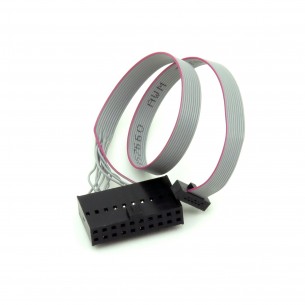
10-wire ribbon cable (1.27mm to 2.54mm) for Segger J-Link EDU mini
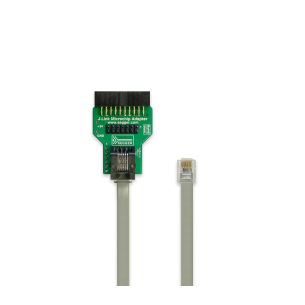
The Segger J-Link Microchip Adapter (8/06/09) provides a debug connection between a J-Link probe and hardware with Microchip PIC32 series microcontrollers. Supports RJ12 debug connector, 14-pin MIPS connector and 6-pin PICkit connector.
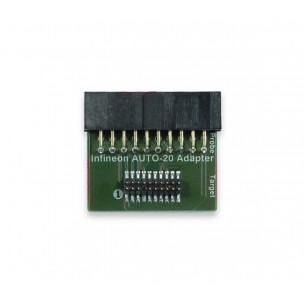
An adapter to connect the JTAG to a target hardware system that has an automotive connector. It has a 20 pin 2.54mm JTAG connector and a 19 pin 1.27mm Samtec FTSH connector. Segger Infineon AUTO-20 Adapter (8.06.33)
No product available!
No product available!
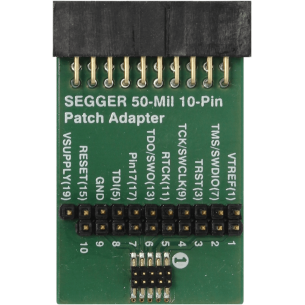
Segger adapter 8.06.28 allows conversion from a 20-pin 0.1" connector to a 10-pin 0.05" Cortex-M type connector with the option of custom pin mapping. A useful solution for integrating programmers and debuggers with devices featuring different pin configurations.
Adapter enabling connection of OCDS DAP interface to systems based on Infineon Aurix™ TC2xx, TC3xx, TC4xx and C167 microcontrollers. Converts standard 20-pin SEGGER connector to 10-pin 0.05\'\' Samtec FTSH, providing stable and reliable communication in debugging and programming processes. Segger Infineon Aurix DAP-10 Adapter (8.06.38)
No product available!
A set of three SON/DFN adapters enables easy testing and programming of flash devices in these packages, eliminating the need for dedicated solutions for each form factor. The adapters are compatible with the SEGGER (Q)SPI Flash Evaluator and other test systems, making them a versatile tool for both test and production. SEGGER (Q)SPI Flash Evaluator Adapter board Pack for SON/DFN (6.40.03)
No product available!
Adapter that enables JTAG connection between Flasher programmer and target hardware with Power Architecture or PowerPC microcontrollers. Converts 20-pin 0.1\'\' connector to 14-pin JTAG, ensuring compatibility, stability and secure connection. Segger PPC 14-Pin Adapter (06.08.07)
No product available!
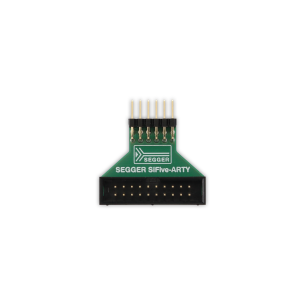
SiFive-ARTY adapter for debugging between J-Link and the ARTY board with SiFive RISC-V. Segger SiFive-ARTY Adapter (8.06.24)
No product available!
Adapter that converts standard 20-pin 2.54 mm connector to SWIM connector and 10-pin connector. Used for programming STM8 chips. Segger STM8 Adapter (8.06.22)
No product available!
The Segger J-Link Mictor 38 Adapter allows connection to a 38-pin Mictor connector in accordance with the ARM "ETM" specification. The adapter connects the GND and JTAG pins to the 20-pin J-Link, and the trace pins on the Mictor connector are not used.
No product available!
The Segger J-Link Supply Adapter (8.06.14) allows you to manually set the debug probe I/O voltage, preventing damage to the target board, adjustable from 1.2V to 5.0V. It can be inserted between J-Link or Flasher and the target device, reducing the number of connections needed, which is especially useful in a production environment.