.png)



zł53.24 tax excl.
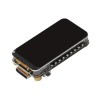
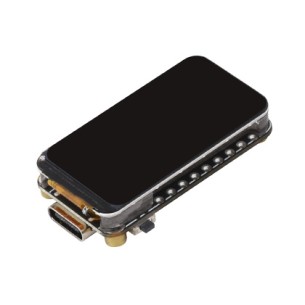
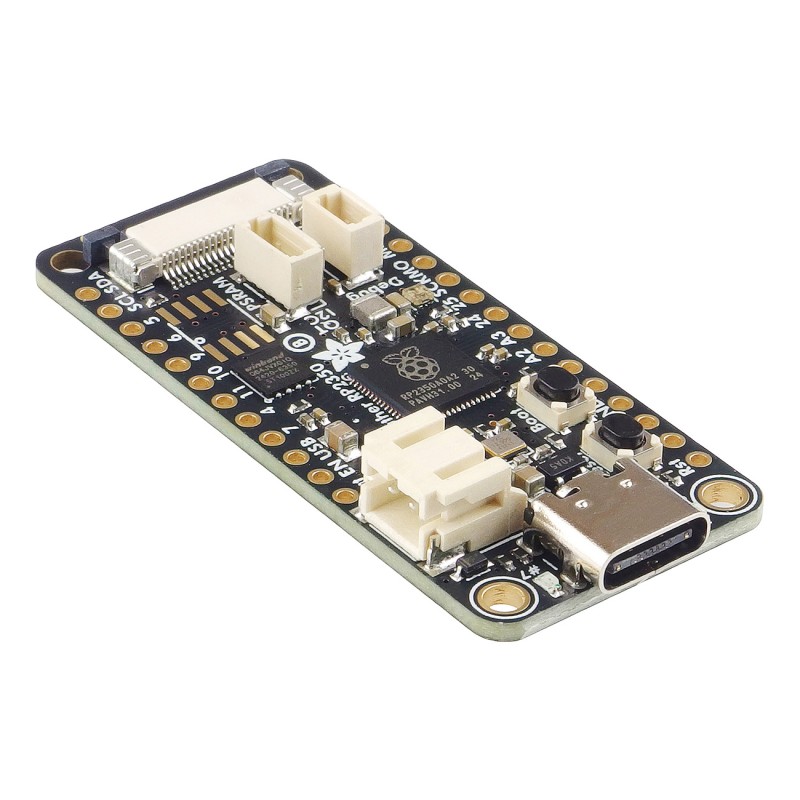
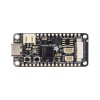
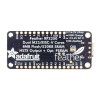
This modern development board features a dual-core Cortex-M33 microcontroller clocked at 150 MHz, 520 KB of RAM, and 8 MB of QSPI Flash. It features a rich set of interfaces, including I2C, SPI, UART, 24 PWM channels, and an HSTX port for high-speed differential data transfer. The board features a STEMMA QT connector, a built-in 200 mA+ LiPo charger, a USB-C port with a UF2 bootloader, and NeoPixel LEDs and a red LED for signaling. The Feather RP2350 is compatible with MicroPython, CircuitPython, Arduino, and C/C++. Adafruit 6000
Feather RP2350 is a versatile and modern development board designed for projects that require high performance and compact dimensions. It features the new RP2350 microcontroller with a dual-core Cortex-M33 running at 150 MHz, providing significantly more computational power than its predecessor, the RP2040. This makes the board ideal for IoT, automation, control systems, real-time applications, and multimedia projects.
The board offers 520 KB of RAM and external 8 MB QSPI Flash memory for storing code, configurations, and user data. It also supports expansion with PSRAM, extending its potential for applications requiring large buffers, such as image or audio processing. Feather RP2350 provides a rich set of interfaces, including I2C, SPI, UART, and 24 PWM channels, ensuring versatility in communication and device control. The included HSTX port enables high-speed differential transmission, for example generating DVI signals without using PIO. The board features a STEMMA QT connector for plug-and-play modules, greatly speeding up prototyping. Additionally, it includes a 200 mA+ LiPo charger and a USB-C port for programming via the UF2 bootloader.
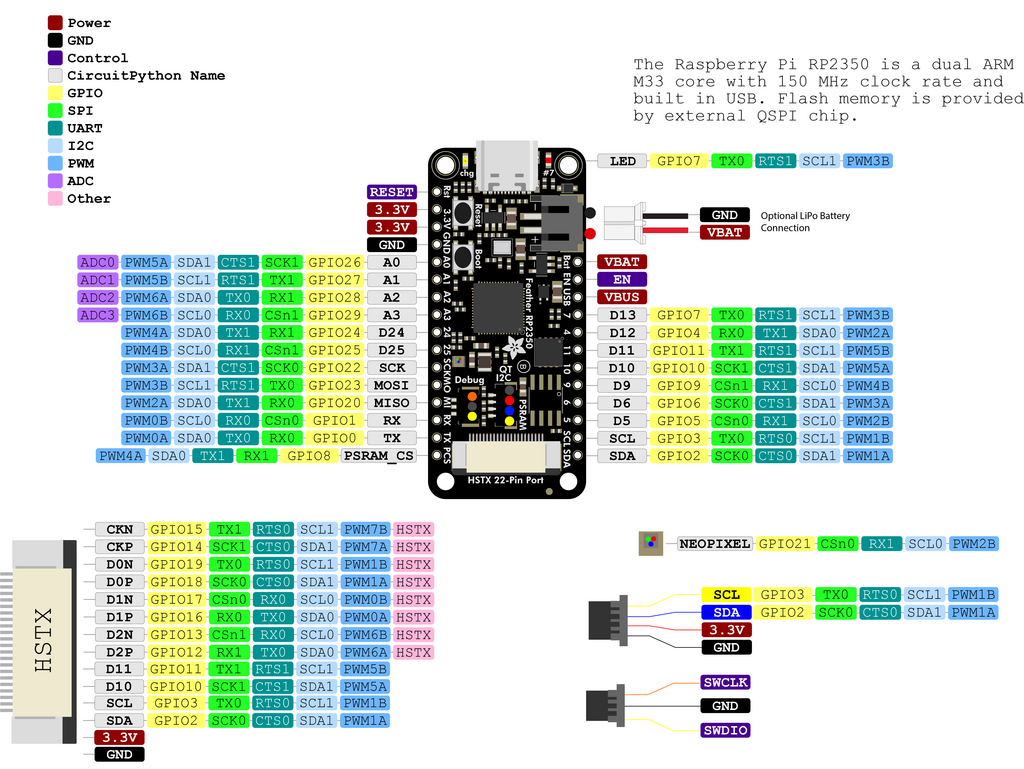
The board includes two RGB NeoPixel LEDs and a red LED for status indication. It is supported by multiple programming environments, including MicroPython, CircuitPython, Arduino, and C/C++, making it suitable for both beginners and advanced developers. Its solid construction, Feather ecosystem compatibility, and wide range of features make the Feather RP2350 with HSTX Port an extremely versatile platform for a broad spectrum of electronic projects. The board is lightweight, energy-efficient, and well-suited for portable, battery-powered applications. Its extensive communication options and high computational power make it an excellent choice for modern embedded systems. Three PIO blocks expand its capabilities for custom protocol handling, while the precise 12 MHz crystal ensures stable timing. Debugging is facilitated via the available SWD connector, making this hardware a reliable solution for demanding electronic system designers.
Data sheet
Manufacturer
Responsible person
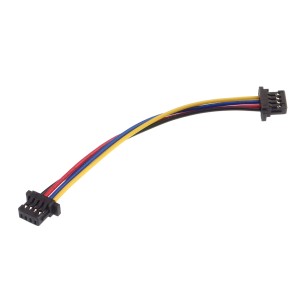
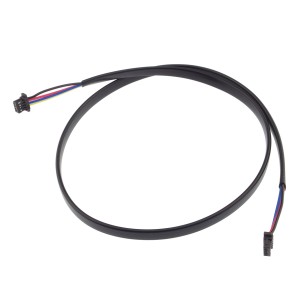
4-wire cable with a length of 50 mm. Both ends with STEMMA QT (Qwiic) plug. Adafruit 4399
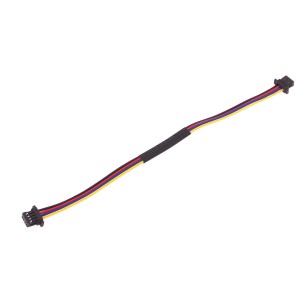
4-wire cable with a length of 100 mm. Both ends with STEMMA QT (Qwiic) plug. Adafruit 4210
4-core cable with a length of 200 mm. Both ends with STEMMA QT (Qwiic) plug. Adafruit 4401
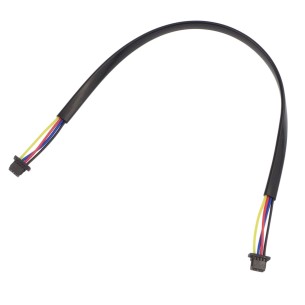
4-core cable with a length of 300 mm. Both ends with STEMMA QT (Qwiic) plug. Adafruit 5384
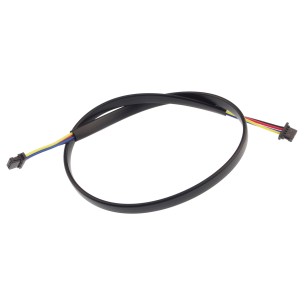
4-core cable with a length of 400 mm. Both ends with STEMMA QT (Qwiic) plug. Adafruit 5385
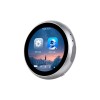
RP2350 1.75" 466×466 with 65K color AMOLED display and capacitive touch panel, equipped with the RP2350A dual-core, dual-architecture microcontroller, 6-axis IMU sensor, RTC, audio codec with microphone, and integrated LC76G GPS module. The board provides SPI, I2C, UART, ADC, PWM, and USB Type-C interfaces, and includes a ceramic GNSS antenna in the set, enabling the development of portable HMI devices and embedded systems with positioning functionality. Waveshare RP2350-Touch-AMOLED-1.75-G
No product available!
RP2350 1.75" 466×466 with 65K color AMOLED display and capacitive touch panel, equipped with the RP2350A dual-core, dual-architecture microcontroller, 6-axis IMU sensor, RTC, audio codec with microphone, and power management system supporting a 3.7 V Li-Ion battery. The version with protective enclosure is designed for portable devices, HMI panels, and interactive embedded systems requiring high-quality image output and touch support. Waveshare RP2350-Touch-AMOLED-1.75-B
No product available!
RP2350 1.75" 466×466 with 65K color AMOLED display and capacitive touch panel, equipped with the RP2350A dual-core, dual-architecture microcontroller, 6-axis IMU sensor, RTC, audio codec with microphone, and power management system supporting a 3.7 V Li-Ion battery. The board provides SPI, I2C, UART, ADC, PWM, and USB Type-C interfaces, enabling the development of portable devices, HMI panels, and interactive embedded systems requiring high-quality display output and touch support. Waveshare RP2350-Touch-AMOLED-1.75
No product available!
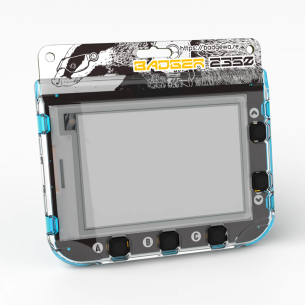
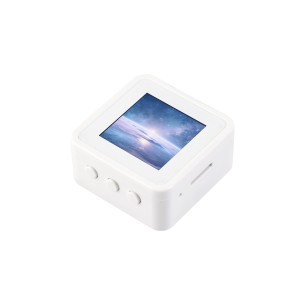
An educational kit with a 2.7-inch e-Paper display with a resolution of 264 x 176 pixels and four grayscale levels, ideal for presenting schedules, QR codes, and IoT messages. The device is based on a dual-core RP2350A microcontroller (2 x Arm Cortex-M33 250 MHz) with 520 KB of SRAM, 16 MB of QSPI Flash, and 8 MB of PSRAM. Connectivity is provided by a Wi-Fi and Bluetooth module (CYW43439). A built-in 1000 mAh LiPo battery, charged via USB-C, enables long, energy-efficient operation, and the RTC allows for the development of cyclic applications. Pimoroni WARE001
No product available!
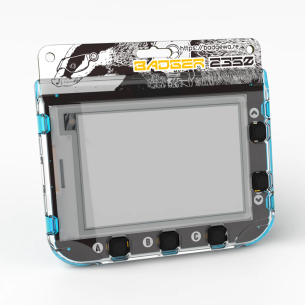
An educational kit with a 2.7-inch e-Paper display with a resolution of 264 x 176 pixels and four grayscale levels, ideal for presenting schedules, QR codes, and IoT messages. The device is based on a dual-core RP2350A microcontroller (2 x Arm Cortex-M33 250 MHz) with 520 KB of SRAM, 16 MB of QSPI Flash, and 8 MB of PSRAM. Connectivity is provided by a Wi-Fi and Bluetooth module (CYW43439). A built-in 1000 mAh LiPo battery, charged via USB-C, enables long, energy-efficient operation, and the RTC allows for the development of cyclic applications. Pimoroni WARE004
No product available!
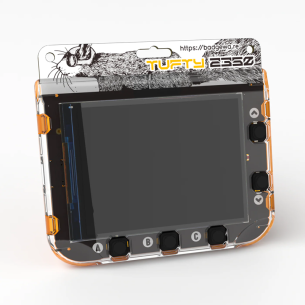
Educational kit with a 2.8" color TFT IPS display with a resolution of 320 × 240 px and adjustable backlight, ideal for game development, data visualization, and IoT projects. The device is based on the RP2350B microcontroller (2 × Arm Cortex-M33 250 MHz) with 520 KB SRAM, 16 MB QSPI Flash, and 8 MB PSRAM, and connectivity is provided by a Wi-Fi and Bluetooth module (CYW43439). A built-in 1000 mAh LiPo battery charged via USB-C guarantees mobile operation without a constant power supply. Five buttons, an I2C Qwiic/STEMMA QT connector, and MicroPython support make the kit a versatile platform for learning programming and STEM experiments. Pimoroni WARE002
No product available!
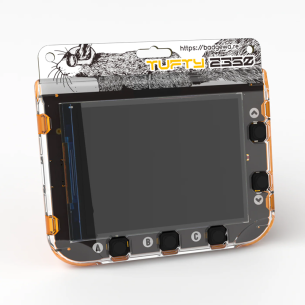
Educational kit with a 2.8" color TFT IPS display with a resolution of 320 × 240 px and adjustable backlight, ideal for game development, data visualization, and IoT projects. The device is based on the RP2350B microcontroller (2 × Arm Cortex-M33 250 MHz) with 520 KB SRAM, 16 MB QSPI Flash, and 8 MB PSRAM, and connectivity is provided by a Wi-Fi and Bluetooth module (CYW43439). A built-in 1000 mAh LiPo battery charged via USB-C guarantees mobile operation without a constant power supply. Five buttons, an I2C Qwiic/STEMMA QT connector, and MicroPython support make the kit a versatile platform for learning programming and STEM experiments. Pimoroni WARE005
No product available!
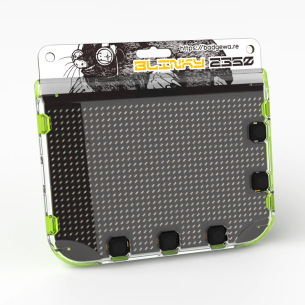
An interactive educational kit with a 39 x 26 LED matrix (872 diodes) capable of displaying animations, text, and pixel graphics. At the heart of the device is a dual-core RP2350A microcontroller (2 x Arm Cortex-M33 250 MHz) with 520 KB SRAM, 16 MB QSPI Flash, and 8 MB PSRAM. Connectivity is provided by a Wi-Fi and Bluetooth module (CYW43439). A built-in 1000 mAh LiPo battery charged via USB-C allows for mobile operation, while additional buttons and a RTC (Real Time Clock) enhance the device\'s functionality. Pimoroni WARE003
No product available!
An interactive educational kit with a 39 x 26 LED matrix (872 diodes) capable of displaying animations, text, and pixel graphics. At the heart of the device is a dual-core RP2350A microcontroller (2 x Arm Cortex-M33 250 MHz) with 520 KB SRAM, 16 MB QSPI Flash, and 8 MB PSRAM. Connectivity is provided by a Wi-Fi and Bluetooth module (CYW43439). A built-in 1000 mAh LiPo battery charged via USB-C allows for mobile operation, while additional buttons and a RTC (Real Time Clock) enhance the device\'s functionality. Pimoroni WARE006
No product available!
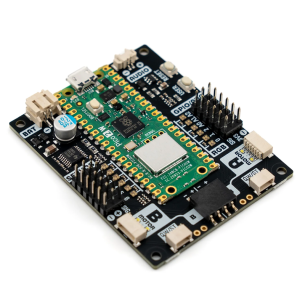
This development board for building robots and mechatronics projects features 2.4 GHz Wi-Fi and Bluetooth 5.2 connectivity. Based on the RP2350 microcontroller (Dual Arm Cortex-M33 up to 150 MHz, 520 KB SRAM, 4 MB QSPI Flash), it allows you to control two DC motors via a DRV8833C H-bridge and support up to six servos. It features 12 addressable RGB (Neopixel) LEDs, ADC inputs, numerous GPIOs, and two Qw/ST headers for connecting sensors. Pimoroni PIM733
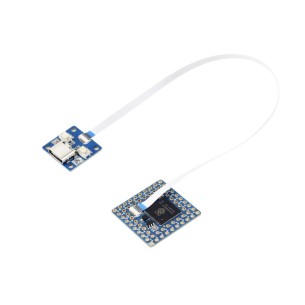
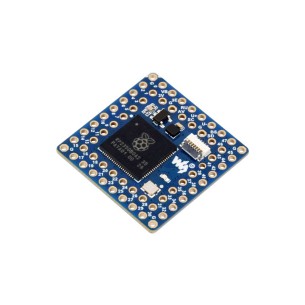
Module with RP2350B microcontroller, clock speed up to 150 MHz, 8 MB PSRAM, 16 MB Flash, 48 GPIO, 2.54 mm pitch, USB adapter and FPC cable included, dimensions 25.40 x 25.40 mm. Waveshare Core2350B2-Kit
No product available!
Module with RP2350B microcontroller, up to 150 MHz, 8 MB PSRAM, 16 MB Flash, 48 GPIO, 2.54 mm pitch, compact size 25.40 x 25.40 mm. Waveshare Core2350B2
No product available!
Module with RP2350B microcontroller, clock speed up to 150 MHz, 2 MB PSRAM, 16 MB Flash, 48 GPIO, 2.54 mm pitch, includes USB adapter and FPC cable, dimensions 25.40 x 25.40 mm. Waveshare Core2350B1-Kit
Module with RP2350B microcontroller, clock speed up to 150 MHz, 2 MB PSRAM, 16 MB Flash, 48 GPIO, 2.54 mm pitch, compact size 25.40 x 25.40 mm. Waveshare Core2350B1
Module with RP2350B microcontroller, clock speed up to 150 MHz, 0 MB PSRAM, 16 MB Flash, 48 GPIO, 2.54 mm pitch, includes USB adapter and FPC cable, dimensions 25.40 x 25.40 mm. Waveshare Core2350B0-Kit
Module with RP2350B microcontroller, clock speed up to 150 MHz, 0 MB PSRAM, 16 MB Flash, 48 GPIO, 2.54 mm pitch, compact size 25.40 x 25.40 mm. Waveshare Core2350B0
This modern development board features a dual-core Cortex-M33 microcontroller clocked at 150 MHz, 520 KB of RAM, and 8 MB of QSPI Flash. It features a rich set of interfaces, including I2C, SPI, UART, 24 PWM channels, and an HSTX port for high-speed differential data transfer. The board features a STEMMA QT connector, a built-in 200 mA+ LiPo charger, a USB-C port with a UF2 bootloader, and NeoPixel LEDs and a red LED for signaling. The Feather RP2350 is compatible with MicroPython, CircuitPython, Arduino, and C/C++. Adafruit 6000