.png)



zł82.83 tax excl.
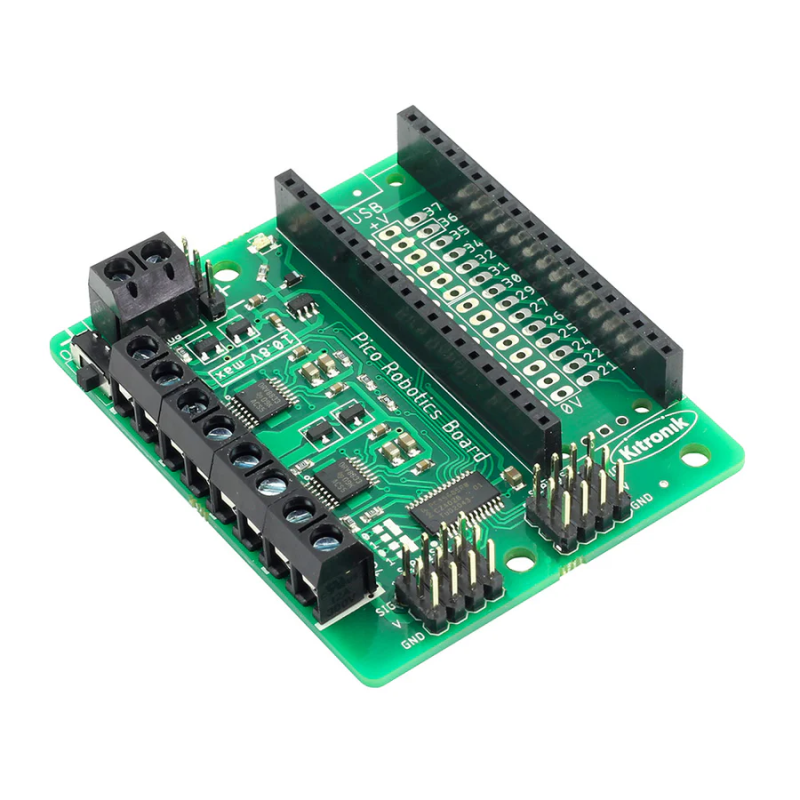
A base board that allows the Raspberry Pi Pico to control four DC motors or two stepper motors and eight servos, offering great flexibility for robotic projects. The board is equipped with dual H Bridge ICs to drive the motors, with full direction control and stopping functions, and power supplied via a terminal or servo connector, which increases its functionality. Additionally, thanks to the regulated 3.3V voltage, there is no need for a separate power supply for the connected Raspberry Pi Pico, simplifying the assembly process and integration with other devices. Kitronik 5329
The Robotics Board is a base board that allows the Raspberry Pi Pico to control 4 DC motors (or 2 stepper motors) and 8 servos. The board is equipped with 27 additional I/O expansion pins as well as power and ground connectors. It is important to note that when using a stepper motor, only half-step control is supported, without micro-stepping. The board features 2 dual H Bridge integrated circuits, each capable of driving 2 standard motors or 1 stepper motor, offering full control over direction (forward, backward) and stopping. Additionally, 8 servo outputs allow for the control of both standard and continuous rotation servos. All motors and servos can be controlled using the I2C protocol, utilizing a 16-channel integrated circuit. The separation of I/O connectors ensures connections to all unused pins on the Pico, allowing for the addition of extra devices such as sensors or ZIP LED strips.
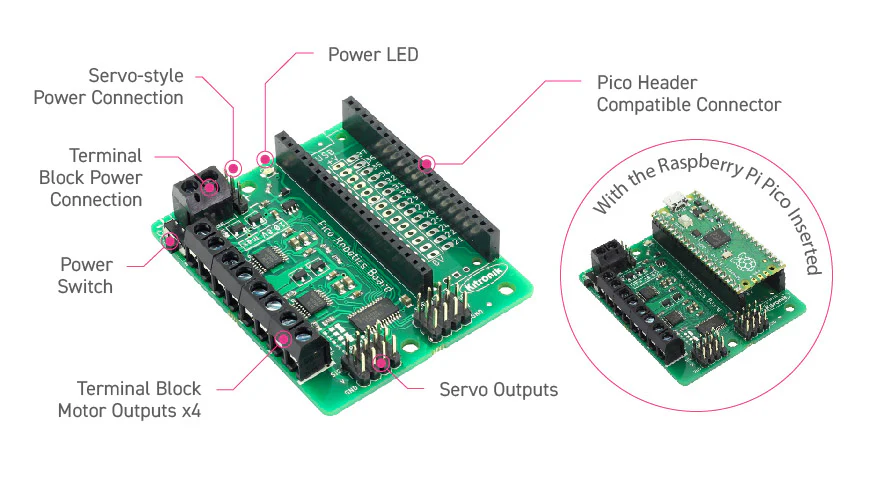
Power is supplied via a terminal block or servo connector. The board has a power on/off switch that controls the power, and a green LED indicates when the board is powered. The board provides a regulated voltage of 3.3 V, which is passed to the 3 V and GND connectors, powering the connected Pico. This eliminates the need for separate power for the Pico. The 3V and GND pins are also available on the connector, allowing for the powering of external devices.
Manufacturer
Responsible person
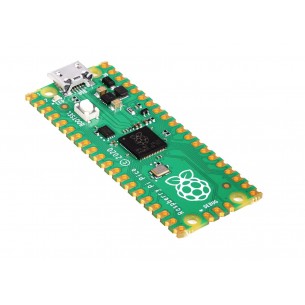
Module with the RP2040 microcontroller with two ARM Cortex-M0 + cores operating at 133 MHz, 256 kB RAM and 30 GPIO. The board also has 2 MB of external QSPI flash memory. Module can be programmed in C/C++ or microPython. Raspberry Pi Pico
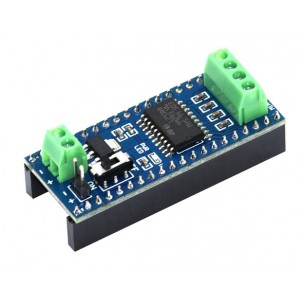
Module with a 2-channel driver for DC motors L293D designed to work with the Raspberry Pi Pico. It can work with a voltage from 6 to 12 V and a current of up to 600 mA. SB Components 21468
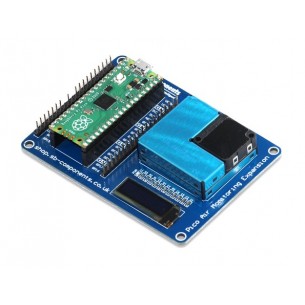
The PMSA003 air quality sensor module to work with the Raspberry Pi Pico. It allows for a analysis of the amount of pollutants in the environment based on the concentration of PM1.0, PM2.5 and PM10 particles. SB Components 21819
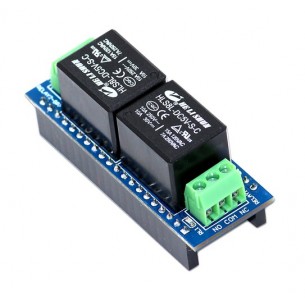
2-channel module with relays designed to work with the Raspberry Pi Pico. It can switch signals up to 250 V AC and 7 A or 30 V DC and 10 A. SB Components 21284
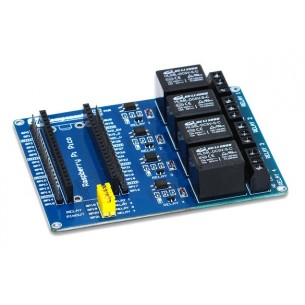
4-channel module with relays designed to work with the Raspberry Pi Pico. It can switch signals up to 250 V AC and 7 A or 30 V DC and 10 A. SB Components 21178
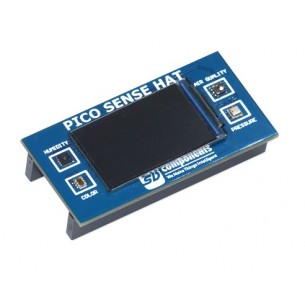
Module with environmental sensors for Raspberry Pi Pico. It allows you to measure temperature, humidity, air quality pressure and color detection. SB Components 22366
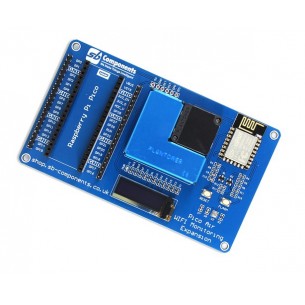
Module with PMSA003 air quality sensor and BME280 pressure sensor designed for Raspberry Pi Pico. It is equipped with WiFi ESP8266 communication. SB Components 22342
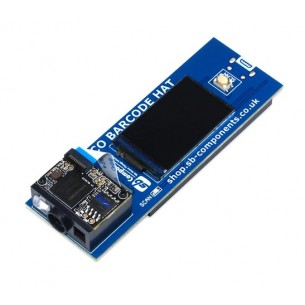
A module with a barcode and QR scanner designed to work with the Raspberry Pi Pico. It allows you to read one-dimensional and two-dimensional codes using the intelligent image recognition algorithm. SB Components 22441
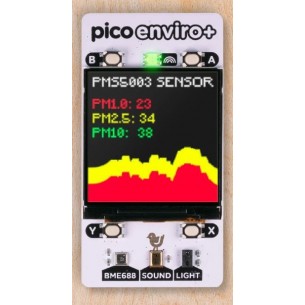
Module with BME688 chip, microphone and LTR-559 light intensity. Equipped with a display, it is dedicated to the Raspberry Pi Pico/Pico W. Pimoroni PIM635
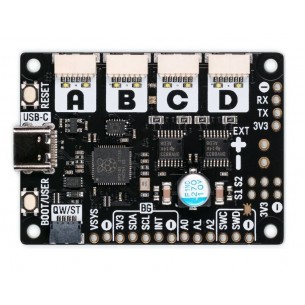
Module of a 4-channel driver of DC motors with RP2040 microcontroller. It allows the connection of encoders and is equipped with a QW/ST connector. Pimoroni PIM636
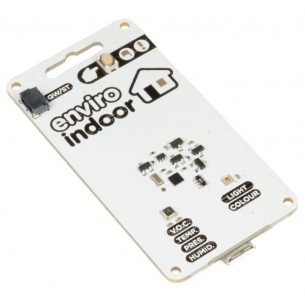
Module with BME688 chip and BH1745 color and light intensity sensor equipped with Raspberry Pi Pico W. Pimoroni PIM630
Module with BME688 chip and BH1745 color and light intensity sensor equipped with Raspberry Pi Pico W. Accessories included. Pimoroni PIM638
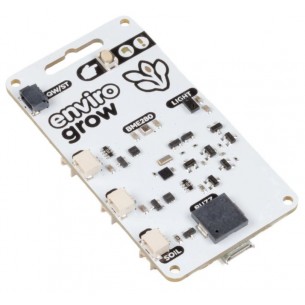
Kit for controlling soil moisture of cultivated plants. Equipped with a Raspberry Pi Pico W-based controller and soil moisture sensors with wires. Pimoroni PIM627
No product available!
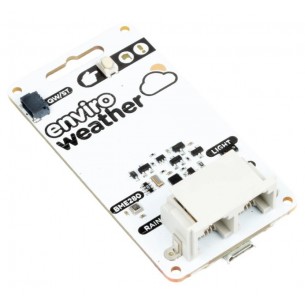
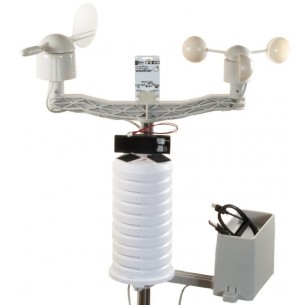
Module for building a weather station equipped with a controller based on Raspberry Pi Pico W. Pimoroni PIM628
No product available!
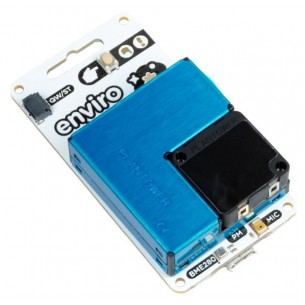
Module with BME280 sensor, microphone and PMSA003I air quality sensor equipped with Raspberry Pi Pico W. Pimoroni PIM629
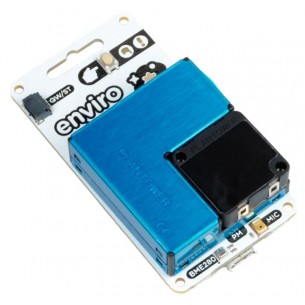
Module with BME280 sensor, microphone and PMSA003I air quality sensor equipped with Raspberry Pi Pico W. Accessories included. Pimoroni PIM639
A set for building a weather station equipped with a controller based on Raspberry Pi Pico W. Pimoroni PIM640
No product available!
A base board that allows the Raspberry Pi Pico to control four DC motors or two stepper motors and eight servos, offering great flexibility for robotic projects. The board is equipped with dual H Bridge ICs to drive the motors, with full direction control and stopping functions, and power supplied via a terminal or servo connector, which increases its functionality. Additionally, thanks to the regulated 3.3V voltage, there is no need for a separate power supply for the connected Raspberry Pi Pico, simplifying the assembly process and integration with other devices. Kitronik 5329