

zł166.67 tax excl.
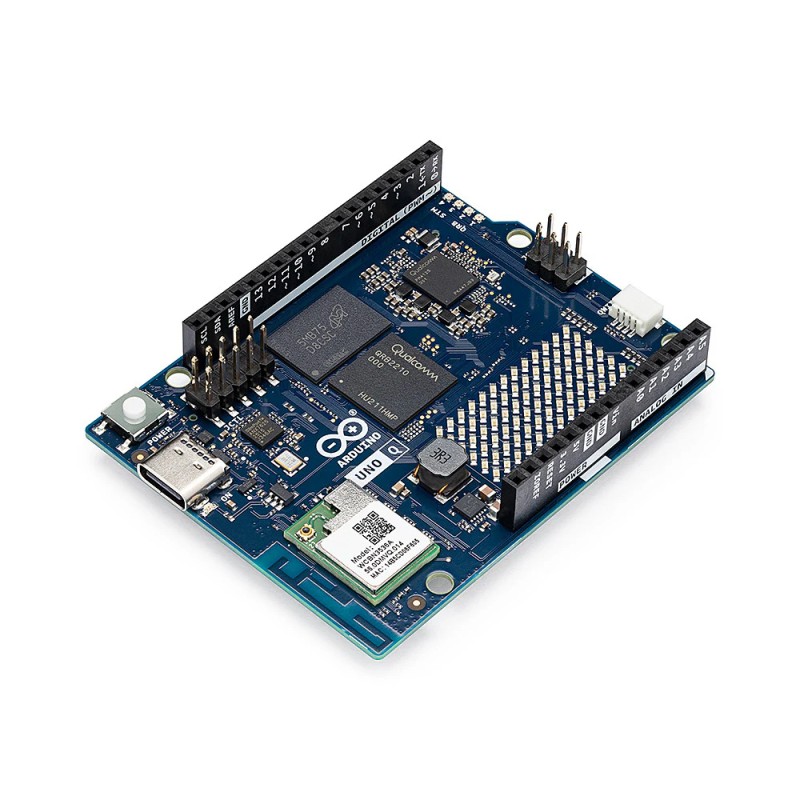
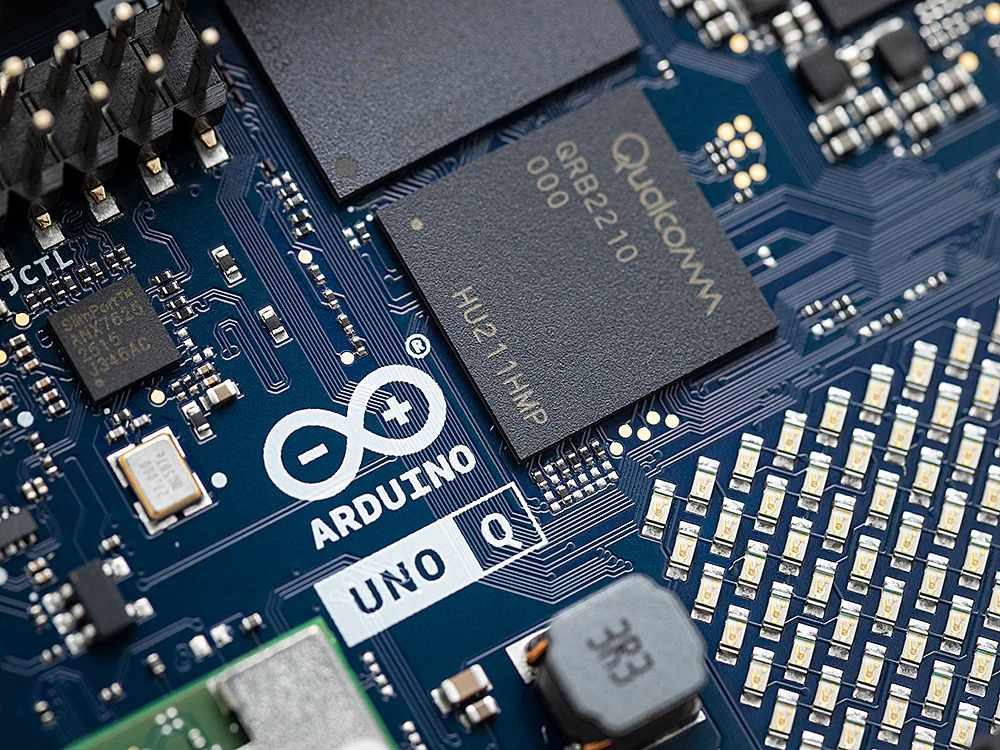
The Arduino UNO Q (ABX00162) board integrates the Qualcomm QRB2210 microprocessor with the STM32U585 microcontroller, offering an advanced platform for designing AI, IoT, and robotics systems. Support for Docker containers, the integrated App Lab environment, and a rich set of interfaces make the board suitable for applications requiring cooperation between Linux and real-time systems.
The Arduino UNO Q development platform integrates the quad-core application microprocessor Qualcomm® QRB2210 and the low-power STM32U585 microcontroller, providing simultaneous execution of applications in the Linux environment and real-time control of devices. By combining microprocessor and microcontroller technologies, the board enables the creation of advanced systems in fields such as mobile robotics, image processing, sound analysis, IoT systems, and embedded AI applications.
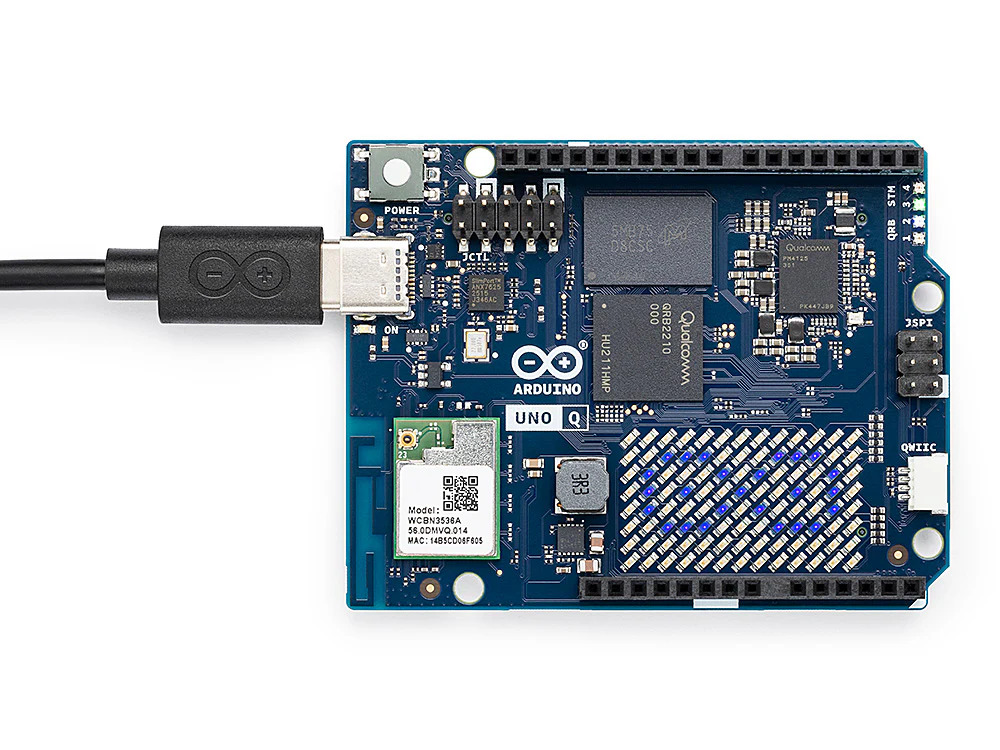
The Qualcomm QRB2210, based on the ARM Cortex®-A53 architecture (4× 2.0 GHz), is supported by the Adreno™ graphics unit and AI accelerator, enabling the execution of complex computational and multimedia tasks. The STM32U585 microcontroller, based on the Cortex®-M33 core, operates under Zephyr OS and provides deterministic control of hardware peripherals. Both systems communicate through a dedicated IPC interface, enabling real-time data exchange.
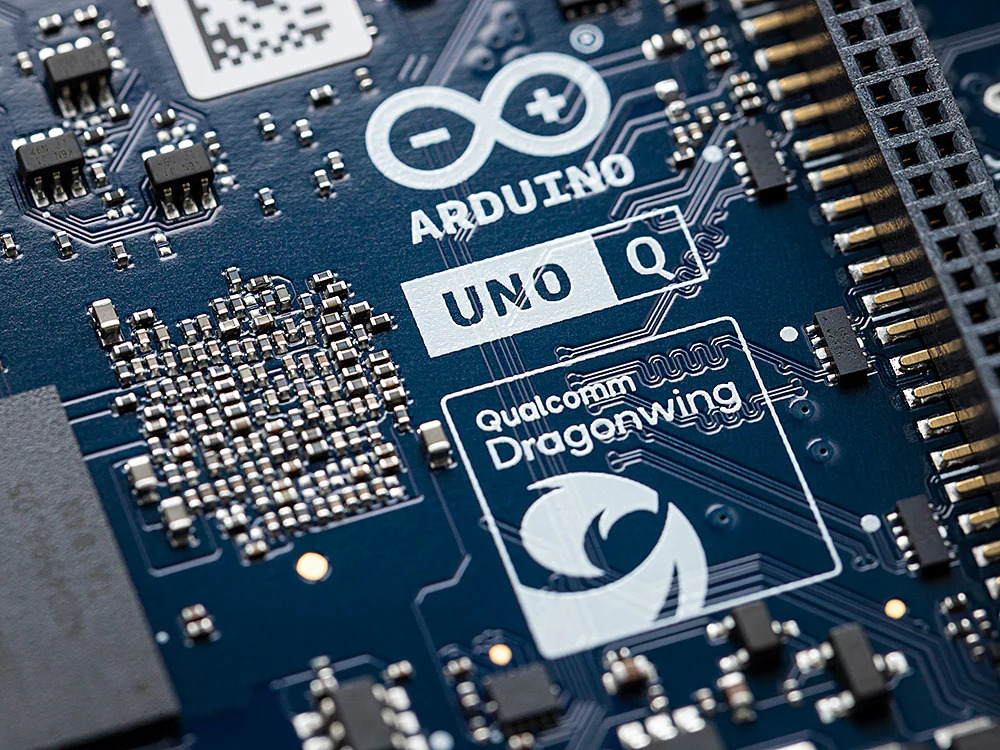
The board features 2 GB of LPDDR4 RAM and 16 GB of eMMC memory, as well as communication interfaces including I²C/I3C, SPI, UART, CAN, GPIO, ADC, and PWM. It also offers a MIPI DSI connector for display connection, an audio output, and a microphone input. Wireless communication modules Wi-Fi 5 and Bluetooth 5.1 ensure connectivity in modern network applications.
The integrated Arduino App Lab environment allows the creation of applications using Arduino sketches, Python scripts, and AI models running in Docker containers. The Debian system with preinstalled App Lab enables work to begin without additional configuration. The board supports the Arduino UNO shield format and includes a Qwiic connector, making system expansion with additional modules possible without soldering.
Additional components, such as an 8×13 LED matrix, four RGB LEDs, a user button, and a USB-C port with video output and host/device functionality, allow for prototyping user interfaces and displaying data directly on a screen. The UNO Q is used in systems integrating classic microcontroller control with data processing under Linux, including edge devices, autonomous mobile platforms, interactive multimedia devices, and embedded systems with AI capabilities.
Compatibility with Arduino UNO projects
UNO Q maintains the physical Arduino UNO form factor and 5 V logic compatibility, allowing the use of existing shields and projects without hardware modification. Support for the classic Arduino IDE, Arduino CLI, and App Lab environment ensures full programming compatibility.
Performance and computing power
The quad-core Cortex-A53 processor running at 2.0 GHz provides the performance required for tasks such as image analysis, sound recognition, local AI model processing, and handling complex user interfaces. The STM32U585 microcontroller acts as a low-level controller, managing precise real-time operations.
Integrated containerization and multilingual application support
Docker and Docker Compose support allows running applications in isolated environments, simplifying testing and deployment of multi-component systems. App Lab integrates Arduino sketches, Python code, and AI models, streamlining the development of hybrid applications.
Expandability and solderless prototyping
The Qwiic connector enables quick connection of ready-made extension modules from SparkFun, Adafruit, or Pimoroni without soldering. The UNO form factor and interfaces I2C, SPI, UART, CAN, GPIO, and ADC allow integration with a wide range of sensors, actuators, and peripheral devices.
Modern communication and multimedia interfaces
The USB-C port allows data transfer, power supply, and video output, making it possible to create interactive user interfaces using external displays. Audio interfaces are also available — microphone input, line-out, and headphone output.
| UNO Q | UNO Rev4 MINIMA | UNO Rev4 WiFi | |
|---|---|---|---|
| Microcontroller | STM32U585 (Cortex-M33) + Qualcomm QRB2210 (Cortex-A53) | RA4M1 | RA4M1 + ESP32-S3-MINI |
| Clock speed | 160 MHz (MCU), 2.0 GHz (MPU) | 48 MHz | 48 MHz |
| Flash memory | 16 GB eMMC | 256 kB | 256 kB |
| SRAM | 2 GB LPDDR4 | 32 kB | 32 kB |
| EEPROM | None | 8 kB | 8 kB |
| Logic level | 3.3 V / 5 V | 5 V | 5 V |
| Digital I/O pins | 14 | 14 | 14 |
| PWM | 6 | 6 | 6 |
| Analog inputs (ADC) | 6 (14bit) | 6 (14bit) | 6 (14bit) |
| SPI/I2C/CAN | 1/2/1 | 1/1/1 | 1/1/1 |
|
Wireless connectivity |
Wi-Fi 5, Bluetooth 5.1 | None | WiFi / Bluetooth LE |
| HID support | Yes (via USB-C) |
Yes |
Yes |
| SWD / JTAG interface | Yes | Yes | None |
| LED matrix | 8×13 red | None | 12 x 8 red |
| Qwiic connector | Yes | None | Yes |
| Programming interface | USB-C | USB type C | USB type C |
|
Power supply voltage |
USB-C 5 VDC or VIN 5 VDC | 6 - 24 V | 6 - 24 V |
Data sheet
Manufacturer BTC Korporacja sp. z o. o. Lwowska 5 05-120 Legionowo Poland sprzedaz@kamami.pl 22 767 36 20
Module with dual-core STM32H747XI microcontroller with CortexM7+M4 core equipped with 2 MB flash memory, 1 kB RAM and clock speeds up to 480 MHz. The board has a built-in WiFi module and Bluetooth 5.1 (Murata 1DX). Arduino ABX00042
Arduino development board with RP2040 microcontroller. Equipped with WiFi and Bluetooth module, 6-axis IMU system with accelerometer and gyroscope, MEMS microphone, RGB LED diode and cryptographic system. Arduino ABX00052
Arduino development board with RP2040 microcontroller. Equipped with WiFi and Bluetooth module, 6-axis IMU system with accelerometer and gyroscope, MEMS microphone, RGB LED diode and cryptographic system. Arduino ABX00053
Board with NXP® i.MX 8M Mini processor (Linux) and dual-core STM32H747XI CortexM7 + M4 microcontroller. Equipped with WiFi and Bluetooth 5.1 communication. Arduino ABX00049
No product available!
Module with 2MP camera and STM32H747AI Dual ARM® Cortex® M7/M4 microcontroller. Dedicated to IoT applications using Arduino IoT Cloud. Arduino ABX00051
Module with motion sensors, magnetometer, pressure and gas sensors. Equipped with nRF52832 microcontroller with Bluetooth communication, perfect for AI, IoT and Edge devices. Arduino ABX00050
No product available!
Module with dual-core STM32H747XI microcontroller with CortexM7+M4 core equipped with 2 MB flash memory, 1 kB RAM and clock speeds up to 480 MHz. The board has a built-in WiFi module and Bluetooth 5.1. Arduino ABX00046
No product available!
Module with a dual-core STM32H747XI CortexM7+M4 microcontroller with a clock speed of up to 480 MHz. Equipped with Ethernet communication. Arduino ABX00045
Development board with 32-bit ATSAMD21G18 microcontroller with ARM Cortex-M0 + core. Equipped with numerous peripheral systems, including UART, SPI, TWI (I2C) communication, analog inputs and outputs, and PWM outputs. Arduino ABX00003
NINA B306 BLE module board based on the nRF52840 microcontroller with CortexM4F core (64 MHz, 1 MB Flash, 256 kB RAM). Equipped with sensors - 9-axis IMU, temperature, pressure, humidity, light, colour, gesture and microphone. Arduino ABX00070
No product available!
NINA B306 BLE module board based on the nRF52840 microcontroller with CortexM4F core (64 MHz, 1 MB Flash, 256 kB RAM). Equipped with sensors - 9-axis IMU, temperature, pressure, humidity, light, colour, gesture and microphone. Arduino ABX00069
No product available!
A compact module that allows speech recognition to be easily implemented. Integrates a Syntiant NDP120 processor dedicated to running artificial intelligence algorithms. Arduino ABX00061
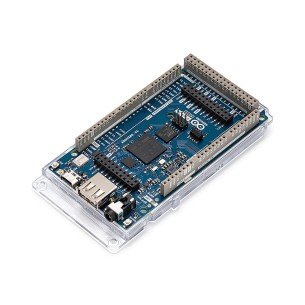
Arduino development board designed for demanding users. It uses a dual-core STM32H747XI microcontroller, a Murata 1DX Wi-Fi and Bluetooth module and an ATECC608A chip to provide cryptography. It looks similar to the Arduino Mega and Arduino Due, but offers significantly more resources and interfaces. Arduino ABX00063
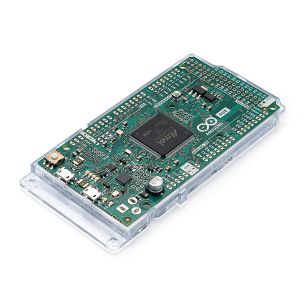
Arduino DUE is a board with an Atmel SAM3X8E microcontroller (ARM, Cortex-M3 core) clocked at 84 MHz. The user has 54 I/O lines (including 12 PWM channels), 12 analog inputs, 2 digital-to-analog converters. Version without soldered connectors. Arduino A000056
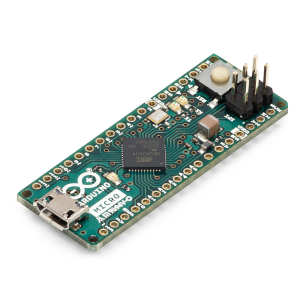
Arduino Micro is a module with an ATmega32U4 microcontroller from the AVR family and a 16 MHz crystal, the connectors include: 20 I/O lines, 7 PWM channels, 12 analog inputs. The module is powered by a voltage of 6 to 20 V. Version without soldered connectors. Arduino A000053
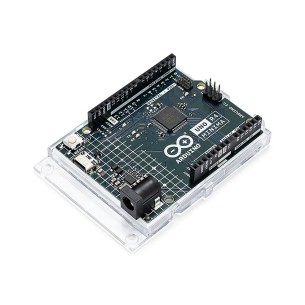
Discover the latest revision of Arduino Uno - the most popular development kit in the world. The Arduino Uno in its newest iteration impresses with a three-fold increase in clock speed, eight-fold larger flash capacity, and a sixteen-fold increase in SRAM capacity. But that\'s just the beginning, as Arduino Uno also offers a wide range of additional peripherals, powered by a 32-bit Renessas RA4M1 microcontroller with an ARM M4 core. With the new Arduino Uno, you don\'t have to worry about compatibility, as the board is compatible with all shields from previous revisions. Thanks to the elaborate security systems and compatibility with existing guides and projects, Arduino Uno becomes the ideal solution for both beginners and advanced electronics enthusiasts. Arduino ABX00080
The Arduino UNO Q (ABX00162) board integrates the Qualcomm QRB2210 microprocessor with the STM32U585 microcontroller, offering an advanced platform for designing AI, IoT, and robotics systems. Support for Docker containers, the integrated App Lab environment, and a rich set of interfaces make the board suitable for applications requiring cooperation between Linux and real-time systems.