.png)



zł41.39 tax excl.
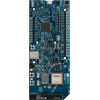
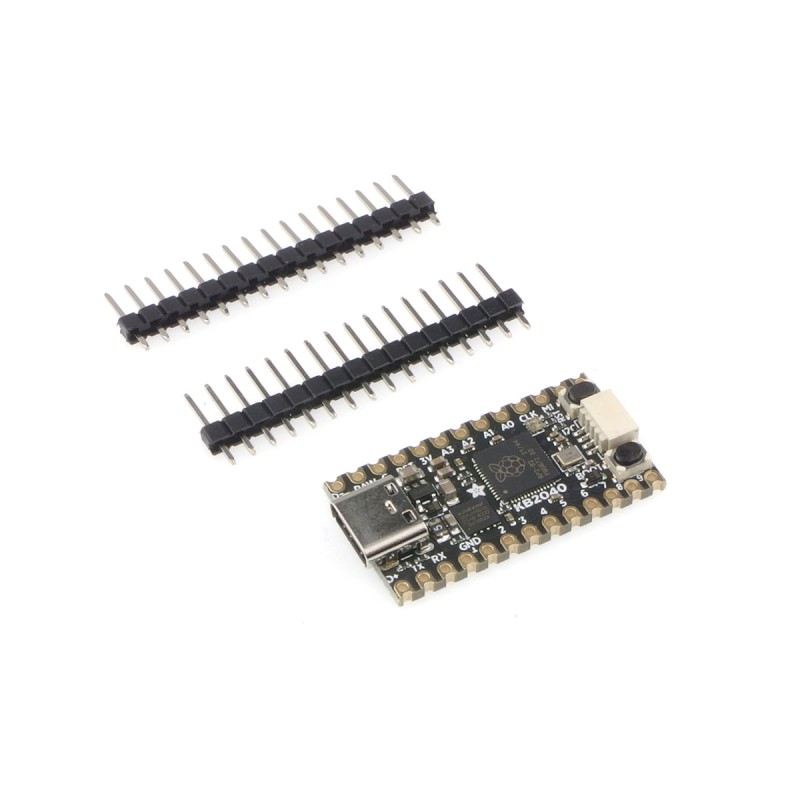
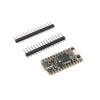
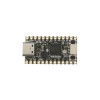
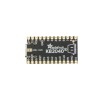
The board with the RP2040 microcontroller equipped with two ARM Cortex-M0 + 133 MHz cores, 264 kB RAM. The board also has 8 MB of QSPI flash memory. The circuit can be programmed in C/C++, CircuitPython or MicroPython. Adafruit 5302
Adafruit KB2040 is a board equipped with the RP2040 microcontroller designed by the Raspberry Pi foundation. The system has two ARM Cortex M0 + cores operating at a frequency of 133 MHz, 264 KB of RAM and 30 GPIO ports. The microcontroller is not equipped with flash memory, but on the board there is an external memory with a capacity of 8 MB connected via the QSPI interface.
On the board, in addition to the RP2040 system and Flash memory, the user will find a 3.3 V voltage stabilizer, Boot and Reset buttons, RGB NeoPixel diode, USB type C connector for powering and programming the module, and 20 GPIO outputs, on which such peripherals as four 12-bit ADC inputs, PWM outputs, two interfaces I2C, SPI and UART. The board is equipped with a STEMMA QT connector and two pads (D+, D-) of the USB interface.
Adafruit KB2040 has outputs compatible with Arduino Pro Micro. The platform supports the popular programming languages MicroPython, CircuitPython and C/C++. Programs can be loaded to the memory via the USB interface using the built-in bootloader.
Data sheet
Manufacturer
Responsible person
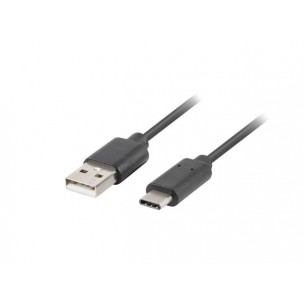
Cable with USB typ A and USB typ C connectors, cable length 0.5 m. LANBERG
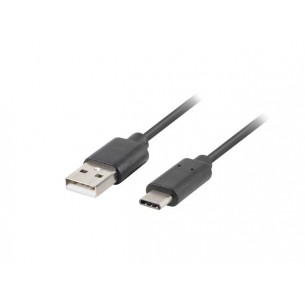
Cable with USB typ A and USB typ C connectors, cable length 1 m. LANBERG CA-USBO-10CC-0010-BK
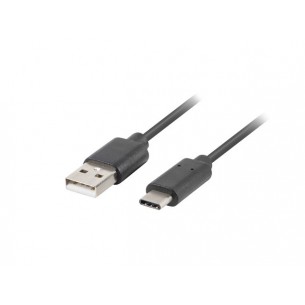
Cable with USB typ A and USB typ C connectors, cable length 1,8 m. LANBERG CA-USBO-10CC-0018-BK
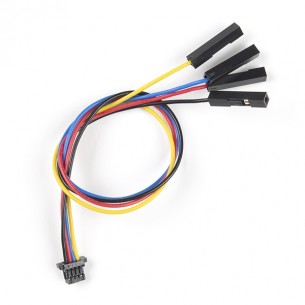
Flexible Qwiic cable, 150 mm long. On one side it is terminated with a female Qwiic connector, and on the other side with single female goldpin connectors. SparkFun PRT-17261
No product available!
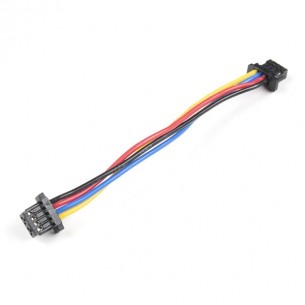
Flexible 4-core cable, 50 mm long, terminated on both sides with a Qwiic plug. Sparkfun PRT-17260
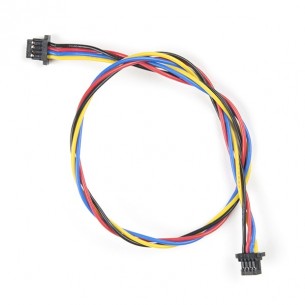
Flexible 4-core cable, 200 mm long, terminated on both sides with a Qwiic plug. Sparkfun PRT-17258
No product available!
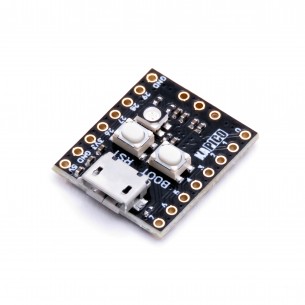
The board with the RP2040 microcontroller equipped with two ARM Cortex-M0 + cores operating at a frequency of 133 MHz, 264 kB RAM. There is as much as 16 MB of QSPI flash memory on the board. The system can be programmed in C / C ++ or microPython. KApico RP2040
No product available!
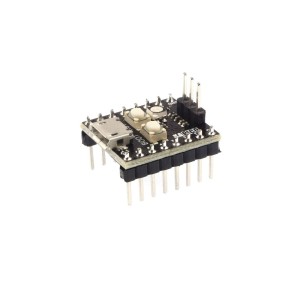
The board with the RP2040 microcontroller equipped with two ARM Cortex-M0 + cores operating at a frequency of 133 MHz, 264 kB RAM. There is as much as 16 MB of QSPI flash memory on the board. The system can be programmed in C / C ++ or microPython. Soldered connectors. KApico RP2040
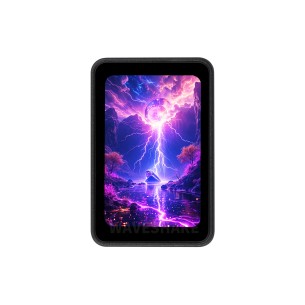
RP2350-Touch-AMOLED-1.8 with battery is an advanced development board with an AMOLED display, touch support, motion sensors, audio, and a wide range of interfaces. Designed for mobile and embedded applications, it enables the creation of compact interactive devices with full open-source support.
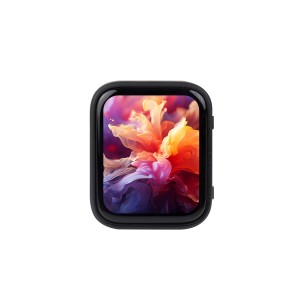
RP2350-Touch-AMOLED-1.64-M is a compact board featuring the RP2350 microcontroller and an AMOLED display, equipped with touch input, motion sensors, and a full set of peripheral interfaces. Designed for modern mobile applications, HMI systems, and experiments with RISC-V and ARM architectures.
A module based on the RP2040 microcontroller that lets you build your own two-player arcade controller, supporting up to 30 buttons and two joysticks. When connected via USB-C, it is automatically detected as a standard game controller on PC, Mac and Linux. With DuPont, Qw/ST connectors and support for backlit Plasma buttons, assembly and expansion are quick and solderless. Pimoroni PIM741
No product available!
A compact, wireless light and sound effects controller based on the RP2040 microcontroller with a Raspberry Pi RM2 Wi-Fi and Bluetooth module. It allows you to control mono and RGB LEDs, create lighting animations, and play sound effects thanks to the built-in I2S audio amplifier. It supports sensors and modules via Qw/ST and JST-SH connectors, and effects can be triggered by motion, sound, or remotely over a network. The plug-and-play kit includes a full set of accessories (LED, speaker, PIR sensor, and power supply). Pimoroni PIM753
A compact, wireless light and sound effects controller based on the RP2040 microcontroller with a Raspberry Pi RM2 Wi-Fi and Bluetooth module. It allows you to control mono and RGB LEDs, create lighting animations, and play sound effects thanks to the built-in I2S audio amplifier. It supports sensors and modules via Qw/ST and JST-SH connectors, and effects can be triggered by motion, sound, or remotely over the network. Pimoroni PIM728
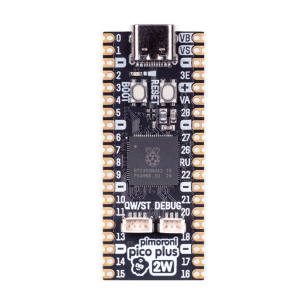
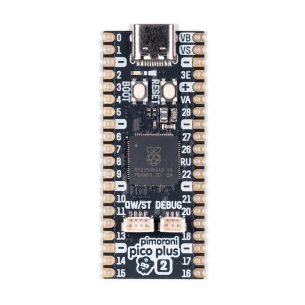
An advanced development board based on the modern RP2350 microcontroller, designed for demanding embedded projects, IoT, and prototyping. It maintains full compatibility with the Raspberry Pi Pico form factor while offering significantly higher performance thanks to a dual-core Arm Cortex-M33 processor and ample Flash and PSRAM. The built-in Raspberry Pi RM2 module provides 2.4 GHz Wi-Fi and Bluetooth connectivity, enabling easy integration with networks and cloud services. A USB-C connector, a Qw/ST interface for I²C modules, RESET and BOOT buttons, and a user LED make the Pico Plus 2W a convenient and versatile tool. Pimoroni PIM726
No product available!
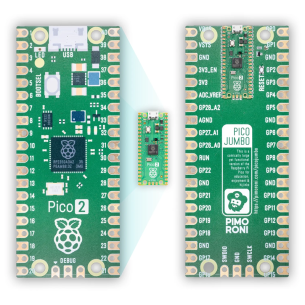
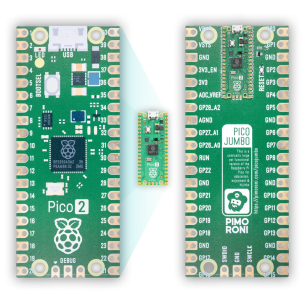
A scaled-up, fully functional version of the Raspberry Pi Pico 2, designed for learning, demonstrations, and educational workshops. The board is based on the modern RP2350 microcontroller with two Arm Cortex-M33 or RISC-V Hazard3 cores clocked at up to 150 MHz, 520 KB of SRAM, and 4 MB of Flash memory. Large pads and holes allow for solderless connection using alligator clips. The kit includes a full set of large components, making it ideal for STEM education. Pimoroni PIM748
No product available!
A scaled-up, fully functional version of the Raspberry Pi Pico 2, designed for learning, demonstrations, and educational workshops. The board is based on the modern RP2350 microcontroller with two Arm Cortex-M33 or RISC-V Hazard3 cores clocked at up to 150 MHz, 520 KB of SRAM, and 4 MB of Flash memory. Large pads and holes allow for solderless connection of components using alligator clips. Pimoroni PIM747
No product available!
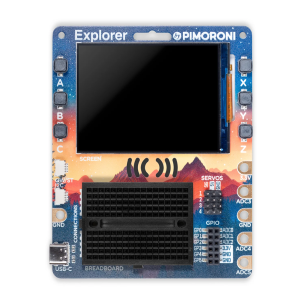
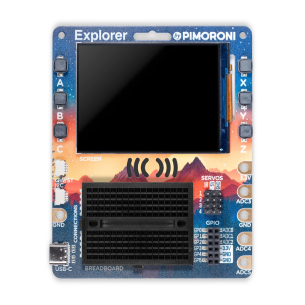
An educational platform based on the modern RP2350 microcontroller with two Arm Cortex-M33 cores up to 150 MHz, 520 KB of SRAM, and 16 MB of Flash memory. It features a 2.8" color IPS display with a resolution of 320 × 240 px, six user buttons, a piezo speaker, and a mini breadboard for solderless prototyping. Numerous GPIO pins, ADCs, servo connectors, alligator clips, and two Qw/ST ports enable quick connection of sensors and actuators. Pimoroni PIM744
No product available!
An educational platform based on the modern RP2350 microcontroller with two Arm Cortex-M33 cores up to 150 MHz, 520 KB of SRAM, and 16 MB of Flash memory. It features a 2.8" color IPS display with a resolution of 320 × 240 pixels, six user buttons, a piezo speaker, and a mini breadboard for solderless prototyping. Numerous GPIO, ADC, servo connectors, alligator clips, and two Qw/ST ports enable quick connection of sensors and actuators. Pimoroni PIM720
No product available!
This Raspberry Pi Pico development board is based on the RP2350B microcontroller with dual Arm Cortex-M33 cores running at up to 150 MHz. It offers 520 KB of SRAM, 16 MB of Flash, and 8 MB of PSRAM, making it ideal for memory-intensive projects. It features a USB-C connector, a Qw/ST port for I2C sensors, an SP/CE connector, an SWD debug interface, and reset and boot buttons. Pimoroni PIM724
No product available!
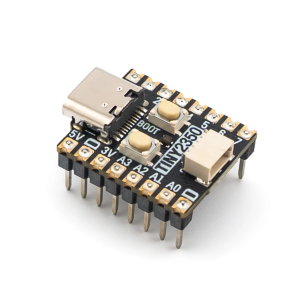
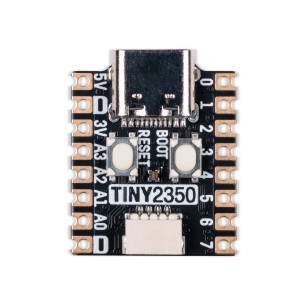
Pimoroni Tiny 2350 PIM766 in the Headered version is a compact development board with the RP2350A, 4 MB of flash memory and a USB-C connector, created for miniature projects. Thanks to the integrated pins, support for MicroPython and the Qw/ST port, it works well in prototyping portable devices and wearables.
Pimoroni Tiny 2350 PIM766 is a compact board with an RP2350A microcontroller, 4 MB of flash memory and a USB-C connector, dedicated to projects requiring small dimensions. Thanks to the castellated pads it works well for PCB integration, and compatibility with MicroPython and the Qw/ST connector facilitates quick prototyping.
No product available!
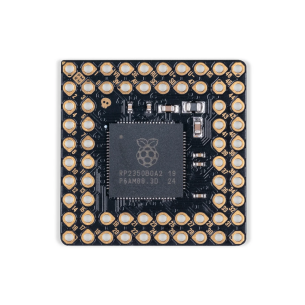
A compact development board based on the RP2350B microcontroller with dual Arm Cortex-M33 cores running at up to 150 MHz, designed for projects requiring a high pin count in a minimal footprint. It offers 520 KB of SRAM, 16 MB of Flash, and 8 MB of PSRAM, as well as 48 GPIO lines, including 8 ADC inputs, arranged in a 2.54 mm pin grid array. The lack of onboard USB, LEDs, or buttons limits the board\'s size to 25.4 x 25.4 mm, giving you complete freedom in designing your own electronics. Pimoroni PIM722
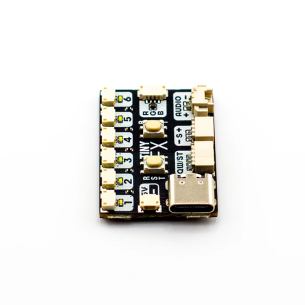
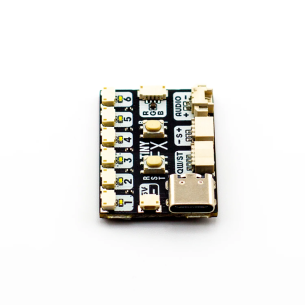
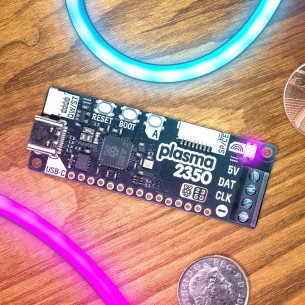
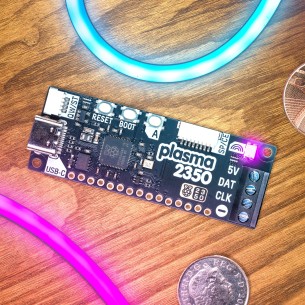
Addressable LED strip controller based on the RP2350A microcontroller with dual Arm Cortex-M33 cores up to 150 MHz. It supports popular WS2812/Neopixel and APA102/Dotstar LEDs and allows for powering and programming via USB-C with current up to 3A. It features screw-type LED connectors, a built-in RGB LED, user-friendly buttons, and a Qw/ST connector for connecting I2C sensors. The kit includes a Star Wire LED strip and a USB-C cable. Pimoroni PIM743
No product available!
Addressable LED strip controller based on the RP2350A microcontroller with dual Arm Cortex-M33 cores up to 150 MHz. It supports popular WS2812/Neopixel and APA102/Dotstar LEDs and allows for powering and programming via USB-C with current up to 3 A. It features screw-type LED connectors, a built-in RGB LED, user buttons, and a Qw/ST connector for connecting I2C sensors. Pimoroni PIM723
The board with the RP2040 microcontroller equipped with two ARM Cortex-M0 + 133 MHz cores, 264 kB RAM. The board also has 8 MB of QSPI flash memory. The circuit can be programmed in C/C++, CircuitPython or MicroPython. Adafruit 5302