







.png)













zł17.28 tax excl.
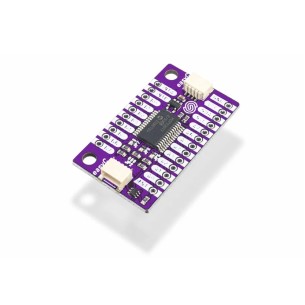
A 4-channel I2C expander module, which is based on the TCA9546A chip. It allows connecting several devices with the same address to a single I2C interface. Adafruit 5663
A 4-channel I2C expander module that is based on the TCA9546A chip. The I2C interface is a popular serial interface used in electronics, allowing communication between several devices via two lines: SDA (data) and SCL (clock). An I2C multiplexer allows us to connect several devices with the same address to a single I2C interface and select the device we want to communicate with at any given time. This allows us to achieve I2C line savings. The module has configuration jumpers that allow us to change the expander's default I2C address, giving us the ability to use up to 8 modules simultaneously. It can be powered by up to 2.3 to 5 volts. I2C multiplexers are often used in electronic projects requiring the connection of several devices to a single microcontroller. Full documentation and examples of use are available on the product page.
Kit contains
Manufacturer
Responsible person
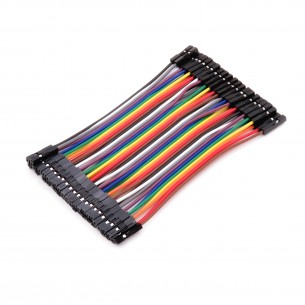
A set of 40 pieces of female-female connecting cables in various colors, 10 cm long
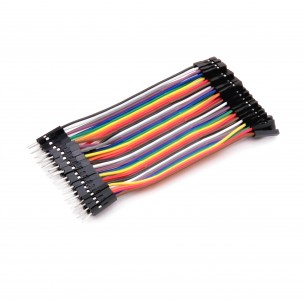
A set of 40 pcs of male-female connecting cables in various colors, 10 cm long
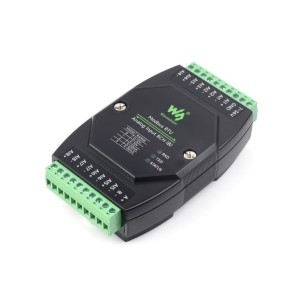
8-channel module with voltage analog inputs ranging from 0 to 10 V. After reconfiguration, it enables measurement of voltage in the range from 2 to 10 V or current in the range from 0 to 20 mA or 4 to 20 mA. It communicates via the RS485 interface and supports the Modbus RTU protocol. The board is enclosed in a housing that can be mounted on an industrial rail. Waveshare Modbus RTU Analog Input 8CH (B)
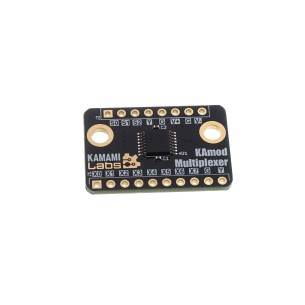
KAmod Multiplexer features the CD4051 chip, which is an analog 8-channel multiplexer/demultiplexer. The chip can handle analog signals with an amplitude of up to 20 VPP and provides low on-state resistance. The active channel is selected through a sequence of states on three digital inputs
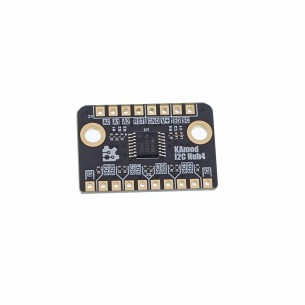
KAmod I2C Hub4 enables splitting the I2C bus into four independent outputs with a voltage level translation function, eliminating address conflicts and increasing connection flexibility. The module is intended for projects with multiple I2C devices requiring separation or diverse supply voltages.
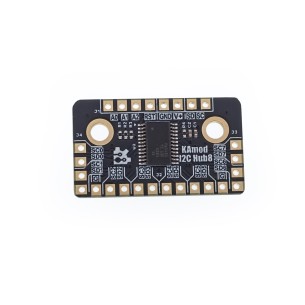
KAmod I2C Hub8 enables splitting the I2C bus into eight independent channels with a voltage translation function, which allows effective integration of multiple devices with repeating addresses. The module is recommended for advanced microprocessor projects with bus separation requirements and diverse voltage levels.
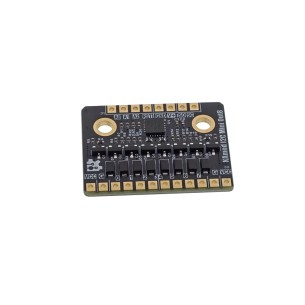
KAmod I2C-Mini Out8 enables easy expansion of microprocessor systems with eight switching outputs for voltages and currents typical of low-voltage load control. Compatibility with the I2C bus and the ability to connect up to 8 modules in a single network make it an ideal solution for automation systems, lighting and power control, and other applications requiring flexible control of multiple circuits.
The KAmod I2C-IOexp16 module is an extension equipped with 16 programmable digital lines (inputs or outputs), based on the MCP23017 system and controlled via the I2C bus with the possibility of connecting up to 8 modules thanks to addressing. The module works with a voltage from 2 to 5 V, has an interrupt output and allows for a current flow of up to 20 mA on each line
Compact module that allows easy changing of I2C sensor addresses, allowing coexistence of multiple devices with the same address on one bus. With DIP switches and optional soldering resistors, users can easily configure sensor addresses without having to modify the code or use external components. DFRobot DFR1185
I2C bus splitter enabling connection of multiple peripheral modules to a single I2C interface, equipped with Qwire connectors compatible with Qwiic and STEMMA QT, a KAmod I2C connector, and goldpin headers. Kamami KAmod I2C Hub Qwire
8-channel analog acquisition module with default current measurement mode (0–20 mA), designed for industrial applications requiring stable and precise data acquisition. Compatible with current sensors, it supports RS485 communication and the Modbus RTU standard, allowing easy integration with SCADA systems and PLC controllers. Galvanic isolation and noise immunity make it suitable for environments with high EMC requirements. Ideal for industrial process monitoring, environmental parameter measurement, and building automation.
No product available!
8-channel solenoid driver controlled via I2C. Compatible with 3V/5V logic, features STEMMA QT / Qwiic connectors. Adafruit 6318
DFRobot DFR1193 module with the LTC4316 chip enables the simultaneous use of multiple identical I2C sensors without address conflicts. It supports quick configuration via DIP switches or resistors, offering a flexible and reliable solution for IoT, robotics, and automation projects.
Crowtail – I2C Hub 2.0 expands the I2C bus with three additional ports, enabling the simultaneous connection of multiple devices in the Crowtail system. Useful in projects with a larger number of I2C modules.
GPIO expander based on the MCP23017 IC, adding 16 configurable digital input/output lines to a microcontroller via I2C. Each line can operate as an input, output, or input with an internal pull-up resistor, while INT A and INT B provide interrupt outputs. The board features two Qwiic connectors and measures 38 × 22mm. Soldered 333007
No product available!
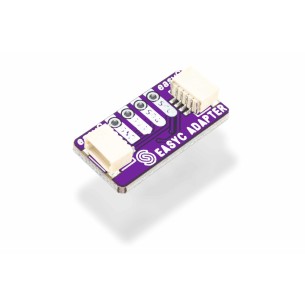
Adapter designed for connecting conventional I2C modules to the Qwiic bus. It provides 2 Qwiic connectors and through-hole connections for SCL, SDA, 3.3 V, and GND, allowing modules without a native Qwiic connector to be integrated into a Qwiic system. Soldered 333015
No product available!
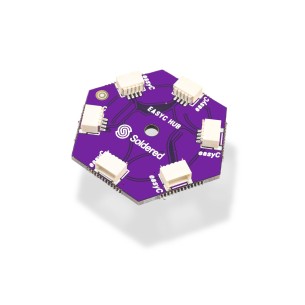
Compact hub designed to expand a Qwiic/I2C bus with additional connection points. It provides six Qwiic connectors, operates at 3.3 V, and helps organize connections between sensors and modules using the Qwiic ecosystem. Soldered 333018
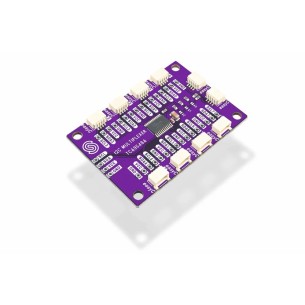
8-channel I2C bus multiplexer based on the TCA9548A, allowing devices with identical I2C addresses to operate with one microcontroller. The multiplexer address can be configured from 0x70 to 0x77 using A0–A2 jumpers, while 10 Qwiic connectors simplify solderless connections. Operating voltage range is 1.65–5.5V. Soldered 333077
A 4-channel I2C expander module, which is based on the TCA9546A chip. It allows connecting several devices with the same address to a single I2C interface. Adafruit 5663