.png)





- Out-of-Stock

Pololu 9V Step-Up Voltage Regulator U3V12F9
Pololu 9V Step-Up Voltage Regulator U3V12F9
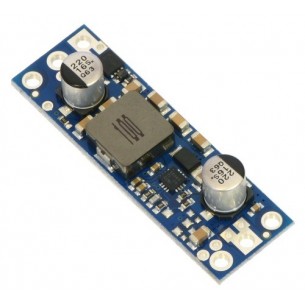
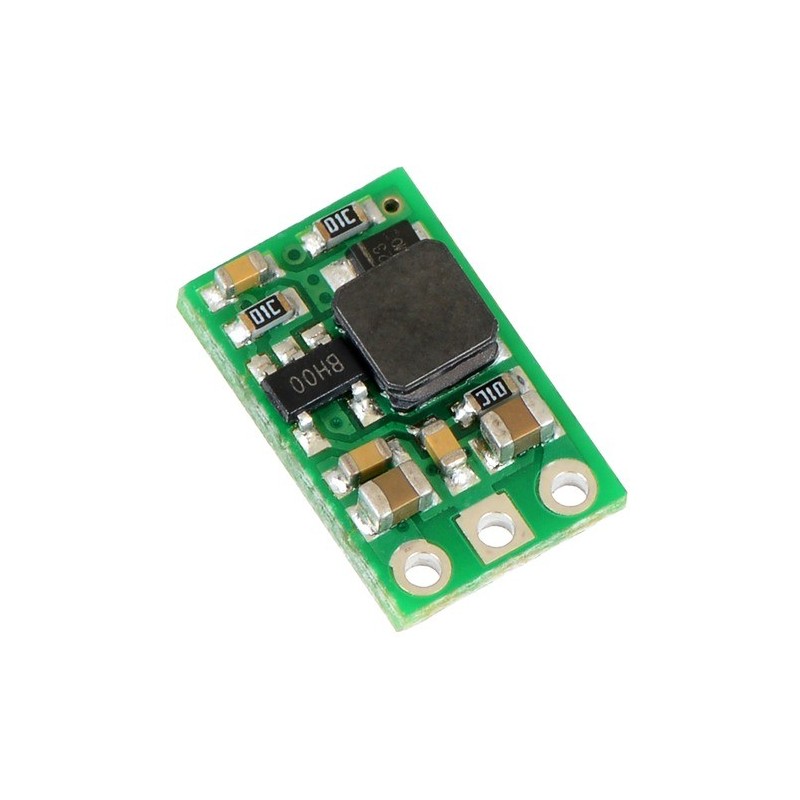
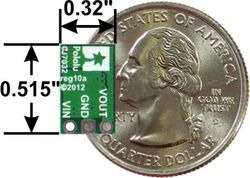
The compact (0.32"×0.515") U3V12F9 switching step-up (or boost) voltage regulator takes an input voltage as low as 2.5 V and efficiently boosts it to 9 V. The pins have a 0.1" spacing, making this board compatible with standard solderless breadboards and perfboards.
 |
These boost (step-up) voltage regulators generate higher output voltages from input voltages as low as 2.5 V. They are switching regulators (also called switched-mode power supplies (SMPS) or DC-to-DC converters) and have a typical efficiency between 80% to 90%. The available output current is a function of the input voltage, output voltage, and efficiency (see Typical Efficiency and Output Current section below), but the input current can typically be as high as 1.4 A. This regulator is available with a fixed 5 V, 9 V, or 12 V output:
The regulator’s thermal shutdown prevents damage from overheating, but it does not have short-circuit or reverse-voltage protection.
 |
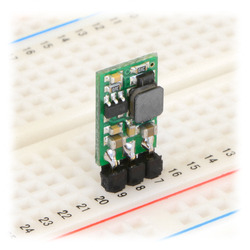 |
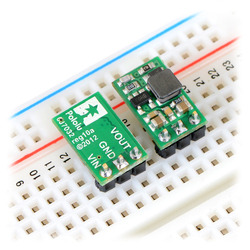
The boost regulator has three connections: input voltage (VIN), ground (GND), and output voltage (VOUT).
The input voltage, VIN, must be at least 2.5 V and should not exceed the output voltage, VOUT. Please be wary of destructive LC spikes that might cause the input voltage to exceed VOUT (see below for more information).
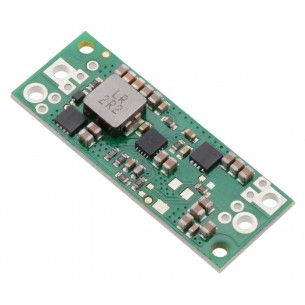
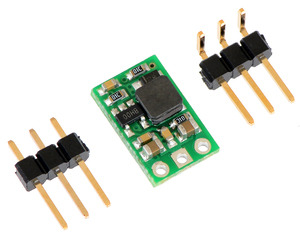
The three connections are labeled on the back side of the PCB, and they are arranged with a 0.1" spacing along the edge of the board for compatibility with solderless breadboards, connectors, and other prototyping arrangements that use a 0.1" grid. You can solder wires directly to the board or solder in either the 3×1 straight male header strip or the 3×1 right-angle male header strip that is included.
 |
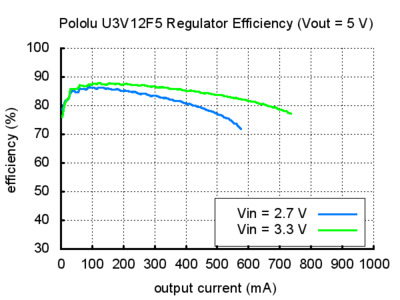
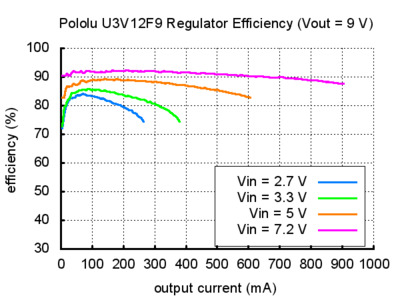
The efficiency of a voltage regulator, defined as (Power out)/(Power in), is an important measure of its performance, especially when battery life or heat are concerns. As shown in the graphs below, this switching regulator typically has an efficiency of 80 to 90%.
 |
 |
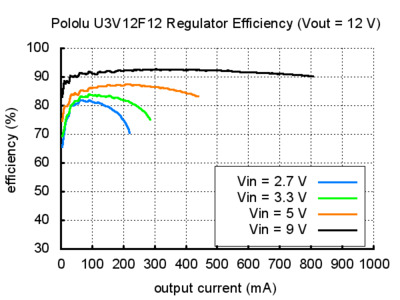 |
The maximum achievable output current is approximately proportional to the ratio of the input voltage to the output voltage. If the input current exceeds the switch current limit (typically somewhere between 1.4 and 2 A), the output voltage will begin to drop. Additionally, the maximum output current can depend on other factors, including the ambient temperature, air flow, and heat sinking.
When connecting voltage to electronic circuits, the initial rush of current can cause damaging voltage spikes that are much higher than the input voltage. In our tests with typical power leads (~30" test clips), input voltages above 10 V caused voltage spikes in excess of 20 V. You can suppress such spikes by soldering a 33µF or larger electrolytic capacitor close to the regulator between VIN and GND.
More information about LC spikes can be found in our application note, Understanding Destructive LC Voltage Spikes.
 |
Pololu 12V Step-Up Voltage Regulator U3V12F12 |
|
Pololu 5V Step-Up Voltage Regulator U3V12F5 |
 |
Pololu 5V Step-Up/Step-Down Voltage Regulator S7V7F5 |
Data sheet
Manufacturer
Responsible person
Pololu 9V Step-Up Voltage Regulator U3V50F9
DC-DC Step-up converter module based on the U3V70F9 system. Input voltage 2.9-9V, output voltage 9V, maximum current 10A. Two mounting holes. Polol 2894
Switch (relay) controlled via Wi-FI, equipped with a socket to connect a temperature or humidity sensor. The device works with the eWeLnik (cloud) application, available for devices with iOS and Android. IM160712005
No product available!
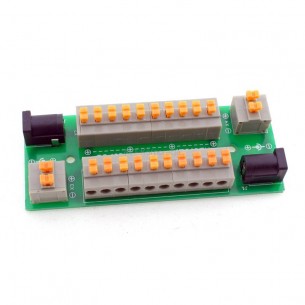
Printed circuit board for practical power splitter with quick clamps. AVT3175 A
No product available!
AVT kit for self-assembly of a practical power splitter with quick-release clamps. AVT3175 B
No product available!
Assembled practical power splitter with quick clamps. AVT3175 C
No product available!
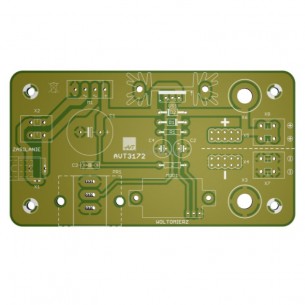
Printed circuit board for a practical workshop power supply. AVT3172 A
No product available!
AVT kit for self-assembly of a practical workshop power supply. AVT3172 B
No product available!
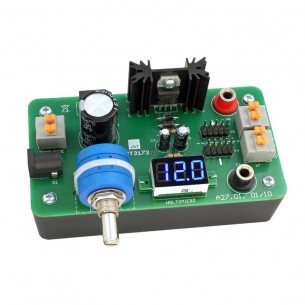
Assembled practical workshop power supply. AVT3172 C
No product available!
No product available!
Programmable BT4.0 module with UART 2x4 pin 2.54 mm UART connector
No product available!
No product available!
No product available!
No product available!
Orange Pi NAS expansion card makes it possible to transform an Orange Pi Zero into a file sharing server by plugging in an external SATA hard drive
No product available!
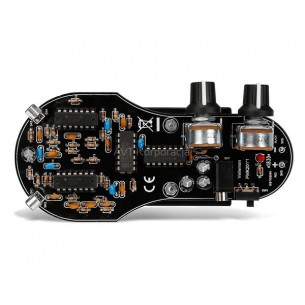
Velleman kit for self-assembly of an ultrasonic bats detector. K8118
No product available!
Printed circuit board and programmed circuit for a remote radio switch. AVT5590 A +
No product available!
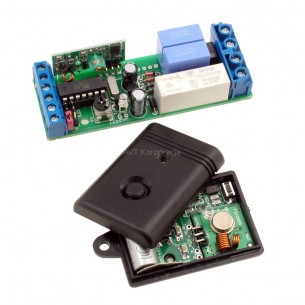
AVT kit for self-assembly remote radio switch. AVT5590 B
No product available!
Pololu 9V Step-Up Voltage Regulator U3V12F9