


zł17.36 tax excl.
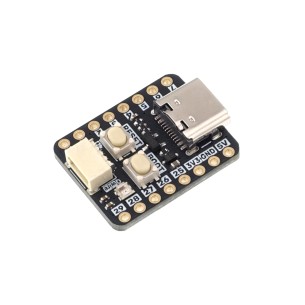
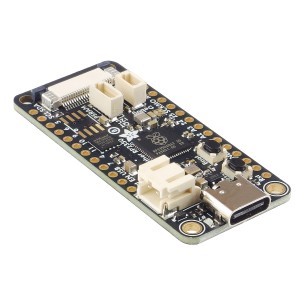
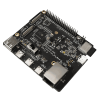
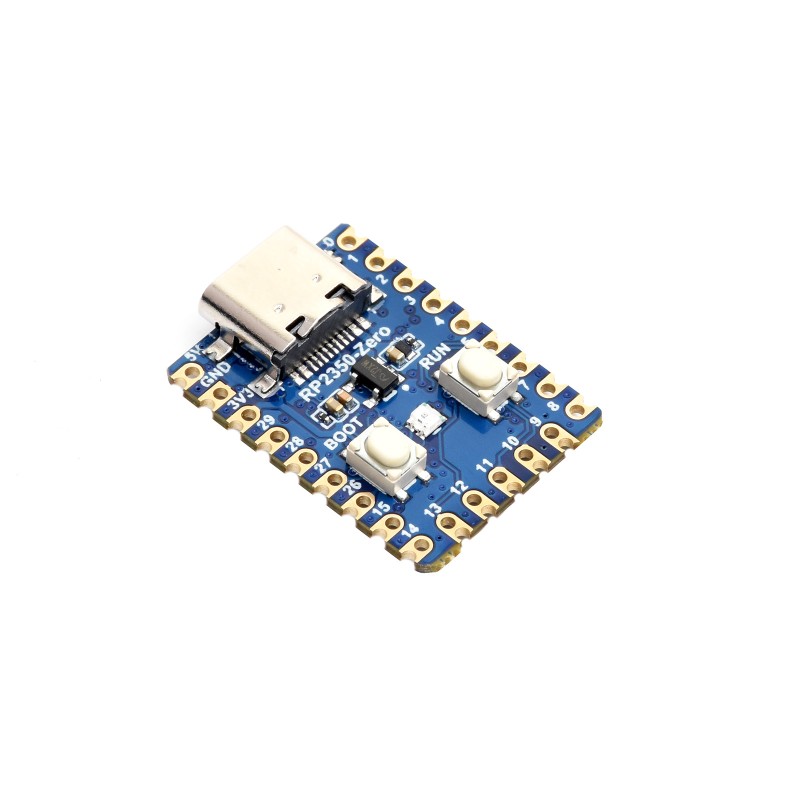
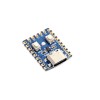
RP2350-Zero enables rapid development of embedded applications while maintaining minimal mounting requirements and excellent flexibility in baseboard design. Particularly recommended for portable devices, educational use, and as a control module in larger systems.
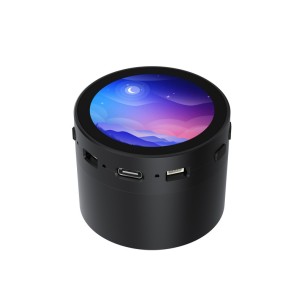
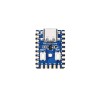
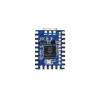
RP2350-Zero is a compact Pico-like development board based on the RP2350A microcontroller, featuring a unique dual-core, dual-architecture design (Arm Cortex-M33 and Hazard3 RISC-V). The module includes castellated edge connectors, allowing direct soldering onto carrier boards in SMD applications. It provides access to 29 multifunction GPIO lines (20 on the edge, the rest as solder pads) and supports a wide range of communication interfaces. Power and programming are handled via a USB Type-C port.
This board is dedicated to projects that require a compact form factor, high integration flexibility, and compatibility with the Raspberry Pi Pico 2 ecosystem. It supports C/C++ and MicroPython development environments.
Data sheet
Manufacturer BTC Korporacja sp. z o. o. Lwowska 5 05-120 Legionowo Poland sprzedaz@kamami.pl 22 767 36 20
Responsible person BTC Korporacja sp. z o. o. Lwowska 5 05-120 Legionowo Poland sprzedaz@kamami.pl 22 767 36 20
Miniature KAmod RP2040 module with Raspberry RP2040 microcontroller and 16 MB flash memory provides high computing performance in a compact format. Suitable for educational, hobbyist, and prototyping applications of devices with USB, I2C, SPI, and UART communication.
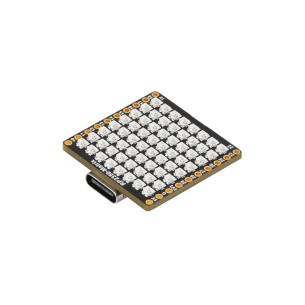
Development board based on the RP2350A microcontroller featuring a unique dual-core, dual-architecture design (Arm Cortex-M33 + Hazard3 RISC-V), an onboard 6-axis sensor, and an 8×8 RGB LED matrix for IoT, robotics, and interactive systems. Waveshare RP2350-Matrix
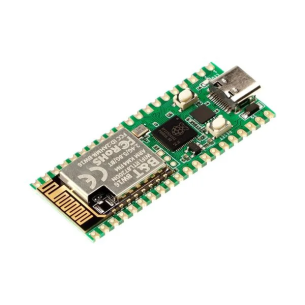
RP2350B-Plus-W is an advanced development board with an RP2350B microcontroller and wireless Wi-Fi/Bluetooth communication, enabling selection between ARM and RISC-V architectures. Intended for educational applications, IoT device prototyping, and projects requiring versatile communication and processing capabilities.
No product available!
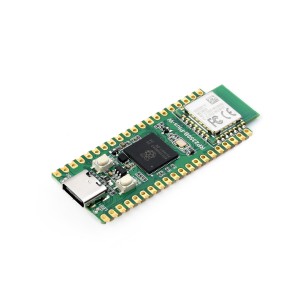
This development board is based on the Raspberry Pi RP2350 microcontroller with an Arm Cortex-M33 or RISC-V Hazard3 core. It offers 2.4/5 GHz Wi-Fi, Bluetooth 5.0, and 8 MB of Flash memory, delivering high performance in a compact form factor. With a USB-C port and full Pico W compatibility, it\'s ideal for IoT projects, home automation, and learning to program. Elecrow RP2350 Pico W5 Board
This modern development board features a dual-core Cortex-M33 microcontroller clocked at 150 MHz, 520 KB of RAM, and 8 MB of QSPI Flash. It features a rich set of interfaces, including I2C, SPI, UART, 24 PWM channels, and an HSTX port for high-speed differential data transfer. The board features a STEMMA QT connector, a built-in 200 mA+ LiPo charger, a USB-C port with a UF2 bootloader, and NeoPixel LEDs and a red LED for signaling. The Feather RP2350 is compatible with MicroPython, CircuitPython, Arduino, and C/C++. Adafruit 6000
Pimoroni Pico LiPo 2 PIM775 is an advanced development board with the RP2350B, 16 MB of flash memory and 8 MB of PSRAM, created with battery-powered projects in mind. Thanks to the Qw/ST, SP/CE and JST connectors and the built-in LiPo charging system, it enables quick prototyping of mobile devices and remote IoT systems.
Pimoroni Pico LiPo 2 XL W PIM776 is an extended development board with the RP2350B, offering Wi-Fi and Bluetooth connectivity, 16 MB of flash memory and 8 MB of PSRAM. Thanks to its 40 GPIO pins, integrated LiPo charging system and numerous interfaces, it works well in advanced IoT projects and battery-powered systems.
No product available!
A modular control platform based on the RP2040 microcontroller, designed for advanced robotics and engineering projects. It can simultaneously support up to six high-power modules, such as motor, servo, and LED lighting controllers. Power is supplied via an XT30 connector, ranging from 5 to 17 V, with built-in current and voltage protection. It supports MicroPython programming. Pimoroni PIM687
No product available!
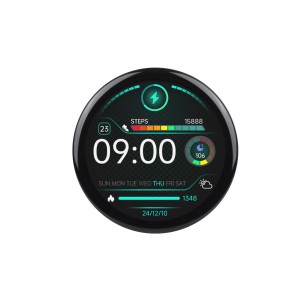
Development board based on the RP2350A microcontroller with a 1.85-inch round capacitive LCD touch display at 360 x 360 resolution and 65K colors, supporting ARM Cortex-M33 and RISC-V architectures, comes with a speaker box, designed for user interfaces and embedded systems. Waveshare RP2350-Touch-LCD-1.85C-BOX-EN
No product available!
Development board based on the RP2350A microcontroller with a 1.85-inch round capacitive LCD touch display at 360 x 360 resolution and 65K colors, supporting ARM Cortex-M33 and RISC-V architectures, supplied with a speaker enclosure and a 3.7 V lithium battery. Waveshare RP2350-Touch-LCD-1.85C-BOX
No product available!
Development board based on the RP2350A microcontroller with a 1.85-inch round capacitive LCD touch display at 360 x 360 resolution and 65K colors, supporting ARM Cortex-M33 and RISC-V architectures, designed for user interfaces and embedded systems. Waveshare RP2350-Touch-LCD-1.85C
No product available!
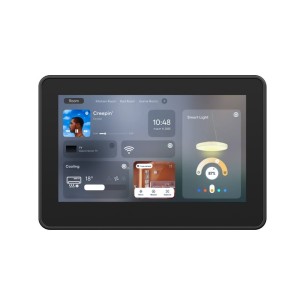
Development board based on the RP2350 microcontroller with a 4.3-inch capacitive touch display 800 x 480, dual-core and dual-architecture support, CAN, RS485 and I2C interfaces, and isolated digital inputs and outputs, designed for control systems and HMI interfaces. Waveshare RP2350-Touch-LCD-4.3B-BOX
No product available!
Development board featuring the RP2350 microcontroller and a 4.3-inch capacitive touch display with 800 × 480 resolution, dual-core and dual-architecture support, designed for HMI interfaces, control systems, and embedded applications. Waveshare RP2350-Touch-LCD-4.3B
No product available!
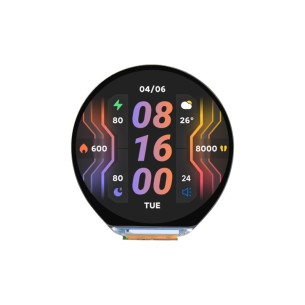
RP2350 development board with a round 1.46" capacitive IPS touch display 480x480, supporting multi-touch and equipped with IMU sensors, RTC, and a wide range of interfaces. RP2350-Touch-LCD-1.46B Waveshare 32868
No product available!
RP2350 development board featuring a 1.46″ round capacitive IPS touch display with 480×480 resolution, multi-touch support, integrated IMU and RTC sensors, rich peripheral interfaces, and protective cover glass. RP2350-Touch-LCD-1.46 Waveshare 32867
No product available!
Development board based on the RP2350 microcontroller, featuring a 2.1" round IPS display with a resolution of 480 x 480 px, a capacitive touch panel, and an extensive set of peripheral interfaces. Waveshare RP2350-Touch-LCD-2.1B
No product available!
RP2350-Zero enables rapid development of embedded applications while maintaining minimal mounting requirements and excellent flexibility in baseboard design. Particularly recommended for portable devices, educational use, and as a control module in larger systems.