







.png)













zł37.00 tax excl.
COM-13716
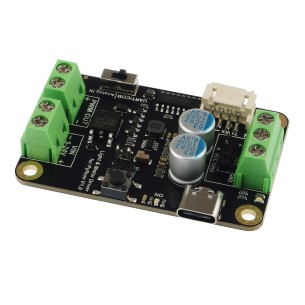
This is the FemtoBuck, a small-size single-output constant current LED driver. Each FemtoBuck has the capability to dim a single high-power channel of LEDs from 0-350mA at up to 36V while the dimming control can be either accessed via PWM or analog signal from 0-2.5V. This board is based off of the PicoBuck LED Driver, developed in collaboration with Ethan Zonca, except instead of blending three different LEDs on three different channels the FemtoBuck controls just one.
For the FemtoBuck, we’ve increased the voltage ratings on the parts to allow the input voltage to cover the full 36V range of the AL8805 driver. Since the FemtoBuck is a constant current driver, the current drawn from the supply will drop as supply voltage rises. In general, efficiency of the FemtoBuck is around 95%, depending on the input voltage. On board each FemtoBuck you will find two inputs for both power input and dimming control pins and an area to install a 3.5mm screw terminal. Finally at either side of the board you will find small indents or “ears” which will allow you to use a zip tie to secure the wires to the board after soldering them down. This version of the FemtoBuck is equipped with a small solder jumper that can be closed with a glob of solder to double the output current from 330mA to 660mA.
Manufacturer
Responsible person
I2C LED driver chip has the ability to PWM each individual LED in a 16x9 grid. Adafruit 2946
Assembled programmed LED driver. AVT1881 C
PCB and programmed circuit for supplying LED strips with time switch. PCB1867 A +
I2C LED driver chip has the ability to PWM each individual LED in a 16x9 grid. Adafruit 2946
KAmodPCA9533 is a module with LED driver from NXP. The module allows you to control the brightness of 4 LEDs using programmable PWM signals (with a frequency from 0.591 Hz to 152 Hz). I2C interface. The board is equipped with a Pmod I2C standard connector and a KAMAMI connector
RGB LED strip controller with an infrared receiver. Enables remote control of multi-colored strips with diodes type 3528 and 5050 powered with voltage of 12 V using an IR remote control
RGB LED strip controller with WiFi communication. It enables remote control of multi-colored strips with diodes powered with voltage from 5V to 28V using a mobile application. SL-LC01
Single-color LED strip driver. It allows you to control strips with LEDs powered with voltage from 12 to 24 V using built-in buttons
Universal driver for DC and LED motors. It can work with a supply voltage from 5 V to 24 V and a load up to 10 A. DFRobot DRI0050
WiFi controller dedicated to LED strips based on addressed diodes, including the popular WS2812, WS2813 and WS2815. SP108E
Controller with 5 m RGB LED strip (10 LEDs per meter). The LEDs are mounted on a flexible white PCB. Communication is via the Grove interface. Seeed Studio 104020005
Module with RGB diode and P9813 controller. It is powered with the voltage of 5 V and controlled by the I2C interface (Grove). Seeed Studio 104030006
Module with LED driver. It can control LED strips with a length of 1 to 2 meters at a voltage of 9 V or from 1 to 5 meters at a voltage of 12 V. Seeed Studio 105020002
RGB LED strip driver module dedicated to Arduino boards. It can work with tapes with a supply voltage of up to 12 V and a current consumption of up to 3 A. DFRobot DFR0274
RGB LED driver module designed for QT Py and Xiao boards. It uses a 3.3V/5V voltage level converter and allows to control 30 Neopixel LEDs. Adafruit 5645
RGB LED driver module equipped with ATtiny1616 microcontroller and STEMMA QT connector. It uses a 3.3V/5V voltage level converter and allows you to control the popular Neopixel LEDs. Adafruit 5766
The PT4110E89E is an advanced step-up LED driver designed to power white LEDs in applications requiring stable current and high energy efficiency. It provides an output current of up to 1.5A at a supply voltage of up to 5.5V, making it an ideal solution for low input voltage LED lighting
This tiny microcontroller card connector plugs into your computer\'s USB port, allowing you to power and control your NeoPixel (SK6812, WS2812) or DotStar (AP102) LEDs without soldering or complicated wiring.
An educational kit that teaches the basics of electronics with an LED that changes colors in response to the lack of light. The kit includes all the necessary components, including a light sensor, a color LED, and a USB cable, and detailed instructions and teaching materials from Kitronik make assembly and introducing the topic of electronics into teaching easy. Kitronik 2184
COM-13716