


- New

zł82.17 tax excl.
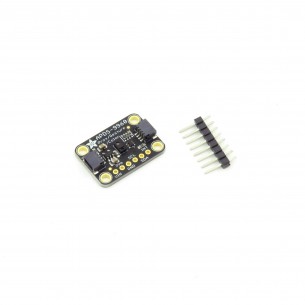
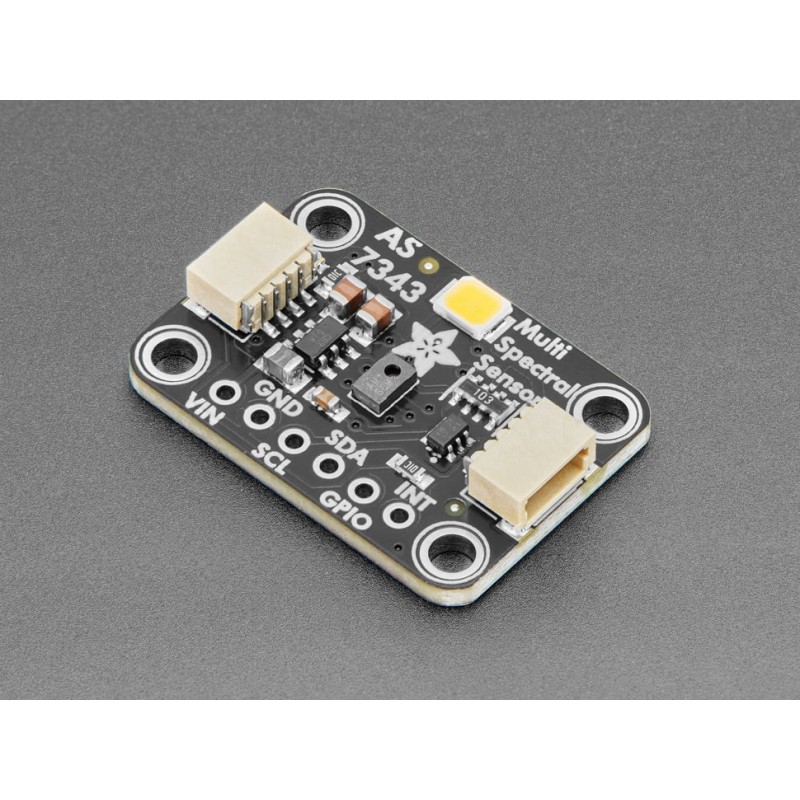
A multi-channel light and color sensor operating as a miniature spectrometer, enabling detailed analysis of the light spectrum. The device offers 14 measurement channels covering 11 visible light bands, a near-infrared (NIR) channel, an unfiltered channel, and flicker detection. Communication with the microcontroller is via an I²C interface, and the STEMMA QT/Qwiic board allows for quick connection to platforms such as Arduino and Raspberry Pi. The built-in 16-bit ADC and SMUX system ensure precise measurements and flexible management of detection channels. Adafruit 6477
Adafruit AS7343 14-Channel Light/Color Sensor is an advanced multi-channel light and color sensor in the form of a compact module designed for integration with microcontrollers as well as educational and prototyping platforms. The device operates as a miniature spectrometer that, in addition to measuring light intensity, can analyze its spectral composition across multiple wavelength ranges. This enables much more precise color detection than traditional RGB sensors, even exceeding the accuracy of human visual perception in some cases.
The core of the module is the AS7343 chip, which in a tiny 3 × 2 mm package integrates as many as 25 photodiodes capable of detecting 11 overlapping bands of visible light, one near-infrared channel, a clear (unfiltered) channel, and a light flicker detection channel. In total, this provides 14 measurement channels. Compared to the earlier AS7341 sensor, the AS7343 offers four additional measurement channels, enabling even more detailed spectral analysis.
The sensor can analyze both light emitted directly by a source and light reflected from surfaces. This makes it suitable for applications such as lighting color analysis, material analysis, lighting control systems, light quality monitoring, precision agriculture, and scientific experiments. Data from the photodiodes is processed by a 16-bit ADC with six channels, which converts analog measurements into digital values accessible through the I²C interface.
Because the number of sensing elements exceeds the number of ADC channels, the chip uses a dedicated Super MUX (SMUX) multiplexer, which dynamically assigns signals from any sensor element to the ADC channels. The device also includes GPIO lines and an interrupt output, allowing the sensor to communicate directly with microcontrollers or other systems.
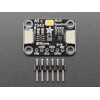
The module is built on a STEMMA QT breakout board equipped with logic-level shifting circuitry and connectors compatible with the Qwiic ecosystem. This allows quick connection to a microcontroller without soldering. The module can work with platforms such as Arduino, Raspberry Pi, and boards supporting CircuitPython. The manufacturer provides libraries for Arduino and CircuitPython that simplify configuration and access to all measurement channels. Thanks to its compact design, large number of spectral channels, and easy integration with popular hardware platforms, the module is a versatile tool for research projects, education, and prototyping of light analysis systems.
Manufacturer BTC Korporacja sp. z o. o. Lwowska 5 05-120 Legionowo Poland sprzedaz@kamami.pl 22 767 36 20
Responsible person BTC Korporacja sp. z o. o. Lwowska 5 05-120 Legionowo Poland sprzedaz@kamami.pl 22 767 36 20
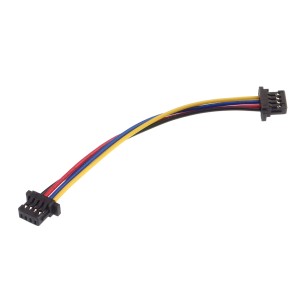
4-wire cable with a length of 50 mm. Both ends with STEMMA QT (Qwiic) plug. Adafruit 4399
No product available!
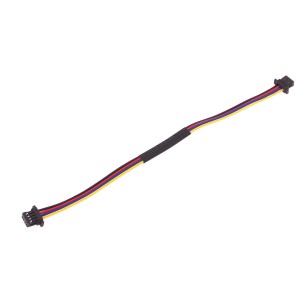
4-wire cable with a length of 100 mm. Both ends with STEMMA QT (Qwiic) plug. Adafruit 4210
No product available!
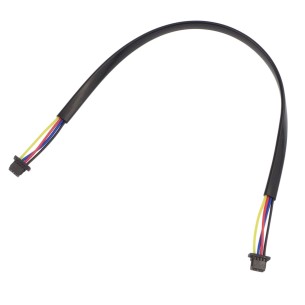
4-core cable with a length of 200 mm. Both ends with STEMMA QT (Qwiic) plug. Adafruit 4401
No product available!
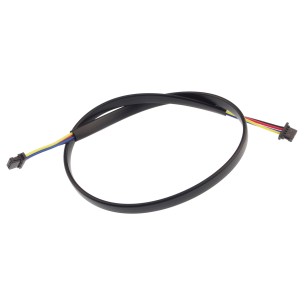
4-core cable with a length of 300 mm. Both ends with STEMMA QT (Qwiic) plug. Adafruit 5384
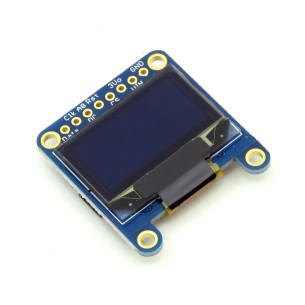
Module with black and white OLED display, 0.96" diagonal and 128x64 px resolution. Equipped with STEMMA QT connector, communicates via I2C or SPI interface. Adafruit 326
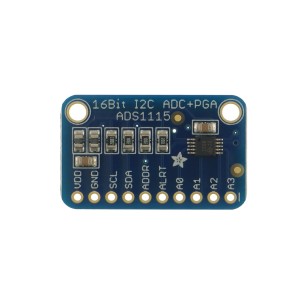
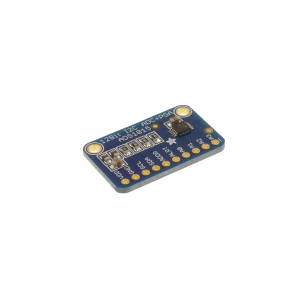
Module with 4-channel ADC ADS1115 converter. Equipped with a STEMMA QT connector, it communicates via the I2C interface. Adafruit 1085
Module with 4-channel ADC ADS1015 converter. Equipped with a STEMMA QT connector, it communicates via the I2C interface. Adafruit 1083
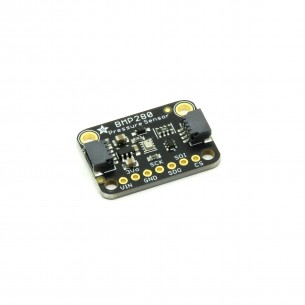
Module with pressure and temperature sensor BMP280. It allows you to read the atmospheric pressure in the range from 300 to 1100 hPa and communicates via the I2C or SPI interface. Adafruit 2651
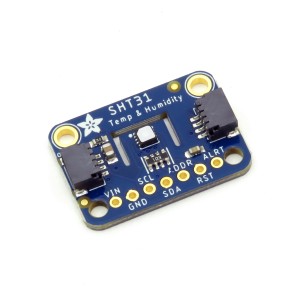
Module with a temperature and humidity sensor based on the SHT31-D system. Equipped with a STEMMA QT connector, it communicates via the I2C interface. Adafruit 2857
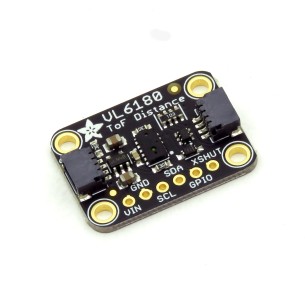
ToF distance sensor module based on the VL6180X system. It offers a range of up to 10 cm and communicates via the I2C interface. Adafruit 3316
A multifunctional module with an optical sensor for measuring the intensity of illumination, the color of the incident RGB light, the distance from the object and the detection of 3D gestures. Adafruit 3595
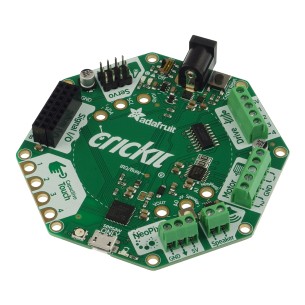
Expansion module (output expander) dedicated to the Circuit Playground Express board. Controlled by the I2C interface, it provides an IO interface, PWM, audio outputs, LED driver, DC motors and a Darlington circuit. Adafruit 3093
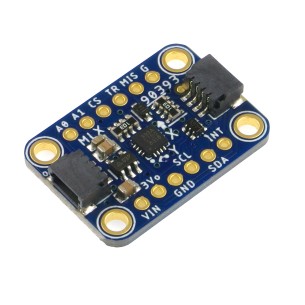
Module with a 3-axis magnetometer based on the MLX90393 system. It has a measuring range from ± 5mT to ± 50mT and a resolution of 0.161 µT. The I2C or SPI interface is used for communication. Adafruit 4022
No product available!
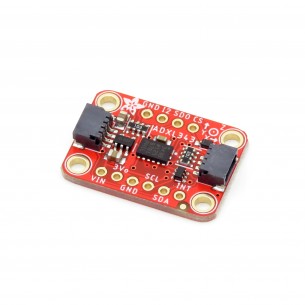
Module with a 3-axis ADXL343 accelerometer with a configurable measuring range of ±2g/±4g/±8g/±16g. Equipped with a STEMMA QT connector, it communicates via the I2C or SPI interface. Adafruit 4097
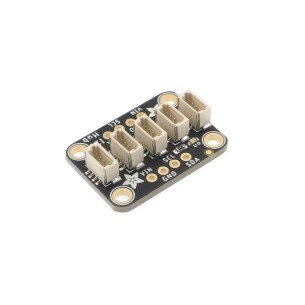
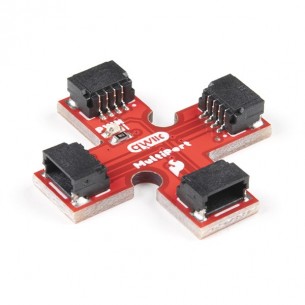
Hub with Qwiic connectors that allows you to connect several boards to the evaluation kit. There is no built-in control system, but only splits one connector into 3 more. SparkFun BOB-18012
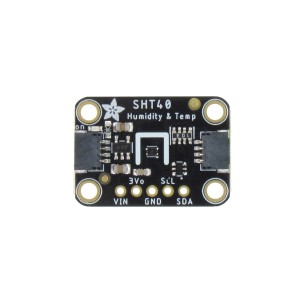
Module with a temperature and humidity sensor based on the SHT40 system. Equipped with a STEMMA QT connector, it communicates via the I2C interface. Adafruit 4885
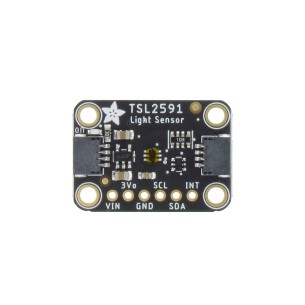
Module with light intensity sensor TSL2591. Equipped with STEMMA QT connector with I2C interface. Adafruit 1980
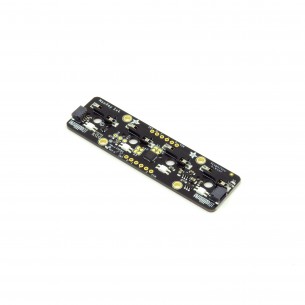
Module for 4 mechanical buttons with LED backlight in the form of NeoPixel diodes. Communicates via I2C. Adafruit 4980
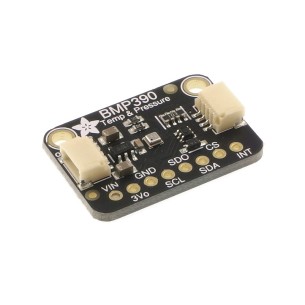
Module with digital barometer BMP390. It enables pressure measurement from 300 to 1250 hPa and temperature from -40℃ to 85℃. Communicates via I2C or SPI. Adafruit 4816
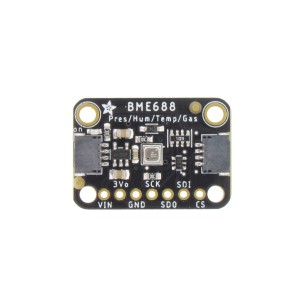
Module with integrated BME688 gas, pressure, temperature and humidity sensor placed in one MEMS housing. It is equipped with an I2C interface. Adafruit 5046
A multi-channel light and color sensor operating as a miniature spectrometer, enabling detailed analysis of the light spectrum. The device offers 14 measurement channels covering 11 visible light bands, a near-infrared (NIR) channel, an unfiltered channel, and flicker detection. Communication with the microcontroller is via an I²C interface, and the STEMMA QT/Qwiic board allows for quick connection to platforms such as Arduino and Raspberry Pi. The built-in 16-bit ADC and SMUX system ensure precise measurements and flexible management of detection channels. Adafruit 6477