.png)



zł203.70 tax excl.
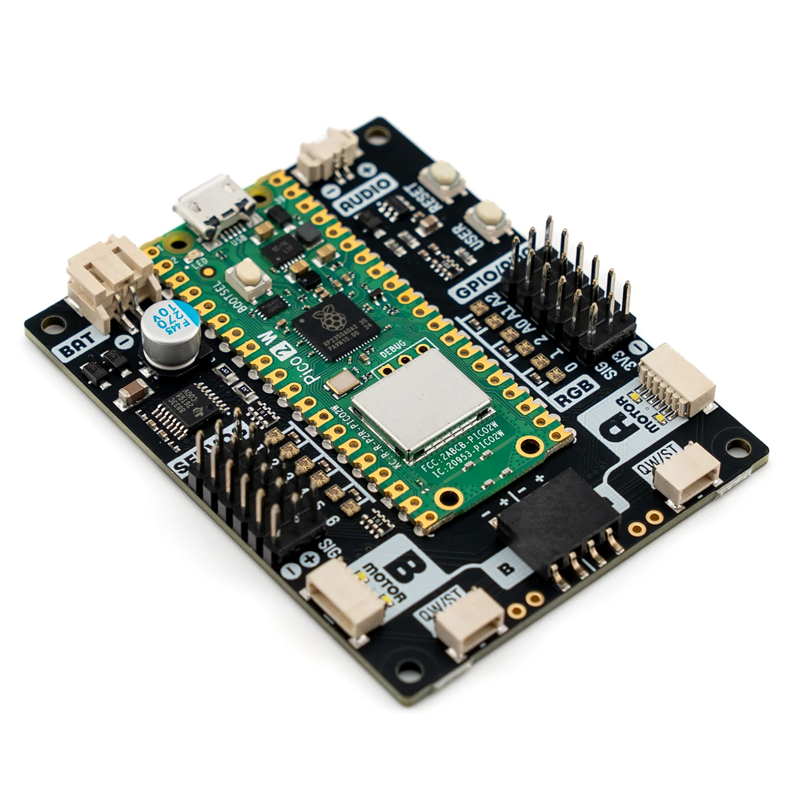
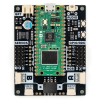
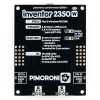
This development board for building robots and mechatronics projects features 2.4 GHz Wi-Fi and Bluetooth 5.2 connectivity. Based on the RP2350 microcontroller (Dual Arm Cortex-M33 up to 150 MHz, 520 KB SRAM, 4 MB QSPI Flash), it allows you to control two DC motors via a DRV8833C H-bridge and support up to six servos. It features 12 addressable RGB (Neopixel) LEDs, ADC inputs, numerous GPIOs, and two Qw/ST headers for connecting sensors. Pimoroni PIM733
Inventor 2350 W is a versatile development board designed for building battery-powered robots, props, and mechanical constructions with wireless connectivity. At its core is the Raspberry Pi Pico 2 W featuring the RP2350 microcontroller with modern Arm Cortex-M33 cores and high performance. Thanks to built-in 2.4 GHz Wi-Fi and Bluetooth 5.2, your projects can communicate with the internet, APIs, or other devices without additional modules. The board allows control of two DC motors (including encoder support) via a dual H-bridge DRV8833C driver. It can also drive up to six hobby servos, making it an ideal platform for walking robots and robotic arms.
Inventor 2350 W includes a speaker connector, enabling projects to generate sound effects and audio signals. A JST-PH battery connector allows powering the board from LiPo batteries or AA/AAA battery holders within a 2.5–5.5 V range. Onboard 12 addressable RGB LEDs (NeoPixel) provide rich lighting effects and status indication. The board also features analog inputs (ADC), additional GPIO pins, and two Qw/ST connectors for quick sensor and expansion module integration. It comes fully assembled and requires no soldering, allowing you to start building immediately. Programming in MicroPython simplifies development of custom control applications. The enhanced RP2350 performance delivers up to twice the speed of RP2040 in MicroPython benchmarks, making it an excellent choice for robotics, IoT projects, and mechatronics enthusiasts.
Data sheet
Manufacturer
Responsible person
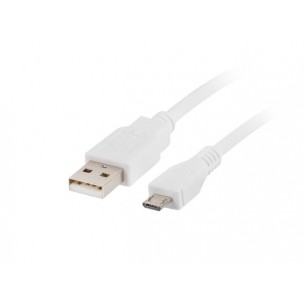
Cable with USB typ A and microUSB typ B connectors, cable length 1 m. LANBERG CCP-MUSB2-AMBM-W-1M
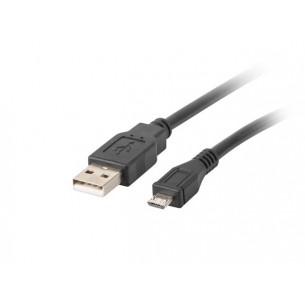
Cable with USB typ A and microUSB typ B connectors, cable length 1.8 m. LANBERG CA-USBM-10CC-0018-BK
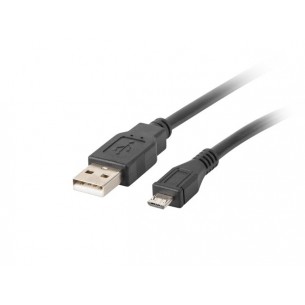
Cable with USB typ A and microUSB typ B connectors, cable length 1 m. LANBERG CA-USBM-10CC-0010-BK
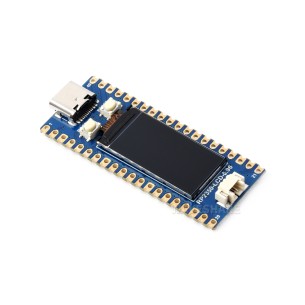
RP2350-LCD-0.96 offers a low-cost and flexible solution for creating projects involving information display, battery-powered operation, and full GPIO control. Ideal for portable devices, user interfaces, and educational applications.
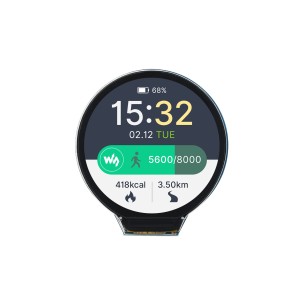
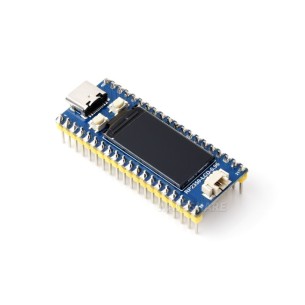
RP2350-LCD-1.28 is an advanced, compact development module with a color LCD display and a rich set of interfaces, designed for embedded projects that require efficient graphics handling and communication. Thanks to its dual processor architectures and programmable peripheral resources, the module is suitable for use in smart devices, HMI systems, and next-generation IoT solutions.
No product available!
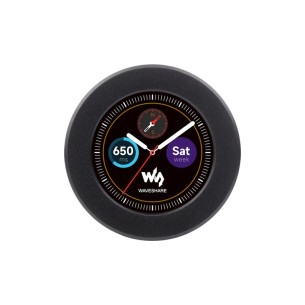
RP2350-LCD-1.28-B is a highly integrated development platform with a display, designed for applications requiring low power consumption and high flexibility in interface design. Thanks to its robust CNC enclosure and support for two processor architectures, the module is perfectly suited for use in portable systems, HMI devices, and intelligent embedded projects.
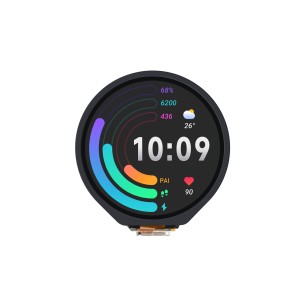
RP2350-Touch-LCD-1.28 is a modern development board with a color touch screen, dedicated to embedded project creators who require high performance and compact dimensions. Thanks to support for two architectures and open-source software, the module is perfectly suited for creating intelligent HMI devices, portable applications, and systems requiring versatile communication and user interaction.
No product available!
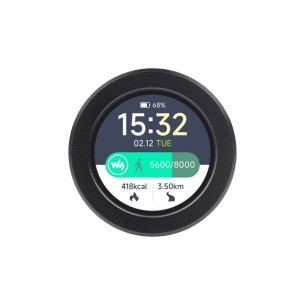
RP2350-Touch-LCD-1.28-B is a compact development module with a color touch screen, ideal for projects requiring an HMI interface and mobile integration with sensors. Thanks to the CNC enclosure, the product gains durability and better heat dissipation, making it suitable for prototyping and embedded applications where reliability and elegant design are important. Support for multiple programming languages and extensive technical documentation facilitate rapid development of applications based on ARM and RISC-V architecture.
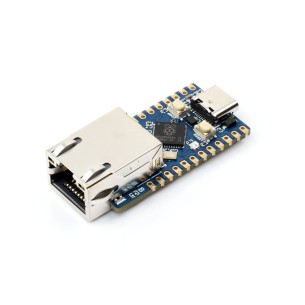
The RP2350-ETH development module combines the computing power of a dual-architecture microcontroller with Ethernet support, enabling the creation of compact and integrated network applications. Dedicated to projects utilizing TCP/IP transmission, it provides support for C/C++, MicroPython, and Arduino languages as well as a wide range of development resources. Thanks to its open architecture and compact form, it is suitable for IoT applications, communication gateways, and embedded systems requiring fast access to a local network.
No product available!
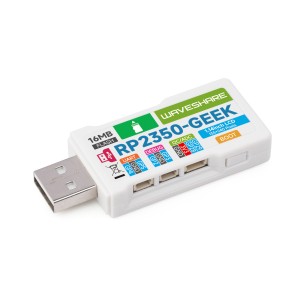
RP2350-GEEK is an advanced diagnostic and development platform for electronics designers. It enables convenient debugging of ARM microcontrollers, testing of I2C and UART peripherals, and data visualization on a color display. Thanks to its compact enclosure and set of interfaces, it is an excellent tool for learning, prototyping, and embedded project development.
RP2350-Zero-M combines compact dimensions with high performance and a rich set of peripherals. With pre-soldered headers and compatibility with popular development environments such as C/C++ and MicroPython, it is an ideal choice for creators of educational projects, embedded system prototypes, and IoT solutions.
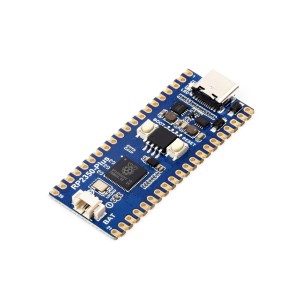
RP2350-Plus without headers is a universal development board designed for developers who prefer surface-mount soldering or custom connector configurations. Thanks to a large number of peripherals, a powerful chip, and full compatibility with the Raspberry Pi Pico, it provides a solid foundation for developing consumer, educational, and professional electronics projects.
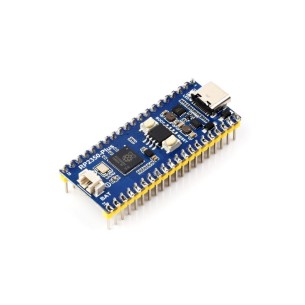
The RP2350-Plus-M offers the flexibility and performance required in modern embedded projects while maintaining full compatibility with Raspberry Pi Pico and its extensions. Factory-soldered headers and built-in Flash memory make the module suitable for rapid prototyping as well as educational and commercial applications.
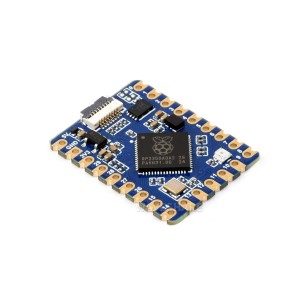
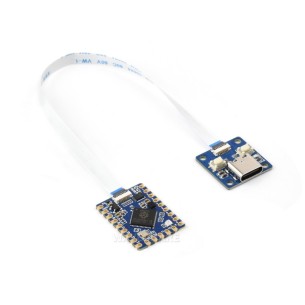
RP2350-Tiny is a minimalist development board based on the RP2350A microcontroller with dual Cortex-M33 and RISC-V architecture, without an integrated USB port. Instead, it features an FPC connector for attaching an external USB-C adapter (not included). The module offers extensive GPIO and peripheral functionality, drag-and-drop programming, support for C/C++ and MicroPython, and SMT mounting capability. It is ideal for embedded projects where minimal space and flexible connectivity are essential.
RP2350-Tiny-Kit is a versatile development kit for embedded and educational projects. With a flexible interface, rich set of peripherals, and support for popular development environments, it enables rapid prototyping and easy integration into larger systems. The version with a USB Type-C adapter provides convenient access for programming and powering the module.
RP2350-LCD-0.96-M is a versatile development board with a display, designed for projects based on RP2350A microcontrollers. It supports multiple interfaces and programming languages, features pre-soldered headers, and is compatible with Pico HAT modules, making it ideal for prototyping embedded systems, portable devices, and educational projects.
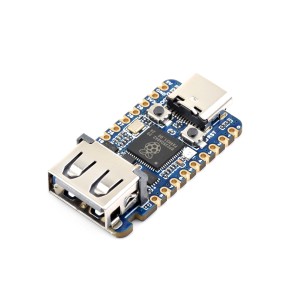
Waveshare RP2350-One is a compact development board featuring the RP2350A microcontroller with dual-core architecture: Arm Cortex-M33 and RISC-V. It offers a rich set of peripherals and 4 MB of Flash memory. With a direct USB Type-A connector, support for C/C++ and MicroPython, and SMT mounting capability, it is ideal for modern embedded applications, automation, and technical education.
RP2350-Touch-LCD-1.69 is a compact and versatile development board offering advanced processing capabilities thanks to its dual-core CPU architecture and large Flash memory. The integrated touchscreen, sensors, and battery power support make it an ideal choice for HMI projects, wearable electronics, measurement systems, and educational solutions based on the RP2350.
RP2350-USB-A is a versatile development board based on the modern RP2350A microcontroller with a unique dual-core architecture: Arm Cortex-M33 + RISC-V. Thanks to the USB Type-A port supported via PIO, a wide range of interfaces, and a compact form factor, the board is ideal for prototyping peripheral devices, learning programming, and integrating into custom projects as an SMD module.
This development board for building robots and mechatronics projects features 2.4 GHz Wi-Fi and Bluetooth 5.2 connectivity. Based on the RP2350 microcontroller (Dual Arm Cortex-M33 up to 150 MHz, 520 KB SRAM, 4 MB QSPI Flash), it allows you to control two DC motors via a DRV8833C H-bridge and support up to six servos. It features 12 addressable RGB (Neopixel) LEDs, ADC inputs, numerous GPIOs, and two Qw/ST headers for connecting sensors. Pimoroni PIM733