.png)





zł61.74 tax excl.
Evaluation board with the ESP32-S2-SOLO-N4R2 module enables the development of applications using 2.4 GHz Wi-Fi and extensive peripheral interfaces. Equipped with 4 MB Flash and 2 MB PSRAM, as well as an integrated PCB antenna, it provides a solid foundation for building IoT projects, automation systems, monitoring solutions, and smart devices. With rich functionality and a large number of GPIO pins, it supports the implementation of even advanced embedded systems.
Evaluation board based on the ESP32-S2-SOLO-N4R2 module, designed for developing applications that use 2.4 GHz Wi-Fi connectivity. The module is built on a SoC with a single-core Xtensa® LX7 microcontroller clocked up to 240 MHz. The board includes 4 MB of Flash and 2 MB of integrated PSRAM, enabling the development of complex IoT projects. With USB OTG support, multiple peripheral interfaces (SPI, I2C, UART, ADC, DAC, PWM), and up to 36 available GPIOs, the board is well-suited for applications requiring high flexibility and complex communication with external devices. The integrated PCB antenna allows for direct wireless communication without the need for an external antenna.
Manufacturer
Responsible person
ESP32-C6 development module with a 1.54-inch 240 × 240px IPS LCD and support for Wi-Fi 6, Bluetooth 5 LE and IEEE 802.15.4. Features a QMI8658 6-axis IMU, dual microphones, speaker, TF card slot, USB-C and 3.7V battery support; non-touch version supplied with a 1000mAh battery. Waveshare ESP32-C6-LCD-1.54
Development board based on the ESP32-C3FH4 with a 1.47-inch 172 × 320px LCD, 2.4GHz Wi-Fi, Bluetooth 5 LE and a QMI8658 6-axis IMU. Version with factory pre-soldered black pin headers, also featuring a TF card slot, USB-C and 15 broken-out GPIOs. Waveshare ESP32-C3-LCD-1.47-M
Development board based on the ESP32-C3FH4 with a 1.47-inch IPS LCD featuring 172 × 320px resolution, 2.4GHz Wi-Fi, Bluetooth 5 LE and a QMI8658 6-axis IMU. Standard version supplied with separate unsoldered pin headers and also equipped with a TF card slot, USB-C and 15 broken-out GPIOs. Waveshare ESP32-C3-LCD-1.47
ESP32-S3R8 development board with a 1.85-inch 360 × 360px LCD capacitive touch display and a CNC-machined aluminum alloy enclosure. Features 2.4GHz Wi-Fi, Bluetooth 5 LE, 8MB PSRAM, 16MB Flash, QMI8658 6-axis IMU, dual microphones, audio circuitry with an output for connecting a speaker and a USB-C interface. Waveshare ESP32-S3-Touch-LCD-1.85B-EN
Compact communication platform based on a dual-core ESP32-S3 processor, designed for building LoRa Mesh networks, IoT projects, and embedded systems. The device features a 1.14" LCD display, a 56-key keyboard, and advanced audio capabilities with a microphone, speaker, and 3.5 mm audio output. The design is fully based on the Cardputer-Adv platform and extends its functionality with the Cap LoRa-1262 module, adding LoRa communication and GNSS positioning with support for GPS, BeiDou, Galileo, and GLONASS. A built-in accelerometer, infrared transmitter, microSD card slot, and Grove interfaces allow easy expansion and sensor integration, while the 1750 mAh Li-ion battery provides mobility and extended operating time. M5Stack K152
ESP32-S3-based development platform featuring a 1.75" round AMOLED display, audio subsystem, IMU sensor, WiFi connectivity, and a rechargeable battery for portable IoT devices. M5Stack C152
No product available!
ESP32-S3-based development platform featuring a 4-inch full-color E Ink Spectra 6 display, audio subsystem, temperature and humidity sensor, microSD card slot, and rechargeable battery for low-power IoT devices and data display applications. M5Stack C151
Portable development device based on the ESP32-S3 microcontroller combines an SX1262 868 MHz LoRa transceiver, a 2.8" IPS color display, a full QWERTY keyboard, and a trackball controller in a compact enclosure. Factory-installed LILYGO Factory Firmware allows immediate use without manually flashing the base firmware. The package includes an 868 MHz LoRa FPC antenna, a power cable, and a 1×6 pin header. The device is designed for LoRa communication terminals, portable messaging devices, IoT projects, and custom applications based on the ESP32-S3 microcontroller. LILYGO TTGO T-Deck 868 MHz Black LILYGO Factory Firmware
No product available!
A development board based on the ESP32 microcontroller that combines an SX1278 LoRa transceiver, a 0.96" OLED display, and a microSD card slot in a single compact design. Preloaded with Disaster-Radio firmware, it supports Wi-Fi, Bluetooth 4.2, and 433 MHz LoRa communication. The kit includes a 433 MHz LoRa antenna, a JST 2-pin power cable, and pin headers for soldering. The board is designed for autonomous communication devices, mesh network nodes, and IoT applications. LILYGO TTGO T3 LoRa32 V1.6.1 Disaster-Radio 433 MHz
No product available!
An ESP32-based development board that combines a LoRa communication module, NEO-6M GPS receiver, and a 0.96" OLED display in a single device. Preloaded with Meshtastic firmware, it supports Wi-Fi, Bluetooth 4.2, and 433 MHz LoRa communication. The kit includes a non-soldered 0.96" OLED display, a 433 MHz LoRa antenna, and pin headers for self-assembly. The board is suitable for building autonomous mesh network nodes, GPS trackers, and battery-powered IoT devices using a 18650 Li-Ion cell or a microUSB power supply. LILYGO TTGO T-Beam Meshtastic 433 MHz Non-Soldered OLED
The LILYGO TTGO T-Dongle S3 With LCD [K193] is an ESP32-S3 development board combining the functionality of a powerful microcontroller with the compact form factor of a USB dongle. It features a 0.96-inch ST7735 IPS color display, 16 MB Flash memory, 2.4 GHz Wi-Fi and Bluetooth 5 connectivity. Compatible with Arduino IDE, PlatformIO, and MicroPython, the module provides a convenient platform for developing IoT devices, portable USB tools, information displays, and embedded applications. LILYGO TTGO T-Dongle S3 With LCD [K193]
No product available!
The LILYGO TTGO T-Embed Black development board is based on the ESP32-S3 microcontroller and integrates a 1.9" IPS color display, a rotary encoder with a push button, dual microphones, a speaker, a microSD card slot, and Wi-Fi and Bluetooth connectivity. The board is designed for HMI panels, IoT devices, controllers, and portable user interfaces requiring local control and wireless communication. LILYGO TTGO T-Embed Black
The LILYGO TTGO VGA32 V1.4 development board is based on the ESP32 microcontroller and enables VGA video output without requiring an external graphics controller. The board features a VGA connector, PS/2 ports for a keyboard and mouse, a microSD card slot, and Wi-Fi and Bluetooth connectivity. With support for the FabGL library, it can be used to create graphical user interfaces, ANSI/VT terminals, games, and applications displayed on VGA monitors. LILYGO TTGO VGA32 V1.4
No product available!
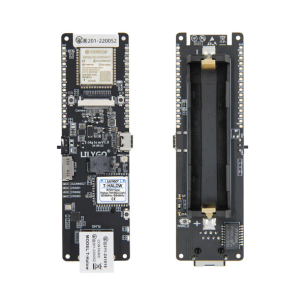
LILYGO T-Halow V1.0 combines the ESP32-S3 microcontroller with a Wi-Fi HaLow (IEEE 802.11ah) module, an RJ45 Ethernet interface, and a camera connector compatible with OV2640 / OV5640 modules. The board features 16 MB Flash, 8 MB PSRAM, a microSD card slot, an 18650 battery holder. LILYGO T-Halow V1.0 859-894 MHz 875M SAW [H766]
No product available!
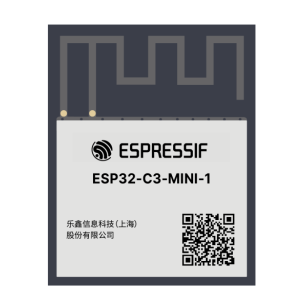
IoT communication module with a RISC-V processor, supporting 2.4 GHz WiFi 802.11 b/g/n and Bluetooth 5 Low Energy. Equipped with 4 MB Flash memory, 15 GPIOs and an integrated PCB antenna. It operates from a 3.0 V to 3.6 V supply and is designed for SMD mounting. Espressif ESP32-C3-MINI-1-H4
No product available!
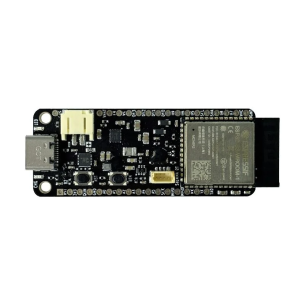
Low-power ESP32-S3 development board in a Feather-compatible format, designed for battery and solar-powered applications. Features 8MB Flash, 2MB PSRAM, Wi-Fi, Bluetooth 5 LE, advanced battery monitoring and support for LiFePO4, Li-ion and LiPo batteries. Elecrow ESP32-S3 PowerFeather V2
Evaluation board with the ESP32-S2-SOLO-N4R2 module enables the development of applications using 2.4 GHz Wi-Fi and extensive peripheral interfaces. Equipped with 4 MB Flash and 2 MB PSRAM, as well as an integrated PCB antenna, it provides a solid foundation for building IoT projects, automation systems, monitoring solutions, and smart devices. With rich functionality and a large number of GPIO pins, it supports the implementation of even advanced embedded systems.